Understanding Modular Blockchains and Their Competitive Advantage
Blockchain technology has continued to grow and develop over the years. Many blockchain networks were created in the early days with the idea that it would be able to do almost anything alone. A single blockchain could conduct transactions, make information available, agree upon it and perform smart contracts. This design is sometimes referred to as a monolithic blockchain. This system is viable but can become slow, costly and impractical to scale when more and more users start to join the network.
This is where the concept of modular blockchains is very relevant. A modular blockchain is a blockchain structure in which various functions are separated into various layers or segments. Rather than each blockchain performing all tasks, each distinct element of the system can perform a specific role. In simple words, it's kind of multiple departments within a company. There's a finance department, a marketing department, and a customer service department. There are specific responsibilities assigned to each department, but they are all working towards the same objective.
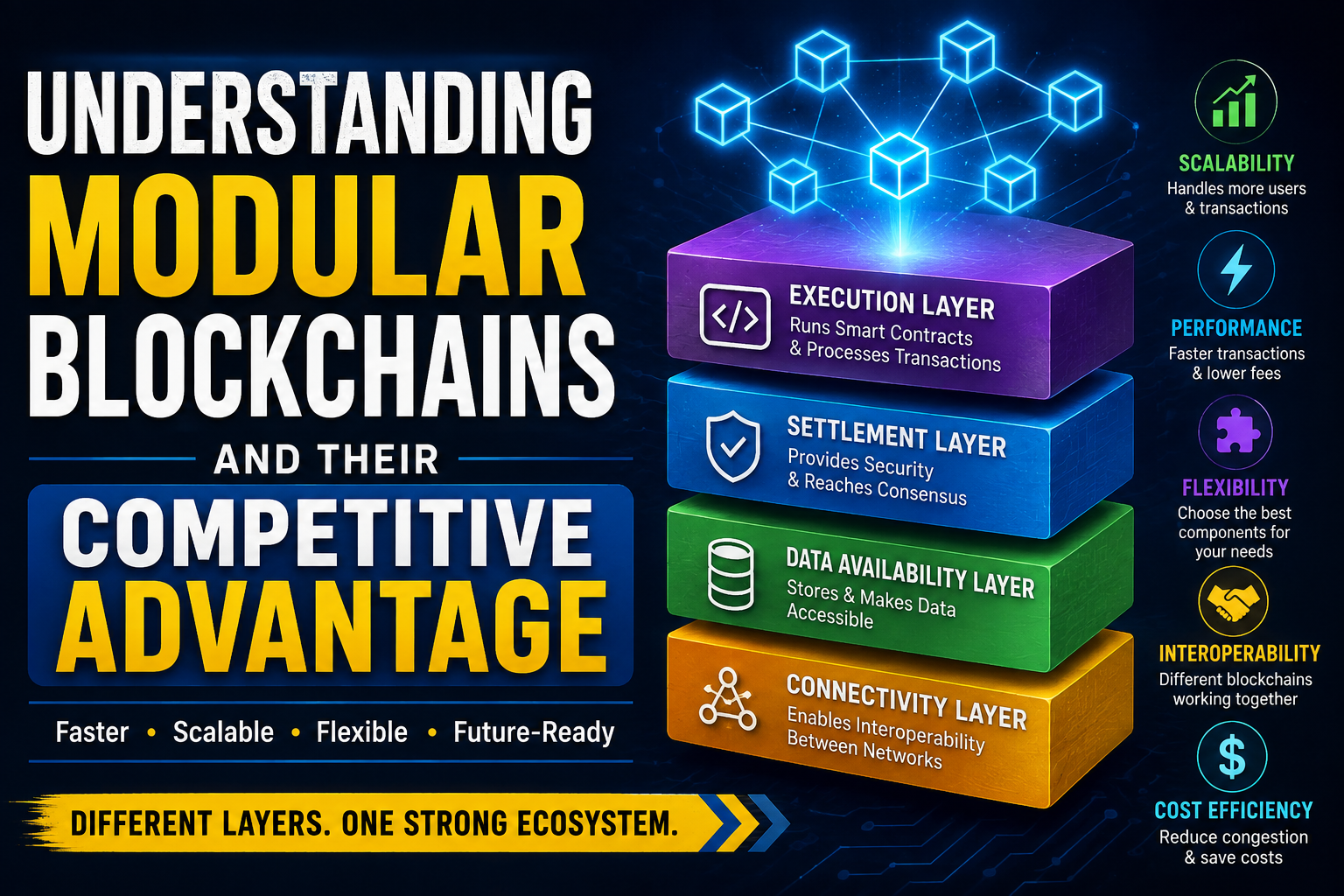
Before we can get a good grasp on modular blockchains, we first need to get a handle on the essentials of what a blockchain does. Typically, a blockchain requires to execute transactions, settle them, reach consensus, and provide data availability. Execution refers to the execution of transactions and smart contracts. Consensus is what is used to agree on the proper state of the blockchain. Settlement refers to the final and secure making of transactions. Data availability guarantees that information related to transactions can be accessed and verified when required.
A traditional monolithic blockchain may have one network solve all of these problems. This can result in a very simple and easy to understand system, but can also pose issues in the event the network is very busy. What if one person had to do 4 tasks simultaneously? Initially, the worker may perform satisfactorily but as workload grows, delays can occur. It's the same scenario with a blockchain network. Transaction fees can go up and transaction speed can go down if too many people are using it.
The modular blockchain addresses this issue by dividing up the networks or layers into specific functions. For instance, one layer could be dedicated to the execution, and another could be dedicated to security and consensus. Still another system can be dedicated to providing blockchain data availability. Division of responsibility allows each part to be designed and enhanced with respect to its own function.
One of the most significant Pros of Modular Blockchains is their Scalability. The term scalability basically refers to the capacity of a system to accommodate more users and more transactions with less slowdown or increase in cost. With the increasing adoption of blockchain technology, scalability is becoming crucial. A thousand-user blockchain may experience significant issues with a million users.
Modular systems can enhance the scalability as the work can be distributed within various layers. The load can be distributed among different networks, rather than relying on a single location for all transactions. This can lead to a quicker and more efficient ecosystem. This is one of the reasons why the modular blockchain technology is gaining traction in the cryptocurrency industry.
One of the other big competitive benefits is specialization. A modular system allows developers to build very efficient networks for a particular function. Transaction execution-focused blockchain can be optimized for performance. A second network dedicated to security can be constructed that will deliver robust security and consensus. Data availability-focused systems can focus on ensuring that valuable blockchain data is easily accessible.
This specialty may result in improved general performance. Rather than developing one super-strong blockchain that performs every task, developers are able to link multiple strong blockchains together. It's like trying to put together a football team. The ideal team is not an eleven-player team that all play the same position. Players come in varieties, and when combined appropriately, it makes the team stronger.
Additionally, modular blockchains can offer developers more flexibility. The developers might have more freedom of selecting the elements of the blockchain that fit their applications. For instance, a project requiring transactions to be completed very quickly may opt for one execution environment, whereas another may contract with a different settlement or consensus layer due to its higher security.
This adaptability can stimulate innovation. The developers do not need to create all the components of blockchain. They can leverage existing infrastructure and invest their efforts into improving applications and services. This, in my view, can cut development time and enable more creative ideas to get to the blockchain space.
Another vital benefit is interoperability. It refers to the compatibility of various blockchain platforms to interact and function harmoniously. In the initial phase of the blockchain development, numerous networks functioned all but like separate islands. Transferring assets or information from one to the other might be challenging. Modular blockchain architecture promotes the growth of systems that can join various layers and networks.
If these blockchain systems can function together well, users may enjoy more choices. They can take advantage of different applications without being totally locked into one blockchain. This may develop an integrated digital economy in which value and information flow more freely between the networks.
This is also an excellent advantage when it comes to cost efficiency. If a blockchain is very busy, users might be required to pay high transaction costs. Some of this pressure can be alleviated by offloading some activity from the main blockchain layer by using modular systems. Some transactions could be executed on the special layers, and the outcome is synchronized to a more secure settlement layer, making it more economical for users to use the system.
But modular blockchains come with their challenges as well. A multitude of layers can make a system more complex. Network communications have to be secure and reliable. A vulnerability in one component of a system could impact the entire system. So, the developer should consider security, interoperability, and user experience very seriously.