Why RTP Describes Long-Run Averages, Not a Session Guarantee
Why RTP Describes Long-Run Averages, Not a Session Guarantee
A practical probability-literacy guide to theoretical RTP, actual RTP, volatility, random outcomes, sample size, and why one session can finish far from the displayed percentage.
Independent probability-literacy explainer. No betting strategy, guaranteed-return claim, or claim about a specific game's certified RTP is made.
RTP Is a Statistical Average, Not a Refund Rate
Return to Player, usually shortened to RTP, is one of the most misunderstood numbers in gaming. A displayed percentage can look like a promise: if a game says 96% RTP, it is tempting to imagine that every ₱100 placed into the game should produce about ₱96 back. That is not what the percentage means.
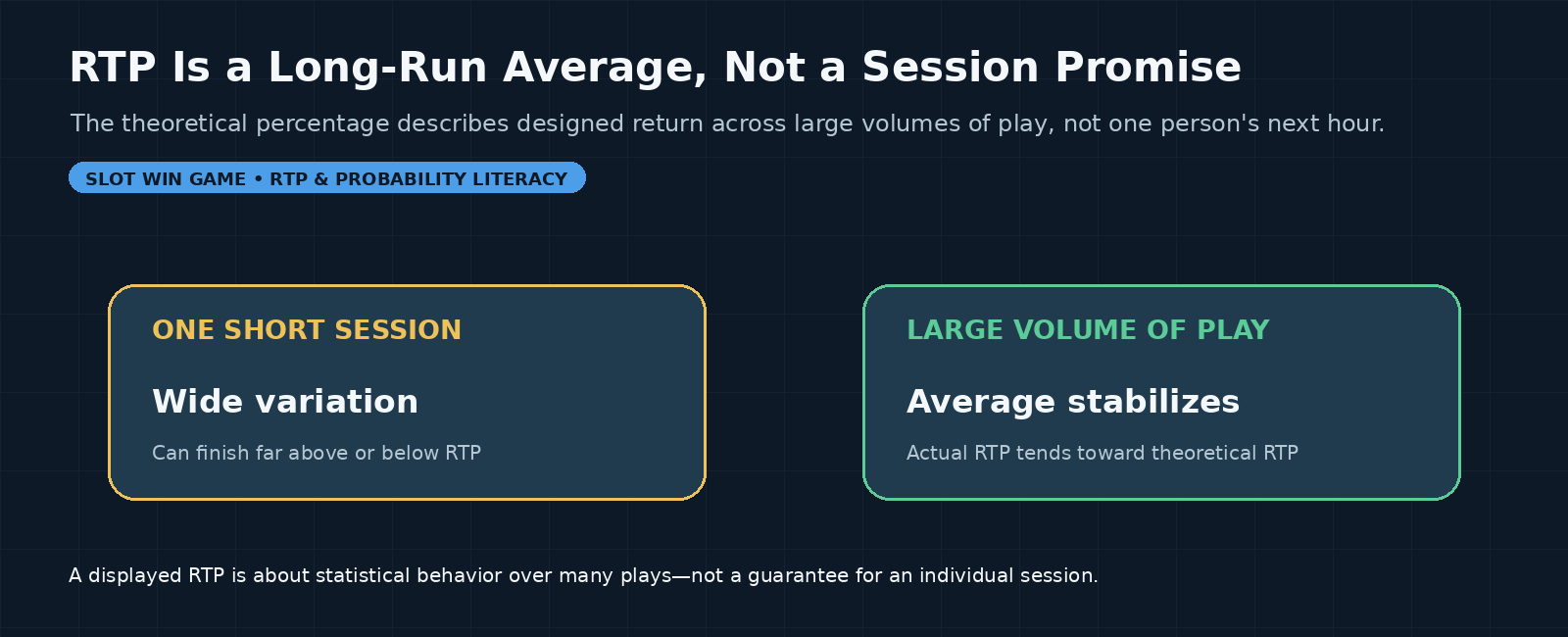
The UK Gambling Commission explains that RTP is an average measured over a large number of games and explicitly warns that a player should not expect the displayed percentage to be returned during an individual session. A short session can finish far above the theoretical percentage, far below it, or anywhere in between.
For readers using the Slot Win Game information site or another gaming-information source, the correct starting point is simple: RTP describes long-run statistical behavior. It does not forecast what will happen to one person in the next ten spins, hundred spins, or evening of play.
Theoretical RTP Is the Designed Percentage
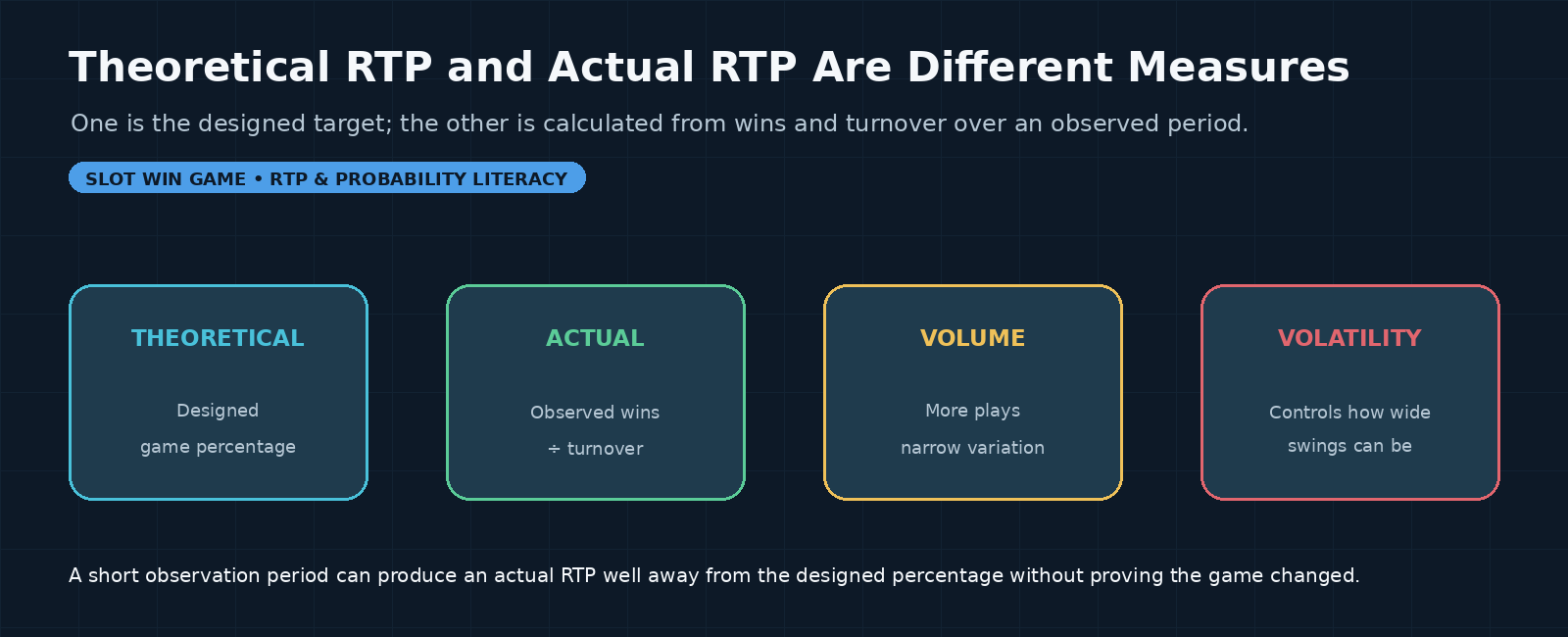
Regulators distinguish between theoretical RTP and actual RTP. The theoretical RTP is the percentage built into the game's mathematical design and shown in player-facing rules where required. It is a design target, not a measurement of one person's experience.
Suppose a hypothetical game has a theoretical RTP of 96%. That number says the game's design is expected to return about 96% of total stakes across a sufficiently large amount of play under the defined rules. It does not mean every group of 100 spins returns 96% and it does not mean the missing 4% appears smoothly.
The time horizon matters because random variation can dominate small samples. A few unusually large prizes or a long sequence with few returns can move short-run results dramatically.
Actual RTP Is Calculated From What Really Happened
Actual RTP is an observed statistic. The UK Gambling Commission describes it as wins divided by turnover for the selected period. If a game records £1,085,000 in wins from £1,200,000 in turnover, for example, the observed RTP for that period is about 90.42%, even if the theoretical design percentage is higher.
A difference between actual and theoretical RTP over a limited period is not automatically evidence of an error. The acceptable amount of variation depends partly on the game's volatility and on how much play has occurred. As more gameplay accumulates, the actual RTP would normally be expected to move closer to the theoretical RTP if the game is operating as designed.
This distinction is useful because it separates a mathematical target from a measured historical result. Mixing the two can make short-run variation look like a contradiction when it is simply a sample-size effect.
Volatility Explains Why the Path Can Be Uneven
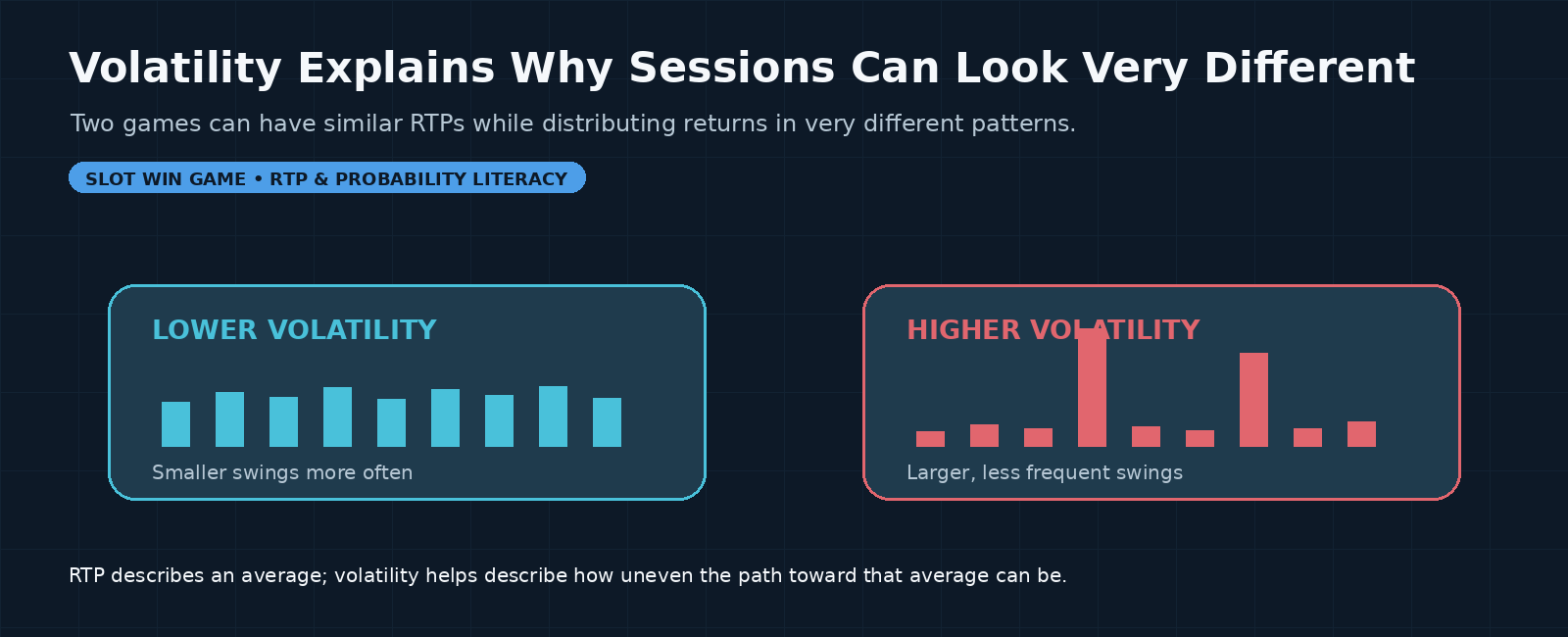
RTP answers one question about average return, but it does not describe how those returns are distributed. Volatility, often represented statistically through standard deviation, helps describe how widely outcomes can vary around the average.
A higher-volatility game may concentrate more of its theoretical return in relatively rare, larger prizes. A lower-volatility game may distribute returns in smaller, more frequent amounts. Two games can therefore have similar theoretical RTPs while producing very different short-session experiences.
The UK Gambling Commission notes that a highly volatile game can require a wider tolerance around theoretical RTP when only a limited amount of play has been measured. As the volume of play grows, that tolerance narrows. That is another reason not to compare one session directly with the advertised long-run percentage.
Random Outcomes Do Not Need to 'Catch Up' for One Player
A common misunderstanding is that a losing streak makes a win increasingly due because the game must eventually return to its RTP. For fully random machines, the UK Gambling Commission states that the odds of winning the current game remain constant and are not affected by wins or losses in previous games.
The long-run average emerges from many random outcomes; it does not require the next spin to repair what happened earlier. If a player has experienced results far below the theoretical RTP, the mathematical target does not create a personal debt that the game must repay.
This is the same logic behind the gambler's fallacy in probability: past independent outcomes do not force the next independent outcome to move in the opposite direction simply because a streak looks unusual.
A Session Can Be Far From RTP Without Breaking the Definition
Consider a hypothetical 96% RTP game. One short session might return 140% of stakes because of a large prize. Another could return 20%. A third might return nothing over a small number of plays. Those session figures can look wildly inconsistent with 96%, but the theoretical percentage was never meant to describe each session separately.
The Slot Win Game RTP explainer currently makes the same core point: RTP is a long-term average and does not guarantee individual-session results. That is a useful contextual reference, although the technical interpretation here is grounded in independent regulatory guidance.
What matters is scale. Regulators and test processes examine game mathematics and performance using large samples, simulation, and statistical tolerances rather than judging whether a single player received the advertised percentage.
RTP Does Not Tell You the Probability of Winning Any Particular Spin
Another common shortcut is treating a higher RTP as though it directly states the chance of a win on the next spin. It does not. RTP combines the probabilities and values of all possible outcomes into a long-run expected return. Win frequency, prize sizes, bonus structures, jackpots, and volatility can vary even when two games display similar RTPs.
A game could return value through many small prizes or through fewer large ones. The overall average can be similar while the probability of any particular result remains different. That is why RTP should be read alongside the game's rules and paytable rather than as a complete description of its probability structure. In other words, RTP is informative, but it is not a shortcut for predicting the next outcome.
RTP Also Depends on the Defined Game and Rules
RTP figures apply to a defined game configuration. Different versions, paytables, stake options, feature settings, or game variants can have different mathematical returns. The relevant percentage is the one stated for the exact version being played, not a number copied from a similarly named game elsewhere.
This is one reason player-facing rules and information pages matter. A percentage without a clear game reference can create false precision. When checking RTP, identify the game, version, and source of the number rather than relying on screenshots, social posts, or unrelated comparison pages.
The strongest source is the game's own rules or another authoritative record tied to that specific configuration.
Four Questions Before Interpreting an RTP Number
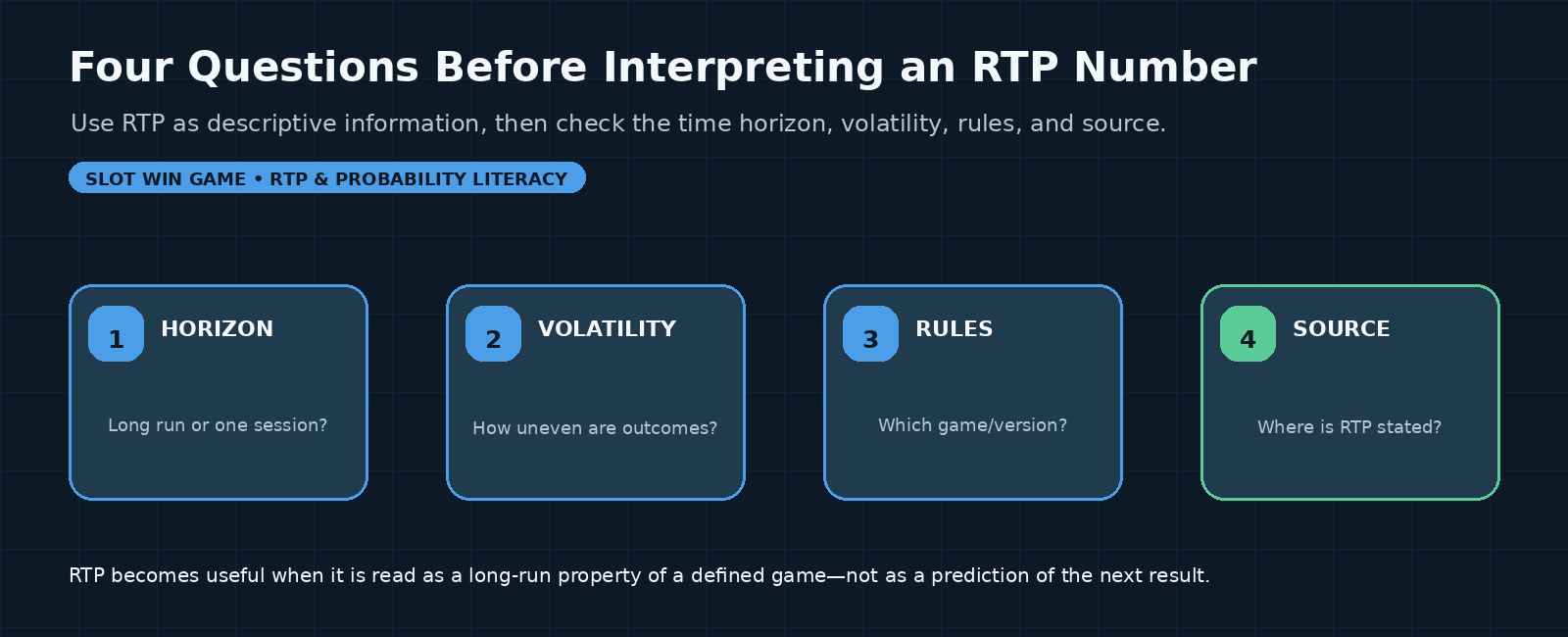
First, what time horizon does the claim describe? RTP is a long-run average, not a session result. Second, what is the game's volatility? Similar averages can hide very different short-run patterns.
Third, which exact game or version does the percentage apply to? Do not assume all variants share the same mathematics. Fourth, where is the RTP figure stated? Prefer the defined game information or another trustworthy source over an unexplained number repeated elsewhere.
These four checks turn RTP from a marketing-looking percentage into what it actually is: a statistical description that needs context.
Final Takeaway
RTP is useful precisely because it summarizes long-run game mathematics. It becomes misleading when it is treated as a promise about one person's session, a prediction of the next spin, or a guarantee that past losses must soon be recovered.
The accurate interpretation is narrower and more useful: theoretical RTP describes the designed average return over large volumes of play, actual RTP measures what a game has returned over a selected period, and volatility helps explain why short sessions can look very different from that long-run average. Read the percentage as information, not certainty.
Sources & References
• UK Gambling Commission - Return to player: how much gaming machines payout.
• UK Gambling Commission - How to calculate return to player (RTP).
• UK Gambling Commission - Key terms relating to live RTP performance monitoring.
• UK Gambling Commission - Gaming machine categories (RTP and volatility guidance).
• UK Gambling Commission - Testing strategy for remote gambling and software technical standards.
• Slot Win Game - RTP explainer (used only as contextual brand material, not as the independent technical authority).