"Living" plastic that decomposes in six days without generating microplastics/Plástico “vivo” que se destruye en seis días sin generar microplásticos
Source
It's been a while since we last talked about the infamous microplastics that are everywhere. But this time we're going to discuss a new development that could put an end to them, since a team of scientists from the Shenzhen Institute of Advanced Technology (China) has developed a "living plastic" with a programmable self-destruction mechanism. It's not that the plastic itself is alive, but rather that it's a hybrid material. The scientists have managed to embed spores of a bacterium (Bacillus subtilis) within a matrix of common plastic polymer.
Hacía tiempo que no hablábamos de los tristemente famosos micro-plásticos que están por todas partes. Pero esta vez vamos a comentar un nuevo desarrollo que podría acabar con ellos ya que, un equipo de científicos del Instituto de Tecnología Avanzada de Shenzhen (China) ha desarrollado un "plástico vivo" con un mecanismo de autodestrucción programable. No es que el plástico en sí tenga vida, sino que es un material híbrido. Los científicos han logrado incrustar esporas de una bacteria (Bacillus subtilis) dentro de una matriz de polímero plástico común.
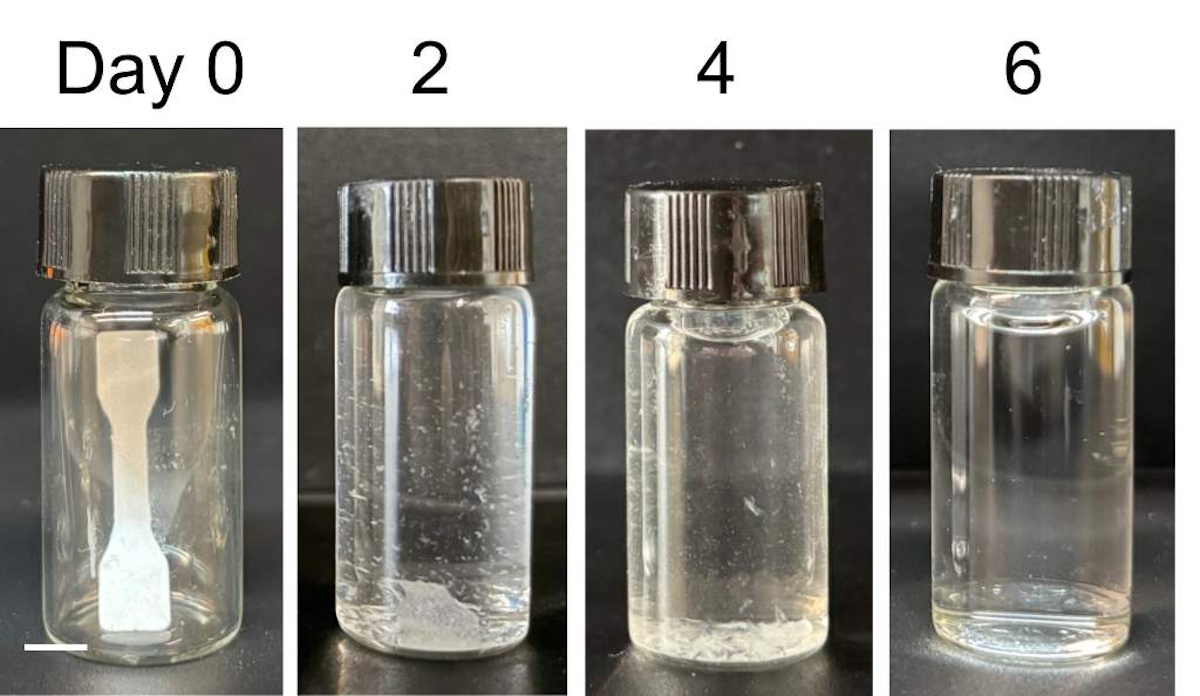
This system is based on a biological "switch" that works in two ways. During normal use of the plastic (such as a bottle or container), the Bacillus subtilis spores remain dormant and undetectable, without affecting the material's properties or the container's contents. To trigger the plastic's self-destruction, an external stimulus is applied. In laboratory tests, this stimulus consisted of immersing the material in a nutrient broth at 50°C (122°F). This heat and the nutrients "awaken" the spores.
Este sistema se basa en un "interruptor" biológico que funciona de dos maneras. Durante el uso normal del plástico (como una botella o un envase), las esporas de Bacillus subtilis permanecen inactivas y son indetectables, sin afectar las propiedades del material ni al contenido del envase. Para que el plástico se autodestruya, se le aplica un estímulo externo. En las pruebas de laboratorio, este estímulo consistió en sumergir el material en un caldo nutritivo a 50°C (122°F) . Este calor y nutrientes "despiertan" las esporas.
Source
Once activated, the bacteria begin producing two types of enzymes that work together to eliminate the plastic without a trace. First, the enzyme Lipase A makes random cuts in the long polymer chains, breaking the material into smaller fragments. A second enzyme, called Lipase B, attacks the fragments from the ends, breaking them down to their basic molecules (monomers). This "dual attack" is so efficient that the plastic is completely decomposed in just six days.
Una vez activas, las bacterias comienzan a producir dos tipos de enzimas que trabajan en equipo para eliminar el plástico sin dejar rastro. Por un lado la enzima Lipasa A realiza cortes aleatorios en las largas cadenas de polímero, rompiendo el material en fragmentos más pequeños. Una segunda enzimd llamada Lipasa B ataca los fragmentos desde los extremos, desgastándolos hasta reducirlos a sus moléculas base (monómeros). Este "ataque dual" es tan eficiente que, en solo seis días, el plástico se descompone por completo.
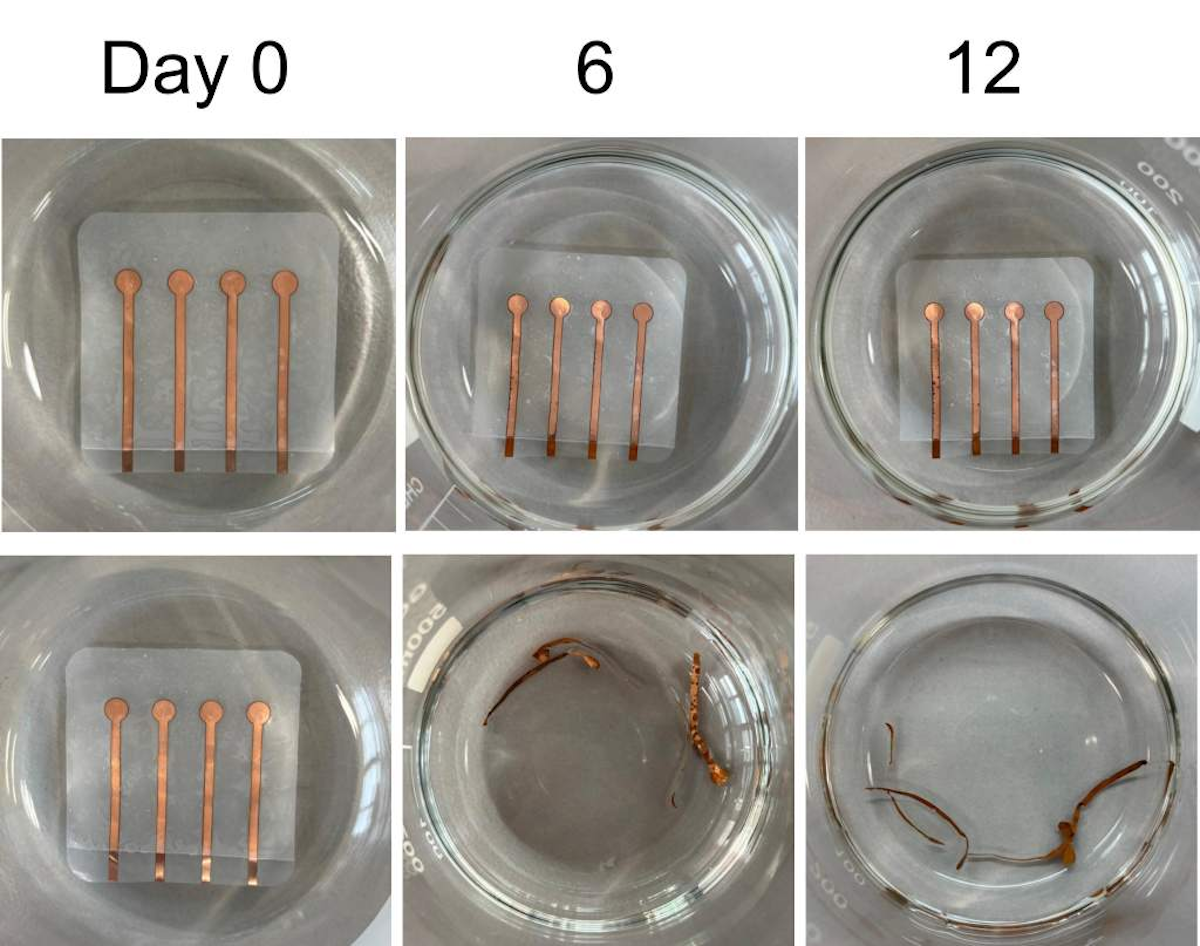
The most important aspect is that the process is one of "total destruction," preventing the formation of microplastics along the way. In a proof of concept, researchers fabricated a wearable electrode using this material, which completely degraded within two weeks of activation. Products (food containers, cutlery, single-use items) could be designed with a programmed lifespan. By placing them in an industrial composting bin or an environment with the appropriate stimulus, they would disappear in just a few days without a trace.
Lo más importante es que el proceso es de "destrucción total", impidiendo que se formen microplásticos en el camino. En una prueba de concepto, los investigadores fabricaron un electrodo portátil con este material, que se degradó por completo en dos semanas tras ser activado. Se podrían diseñar productos (envases de comida, cubiertos, artículos de un solo uso) con una vida útil programada. Al tirarlos a un contenedor de compostaje industrial o a un entorno con el estímulo adecuado, desaparecerían en solo unos días sin dejar rastro.

Source
If the "switch" can be made as simple as seawater, it would be an incredible tool for cleaning the oceans and seas, where traditional plastic persists for centuries. But we must be cautious and keep in mind that this is a laboratory prototype, and there are still significant hurdles to overcome before we see it on supermarket shelves. The study was conducted using polycaprolactone (PCL), a biodegradable polymer that, while useful in 3D printing or surgical sutures, is not as common as the PET used in bottles or the polyethylene used in bags.
Si se logra que el "interruptor" sea algo tan sencillo como el agua de mar, sería una herramienta increíble para limpiar los océanos y mares, donde el plástico tradicional persiste durante siglos. Pero hay que ser prudentes y tener en cuenta que esto es un prototipo de laboratorio y aún hay obstáculos importantes antes de verlo en los estantes de los supermercados. El estudio se ha realizado con policaprolactona (PCL) , un polímero biodegradable que, aunque útil en impresión 3D o suturas quirúrgicas, no es tan común como el PET de las botellas o el polietileno de las bolsas.
Furthermore, the current activation method, which uses a nutrient broth at 50°C, is not viable for a garbage bag or a yogurt container. The big question is whether a simpler switch can be designed, such as sunlight, humidity, or something found in landfills. Producing plastics with encapsulated microorganisms would currently be more expensive than conventional plastics, hindering their widespread adoption. But, in any case, "living" plastic is a brilliant scientific breakthrough, demonstrating that we can learn from biology to solve problems we ourselves create.
Además, el método de activación actual que, es un caldo nutritivo a 50°C, no es viable para una bolsa de basura o un envase de yogur. La gran pregunta es si se podrá diseñar un interruptor más sencillo, como la luz solar, la humedad o algo presente en los vertederos. Producir plásticos con microorganismos encapsulados sería, hoy por hoy, más caro que los plásticos convencionales, lo que dificultaría su adopción a gran escala. Pero, de cualquier modo, el plástico "vivo" es un avance científico brillante, que demuestra que podemos aprender de la biología para resolver problemas que nosotros mismos creamos.
More information/Más información
https://www.techspot.com/news/112317-scientists-create-living-plastic-can-self-destruct-command.html
Crear un plástico con bacteria que lo destruyen al activarse es genial.
Lo positivo es que no genera residuo evitando la formación de microplásticos tan dañinos para el ambiente. Otro aspecto positivo es que su degradación es rápida reduciendo los ciclos de contaminación en poco tiempo y en los vertederos son asimilados de manera natural.
Tiene importantes desafíos ya que es muy costoso reciclarle y aún no funciona el los plásticos fuertes como el PET.
Durante el transporte o almacenaje el plástico podría empezar a destruirse antes de tiempo por calor o humedad.
Gracias por compartir, saludos y éxitos..!
Muchas gracias por el apoyo..!
Feñiz dia...!