Lunar soil identified as a natural material ultra resistant to heat/Identifican el suelo lunar como un material natural ultra resistente al calor
Source
Today, the conquest of our artificial satellite seems inevitable, not only for sporadic visits but also as a permanent colony of increasingly numerous humans. Although, thanks to SpaceX technology, the cost of sending payloads into space has been drastically reduced, it remains unfeasible to build on the Moon if we have to transport the building materials from Earth. That's why obtaining resources "in situ" is so important to enable us to carry out this incredible mission in a reasonable timeframe.
A día de hoy ya parece es inevitable la conquista de nuestro satélite artificial, no solo para visitas esporádicas sino como una colonia permanente de humanos cada vez más numerosa. A pesar de que, gracias a la tecnología de SpaceX, el coste de enviar cargas al espacio se ha reducido drásticamente, sigue siendo inviable construir en la Luna si tenemos que llevar los "ladrillos" desde la Tierra, por eso es tan importante la obtención de recursos "in situ" que permitan llevar a cabo esta increíble misión en un tiempo razonable.
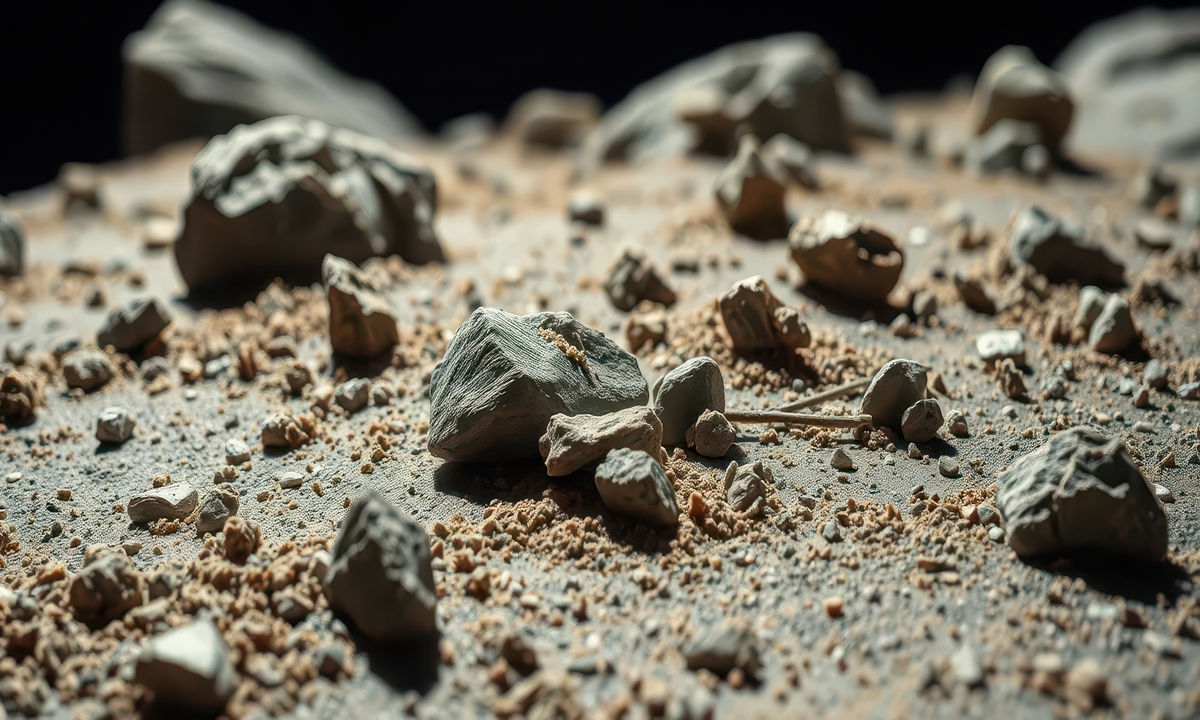
Along these lines, a group of Chinese scientists have identified a component of lunar soil, called "lunar binder," as an ultra-heat-resistant natural material. In fact, it is one of the materials with the lowest thermal conductivity known in nature, surpassing the insulating capacity of many man-made materials. This "lunar binder" formed as a result of the Moon's surface being bombarded by tiny meteorites over billions of years.
En esta línea, un grupo de científicos chinos han identificado que un componente del suelo lunar, llamado "aglutinado lunar", ha resultado ser un material natural ultra-resistente al calor. De hecho, es uno de los materiales con la menor conductividad térmica conocidos en la naturaleza, superando en su capacidad aislante a muchos materiales creados por el ser humano. Este "aglutinado lunar" se ha formado gracias a que la superficie de la Luna ha sido golpeada por meteoritos diminutos durante miles de millones de años.

Source
When a micrometeorite impacts the Moon, the extreme heat melts tiny particles of lunar dust and rock. This molten material acts as a "glue" that binds other fragments (minerals, glass, etc.). In this process, minute gas bubbles are trapped. Everything cools and solidifies rapidly, forming complex particles less than 1 millimeter in size that make up the aforementioned lunar aggregate. The key lies in its incredibly complex internal microstructure, which we could say has two key characteristics.
Cuando un micrometeorito impacta contra la Luna, el calor extremo funde pequeñas partículas de polvo y roca lunar. Este material fundido actúa como un "pegamento" que une otros fragmentos (minerales, vidrio, etc.). En ese proceso, quedan atrapadas diminutas burbujas de gas. Todo se enfría y solidifica rápidamente, formando unas partículas complejas de menos de 1 milímetro que conforma el mencionado aglutinado lunar. El truco está en su microestructura interna, que es increíblemente compleja que podríamos decir que tiene dos características clave.
On one hand, the aggregate is filled with pores (voids) of all sizes, ranging from nanometers to micrometers. Heat is transferred less efficiently through a vacuum (or trapped gas), so these pores act as barriers. Within the particle, there are countless boundaries where different materials (glass, minerals, metals) meet. Each of these interfaces scatters the heat-carrying vibrations (phonons), preventing thermal energy from flowing easily.
Por un lado el aglutinado está lleno de poros (huecos) de todos los tamaños, que van desde nanómetros hasta micrómetros. El calor se transfiere peor a través del vacío (o del gas atrapado), así que estos poros actúan como barreras. Dentro de la partícula hay innumerables fronteras donde se encuentran diferentes materiales (vidrio, minerales, metales). Cada una de estas interfaces dispersa las vibraciones que transportan el calor (los fonones), impidiendo que la energía térmica fluya con facilidad.

Source
This discovery has practical implications for both science and future technology. On the one hand, it explains why the lunar surface experiences such extreme temperature changes (from 120°C during the day to -180°C at night), while the shallow subsurface maintains a more stable temperature. This is key to designing future lunar bases. Now that we know nature has created a perfect insulator on the Moon with a very specific structure, scientists can mimic this structure to design a new generation of artificial thermal insulators, potentially more efficient, lighter, and cheaper than those currently available.
Este descubrimiento tiene implicaciones prácticas tanto para la ciencia como para la tecnología futura ya que, por un lado, explica por qué la superficie lunar sufre cambios de temperatura tan extremos (de 120 °C de día a -180 °C de noche) mientras que el subsuelo, a poca profundidad, mantiene una temperatura más estable, Lo cual resulta clave para diseñar futuras bases lunares. Ahora que aabemos que la naturaleza, en la Luna, ha creado un aislante perfecto con una estructura muy específica los científicos pueden imitar esta estructura para diseñar una nueva generación de aislantes térmicos artificiales, posiblemente más eficientes, ligeros y baratos que los actuales.
Among its potential applications, the aerospace industry could manufacture improved heat shields for spacecraft and spacesuits. In electric cars, it could be used as insulation to prevent batteries from overheating and causing fires. In construction, it could be used to create new insulation materials for buildings, reducing energy consumption for heating and air conditioning. The next step is to learn how to manufacture copies of this remarkable material here on Earth.
Entre sus aplicaciones potenciales, la industria aeroespacial podrá fabricar mejores escudos térmicos para naves y trajes espaciales. En los coches eléctricos pueden utilizarse como aislantes para evitar que las baterías se sobrecalienten con el consiguiente riesgo de incendio. En la construcción podrían crearse nuevos materiales de aislamiento para edificios, reduciendo el consumo de energía en calefacción y aire acondicionado. El próximo paso que nos queda por dar es aprender a fabricar copias de este material milagroso aquí en la Tierra.
More information/Más información
https://tvbrics.com/en/news/chinese-scientists-identify-lunar-soil-as-natural-ultra-insulating-material/