MiNaMi, Europe's ambitious plan to boost hydrogen in maritime transport/MiNaMi, el ambicioso plan de Europa para impulsar el hidrógeno en el transporte marítimo

Source
According to the most recent data from multiple international sources, maritime traffic is responsible for approximately 3% of global greenhouse gas emissions. Focusing specifically on carbon dioxide emissions, a European Commission report indicates that, together with aviation, maritime transport accounts for approximately 4.6% of global energy-related emissions. While 3% may seem like a small percentage, the absolute volume of emissions is very significant and, more critically, has strong growth potential.
De acuerdo a los datos más recientes de múltiples fuentes internacionales, el tráfico marítimo es responsable de aproximadamente el 3% de las emisiones globales de gases de efecto invernadero. Si nos centramos específicamente en las emisiones de dióxido de carbono, un informe de la Comisión Europea precisa que, junto con la aviación, el transporte marítimo representa aproximadamente el 4.6% de las emisiones globales relacionadas con la energía. Aunque el 3% pueda parecer un porcentaje pequeño, el volumen absoluto de emisiones es muy significativo y, lo más crítico, tiene un fuerte potencial de crecimiento.
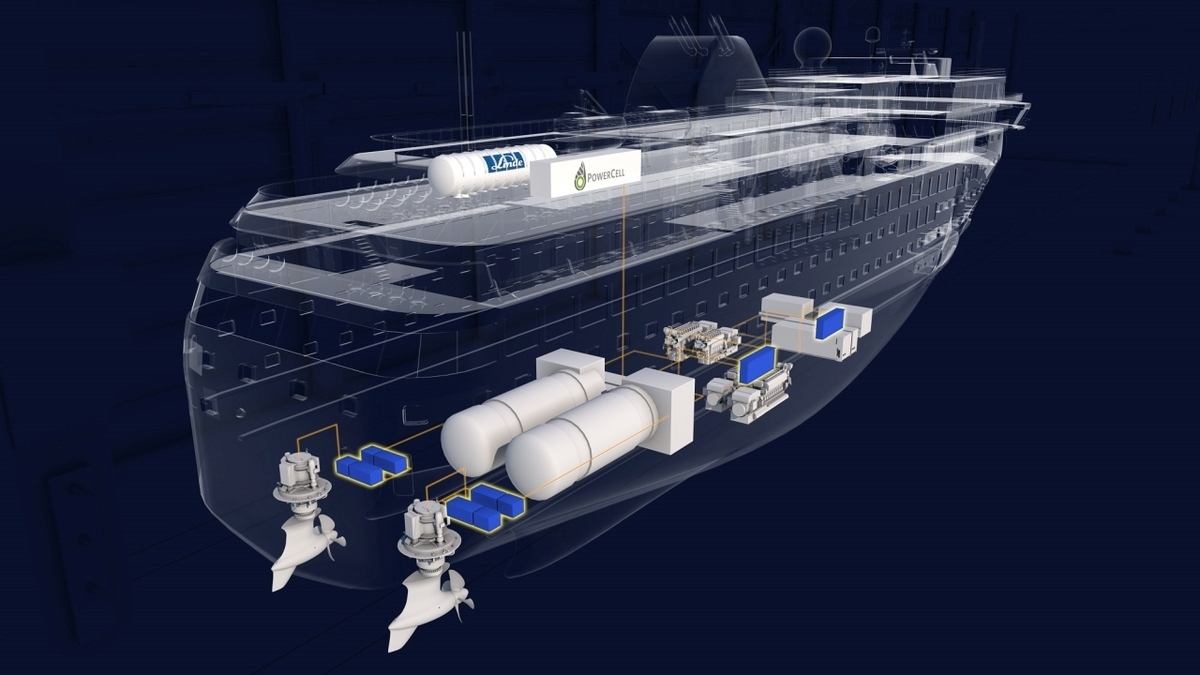
In this vein, Europe is launching the MiNaMi project, one of the most promising initiatives developed by Europe to decarbonize maritime transport using hydrogen. MiNaMi is an acronym for "Million Nautical Mile Fuel Cell System," and its main objective is to develop the first megawatt (MW) scale proton exchange membrane (PEM) fuel cell system in Europe, specifically designed for use in maritime transport.
En esta línea Europa lanza ell proyecto MiNaMi, una de las iniciativas más prometedoras desarrollada por Europa para descarbonizar el transporte marítimo usando hidrógeno. MiNaMi es el acrónimo de "Million Nautical Mile Fuel Cell System" (Sistema de Pila de Combustible para un Millón de Millas Náuticas) y su objetivo principal es desarrollar el primer sistema de pila de combustible de membrana de intercambio de protones (PEM) de escala megavatio (MW) en Europa, específicamente diseñado para su uso en el transporte marítimo.
Source
The MiNaMi consortium, coordinated by the Finnish research center VTT, brings together nine leading industrial and research partners in Europe, covering the entire value chain: from technology development to final implementation. Prominent partners include battery manufacturer PowerCell, shipping company DFDS, automation firm ABB, and sensor company Vaisala. The plan is structured around several key technical objectives.
El consorcio MiNaMi, coordinado por el centro de investigación finlandés VTT, reúne a nueve socios industriales y de investigación líderes en Europa, cubriendo toda la cadena de valor: desde el desarrollo de la tecnología hasta su implementación final. Entre los socios más destacados se encuentran el fabricante de pilas PowerCell, la naviera DFDS, la empresa de automatización ABB y la firma de sensores Vaisala. El plan se estructura en torno a varios objetivos técnicos clave.
To create a modular, MW-class PEM fuel cell system that can be scaled to installations exceeding 10 MW to power large vessels. The system must be designed for a lifespan exceeding 80,000 operating hours, as this is crucial for its viability in the demanding marine environment. The goal is for the system to be capable of propelling a vessel for over one million nautical miles (hence its name) at a speed of 12.5 knots, demonstrating its reliability and efficiency over long distances.
Crear un sistema de pila de combustible PEM de clase MW, que sea modular y pueda escalarse a instalaciones de más de 10 MW para impulsar buques de gran tamaño. Diseñar el sistema para que tenga una vida útil superior a las 80,000 horas de operación, ya que esto es fundamental para que sea viable en el exigente entorno marítimo. El objetivo es que el sistema sea capaz de propulsar un buque durante más de un millón de millas náuticas (de ahí su nombre) a una velocidad de 12.5 nudos, demostrando su fiabilidad y eficiencia en largas distancias.

Source
In short, Europe aims to develop the first megawatt hydrogen fuel cell system for ships in Europe with a budget of approximately seven million euros. The system will not only be used for ships, as the technology developed is designed for application in other energy-intensive sectors, such as rail transport, stationary power generation, and heavy machinery (e.g., mining trucks). Each partner contributes its expertise; for example, the German company Allengra is developing advanced ultrasonic sensors to measure hydrogen flow with extreme precision, a critical aspect for the system's safety and performance.
En definitiva Europa pretende desarrollar el primer sistema de pila de combustible de hidrógeno de megavatios para barcos en Europa con un presupuesto de aproximadamente siete millones de euros. El sistema no solo servirá para barcos ya que la tecnología desarrollada está pensada para aplicarse en otros sectores de alta demanda energética, como el transporte ferroviario, la generación estacionaria de energía o maquinaria pesada (ej. camiones mineros). Cada socio aporta su experiencia, por ejemplo, la empresa alemana Allengra está desarrollando sensores ultrasónicos avanzados para medir con extrema precisión el flujo de hidrógeno, un aspecto crítico para la seguridad y el rendimiento del sistema.
Currently, 99.9% of large shipping vessels use enormous diesel engines. The MiNaMi project aims to replace these engines and their fuel tanks with much more efficient hydrogen-powered fuel cells, which will drive the electric motors of the shipping vessels of the near future. In essence, MiNaMi seeks to lay the technological groundwork for hydrogen to become a clean, reliable, and commercially viable energy source for large-scale shipping, helping Europe achieve its ambitious climate goals.
Actualmente el 99,9 % de los grandes barcos de transporte marítimo utilizan enormes motores diésel, el proyecto MiNaMi quiere cambiar estos propulsores y sus depósitos de carburante por unas mucho más eficientes pilas de combustible alimentadas por hidrógeno, que moverán los motores eléctricos de los buques de transporte marítimo del futuro próximo En esencia, MiNaMi busca sentar las bases tecnológicas para que el hidrógeno se convierta en una fuente de energía limpia, fiable y comercialmente viable para el transporte marítimo de gran escala, ayudando a Europa a alcanzar sus ambiciosos objetivos climáticos.
More information/Más información
https://fuelcellsworks.com/2026/02/27/fuel-cells/powercell-joins-eu-project-minami-targeting-ultra-long-lifetime-megawatt-fuel-cell-systems-for-maritime-applications
I think this is one of the most significant issues that has received little, if any, focus. When considering how many merchant vessels operate under diesel propulsion with a world trading pattern that generates an extraordinary amount of global shipping trade, the fact that 99.9% of all large vessels operate on diesel is mind-blowing! MiNaMi appears to be an excellent move in the right direction. Furthermore, from a technology perspective, the 80,000 hours of expected life provides evidence of their commitment to not only proving a concept but also delivering products with a reasonably long-life of service. My question is - which of these two aspects do you believe will present the greater barrier to successful implementation of this type of technology within the shipping industry - the advancement of the technologies themselves or the willingness of the shipping industry to implement the technology at all? My initial thought is that the shipping industry will continue to lag significantly behind other industries with respect to adopting new technologies.