Scientists develop a water-resistant biomaterial that could replace plastic/Desarrollan un biomaterial resistente al agua que podría jubilar el plástico
Source
We've discussed more than once in this publication how harmful plastic is to the environment and, at the same time, how useful it is, having practically taken over our lives. That's why it's urgent to find alternative solutions that can replace plastic in all its uses and that are also environmentally friendly. Along these lines, the Institute for Bioengineering of Catalonia (IBEC) has presented a very promising discovery. It's a new biomaterial that, unlike most, doesn't weaken with water, but rather becomes up to 50% stronger.
Ya hemos comentado más de una vez en este medio lo dañino que es el plástico para el medio ambiente y a su vez lo útil que resulta ya que prácticamente se ha adueñado de nuestras vidas. Por eso urge encontrar soluciones alternativas que puedan reemplazar al plástico en todos sus usos y que también sea respetuoso con el medio ambiente. En esta línea el Instituto de Bioingeniería de Catalunya (IBEC) ha presentado un descubrimiento muy prometedor. Se trata de un nuevo biomaterial que, al contrario que la mayoría, no se debilita con el agua, sino que se vuelve hasta un 50% más resistente.
This is a composite material created from two main ingredients: a natural polymer called chitosan, which is derived from chitin, the second most abundant organic material on Earth after cellulose. Chitin is found in the shells of crustaceans (such as shrimp and crabs), insects, and fungi. For this development, the researchers used chitosan from shrimp shell waste, which already represents added value in terms of recycling. A small amount of nickel, a naturally occurring trace element, is incorporated into the chitosan structure.
Se trata de un material compuesto creado a partir de dos ingredientes principales: un polímero natural llamado "Quitosano" que se obtiene de la quitina, que es el segundo material orgánico más abundante en la Tierra después de la celulosa . La quitina se encuentra en los caparazones de crustáceos (como gambas o cangrejos), en insectos y en hongos. Para este desarrollo, los investigadores utilizaron quitosano procedente de desechos de cáscaras de gambas, lo que ya supone un valor añadido en términos de reciclaje . A la estructura del quitosano se le incorpora una pequeña cantidad de níquel, que es un oligoelemento natural.

Source
The secret lies in how the material interacts with water at a molecular level, a concept inspired by nature, specifically the cuticle of arthropods and the tusks of the sandworm Nereis virens. Scientists observed that if zinc was removed from the tusks of this worm, they became soft when wet. This led them to believe that metals play a key role in how biological structures interact with water. By introducing nickel into chitosan and exposing it to water, a rigid, inert structure like that of plastic is not created; instead, a dynamic network of weak, reversible bonds forms.
El secreto reside en cómo el material interactúa con el agua a nivel molecular, un concepto inspirado en la naturaleza, concretamente en la cutícula de los artrópodos y en los colmillos del gusano de arena Nereis virens. Los científicos observaron que si se retiraba el zinc de los colmillos de este gusano, estos se volvían blandos al mojarse. Esto les llevó a pensar que los metales juegan un papel clave en cómo las estructuras biológicas interaccionan con el agua. Al introducir el níquel en el quitosano y exponerlo al agua, no se crea una estructura rígida e inerte como la del plástico, en su lugar, se forma una red dinámica de enlaces débiles y reversibles.
Water molecules and nickel ions are mobile within this network. When the material is subjected to stress or impact, these bonds constantly break and reform. This continuous microscopic reconfiguration allows the material to absorb energy and reorganize itself, redistributing stress and preventing fracture. According to its creators, it is a material that demonstrates that "being 'soft' at the molecular scale makes it stronger" at the macroscopic scale. Water, instead of being a threat, becomes an active structural component.
Las moléculas de agua y los iones de níquel tienen movilidad dentro de esta red, cuando el material sufre una tensión o un impacto, estos enlaces se rompen y se re-forman constantemente. Esta reconfiguración microscópica continua permite que el material absorba la energía y se reorganice, redistribuyendo la tensión y evitando que se fracture. Según sus creadores, es un material que demuestra que "ser 'blando' a escala molecular lo hace más fuerte" a escala macroscópica. El agua, en lugar de ser una amenaza, se convierte en un componente estructural activo.

Source
This discovery is important not only for its water resistance but also for the range of advantages it offers. The material remains essentially the same chitosan molecule, so nature recognizes it and it can be easily reintegrated into ecological cycles at the end of its useful life, thus avoiding persistent pollution like conventional plastics. Chitin is extremely abundant in nature, and chitosan can be obtained from local sources (food scraps, the fishing industry, fungi), avoiding dependence on a single global supply chain.
Este hallazgo no solo es importante por su resistencia al agua, sino por el conjunto de ventajas que ofrece. El material sigue siendo esencialmente la misma molécula de quitosano, por lo que la naturaleza lo reconoce y puede reintegrarse fácilmente en los ciclos ecológicos al final de su vida útil, por lo que no genera contaminación persistente como los plásticos convencionales. La quitina es abundantísima en la naturaleza, el quitosano puede obtenerse de fuentes locales (restos de comida, industria pesquera, hongos), evitando depender de una cadena de suministro global única.
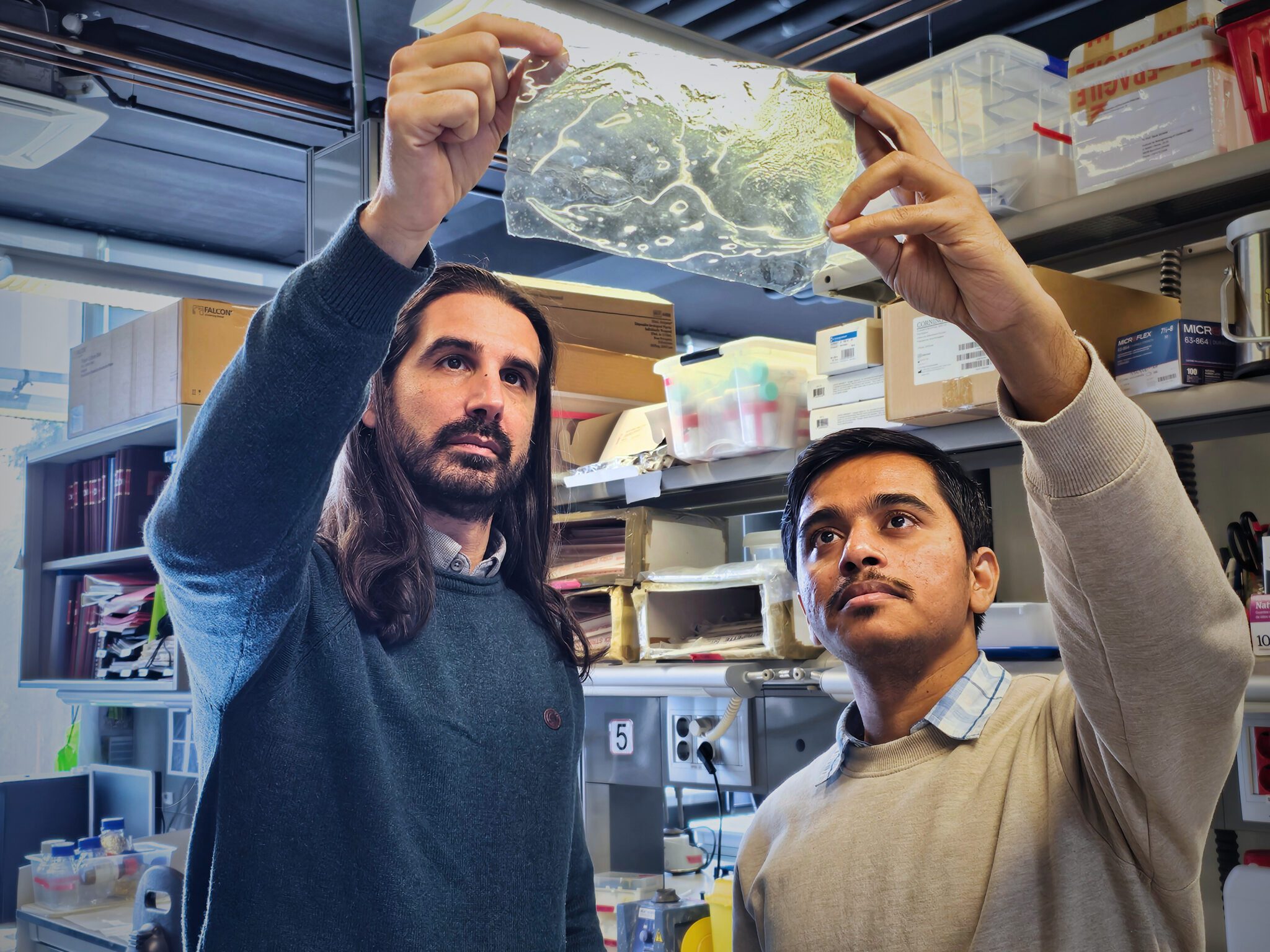
Researchers have already manufactured prototypes such as large cups and sheets, demonstrating their potential for creating watertight containers. The first applications are expected in sectors where exposure to water is constant and biodegradable materials are needed, such as films to cover floors, crop protectors, or packaging for products that require moisture. These materials could also be used to manufacture nets, fishing gear, and containers that, if lost at sea, would biodegrade without leaving permanent residue, and as an alternative to single-use plastics, especially for food or moist products.
Los investigadores ya han fabricado prototipos como vasos y láminas de gran tamaño, demostrando su potencial para crear recipientes estancos . Las primeras aplicaciones se esperan en sectores donde la exposición al agua es constante y se necesitan materiales biodegradables como películas para cubrir suelos, protectores de cultivos o envases para productos que requieren humedad. Fabricación de redes, aparejos y contenedores que, si se pierden en el mar, se biodegradarían sin dejar residuos permanentes y también como alternativa a los plásticos de un solo uso, especialmente para alimentos o productos húmedos.
More information/Más información
https://ibecbarcelona.eu/un-material-biologico-que-aumenta-su-fuerza-cuando-se-moja-podria-sustituir-al-plastico/