"SpudCells", synthetic cells that behave like living cells/"SpudCells", células sintéticas que se comportan como células vivas

Source
A team at the University of Minnesota has created the "SpudCell," a synthetic cell built from scratch using non-living chemical components. This cell is capable of growing, replicating its DNA, and dividing—something that had not been achieved until now. However, although it can mimic vital functions, it is not considered a living cell in the traditional sense. The SpudCell is a synthetic biology project that aims to build a biological system "from scratch" in the laboratory in order to fully understand and control it.
Un equipo de la Universidad de Minnesota ha creado la "SpudCell", una célula sintética construida desde cero con componentes químicos no vivos, que es capaz de crecer, replicar su ADN y dividirse, algo que no se había logrado hasta el momento. Sin embargo, aunque puede imitar funciones vitales, no se considera una célula viva en el sentido tradicional. La SpudCell es un proyecto de biología sintética que busca construir un sistema biológico "desde cero" en el laboratorio para entenderlo y controlarlo por completo.
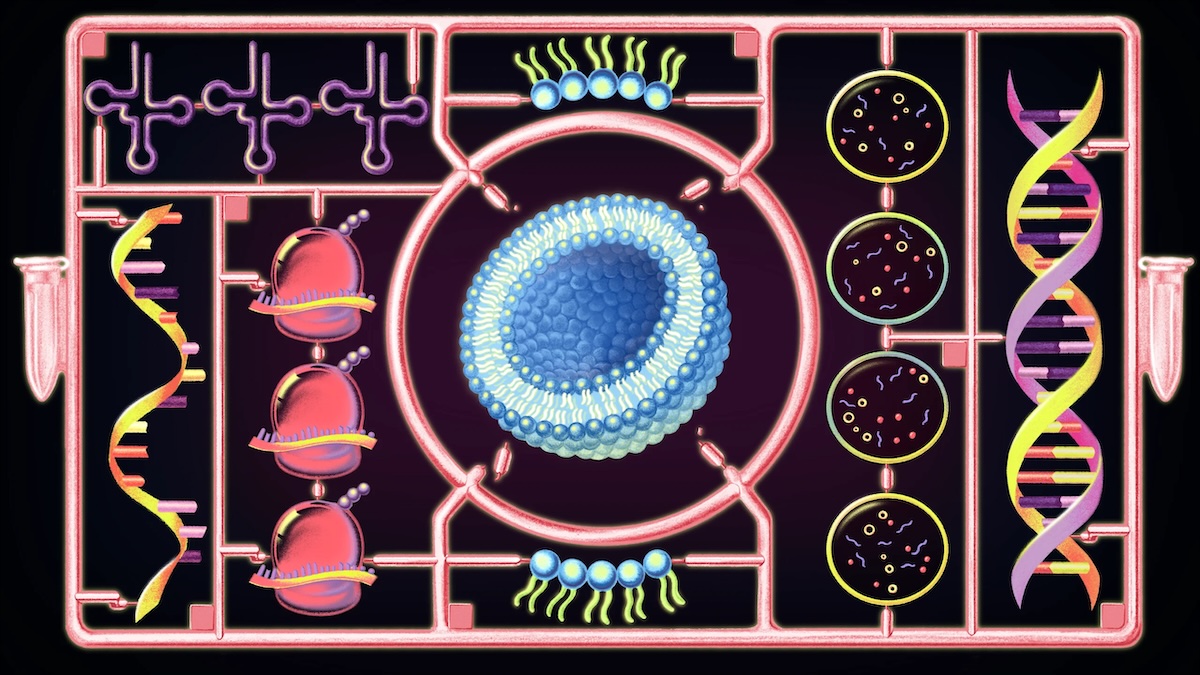
Unlike other experiments that modify existing cells, the SpudCell is assembled from non-living components. It is created inside a liposome (a microscopic bubble of fat) that acts as its cell membrane. Inside, it contains a genome of 36 genes (about 90,000 base pairs, much smaller than the human genome). These genes, extracted from bacteria such as E. coli and viruses, give it instructions for basic functions. The SpudCell "eats" by fusing with tiny bubbles of food that provide it with the nutrients, energy, and components necessary for growth.
A diferencia de otros experimentos que modifican células existentes, la SpudCell se ensambla a partir de componentes no vivos. Se crea dentro de un liposoma (una burbuja microscópica de grasa) que actúa como su membrana celular. En su interior contiene un genoma de 36 genes (unas 90.000 pares de bases, mucho más pequeño que el genoma humano). Estos genes, extraídos de bacterias como E. coli y virus, le dan instrucciones para funciones básicas. La SpudCell "come" fusionándose con pequeñas burbujas de alimento que le proporcionan los nutrientes, energía y componentes necesarios para crecer.
Source
To replicate, it produces proteins that accumulate on its surface, exerting pressure until the membrane ruptures, dividing into two daughter cells. But this is a very fragile system. It cannot manufacture its own ribosomes (the protein factories) or eliminate its waste products, so it depends entirely on a laboratory environment and ceases to function after a few generations. Furthermore, although it can experience something akin to natural selection, it is incapable of evolving on its own.
Para replicarse, produce sus proteínas que se acumulan en su superficie, ejerciendo presión hasta que la membrana se escinde, dividiéndose en dos células hijas. Pero este es un sistema muy "frágil". No puede fabricar sus propios ribosomas (las fábricas de proteínas) ni eliminar sus residuos, por lo que depende totalmente de un entorno de laboratorio y deja de funcionar tras unas pocas generaciones. Además, aunque puede experimentar algo parecido a la selección, no es capaz de evolucionar por sí misma.
The main goal is not to create life in the laboratory, but to build a programmable bioengineering platform. A fully defined cell would allow the design of custom-made "biological factories" to produce substances that natural cells cannot efficiently or safely manufacture. Its applications are varied in principle; in medicine, it could be used to manufacture new drugs or produce existing medications more efficiently and economically. It could also be used to produce biofuels, plastics, and other materials, reducing dependence on fossil fuels and petrochemicals.
El objetivo principal no es crear vida en el laboratorio, sino construir una plataforma de bioingeniería programable. Una célula completamente definida permitiría diseñar "fábricas biológicas" a medida para producir sustancias que las células naturales no pueden fabricar de forma eficiente o segura. Sus aplicaciones en principio son variadas, en medicina se podrían utilizar para fabricar nuevos fármacos o producir medicamentos existentes de manera más eficiente y económica. También se podrían producir biocombustibles, plásticos y otros materiales, reduciendo la dependencia de los combustibles fósiles y la petroquímica.

Source
Cells could also be designed to capture carbon or decontaminate the environment. And what seems most promising: helping us understand the fundamental principles of life and its origins. To foster the development of this technology, the team has created a non-profit organization called Biotic, with the intention that SpudCell be an open resource for the scientific community, similar to open-source software. They envision creating a kind of pseudo-biological GitHub with synthetic cells.
También se podrían crear células diseñadas para capturar carbono o descontaminar el medio ambiente. Y lo que parece más prometedor: ayudar a comprender los principios fundamentales de la vida y sus orígenes. Para fomentar el desarrollo de esta tecnología, el equipo ha creado una organización sin ánimo de lucro llamada Biotic, con la intención de que la SpudCell sea un recurso abierto para la comunidad científica, similar al software de código abierto. Crear una especie de Git-Hub pseudo-biológico con células sintéticas.
Despite these achievements, SpudCell lacks the "spark" that would make it a living organism. It has several key limitations: it's a very fragile and dependent system that needs scientists to constantly provide it with "food"—ribosomes (the protein factories) and other components. Without this external help, it dies. Although the researchers demonstrated a principle of selection by introducing a beneficial mutation, it didn't arise spontaneously. The cell can't evolve on its own. Nevertheless, with this kind of scientific progress, I don't know whether to applaud or run for the hills.
A pesar de estos logros, la SpudCell carece de la "chispa" que la convertiría en un organismo vivo. Presenta varias limitaciones clave: es un sistema muy frágil y dependiente que necesita que los científicos le proporcionen constantemente "comida", ribosomas (las fábricas de proteínas) y otros componentes. Sin esta ayuda externa, muere. Aunque los investigadores demostraron un principio de selección al introducir una mutación beneficiosa, esta no surgió de forma espontánea. La célula no puede evolucionar por sí misma. No obstante yo, con este tipo de avances cientíicos, no sé si aplaudir o echar a correr.
More information/Más información
https://edition.cnn.com/2026/07/01/science/synthetic-cell-research
An interesting discovery as SpudCell demonstrates just how advanced synthetic biology has come since the time of creating living things from non-living materials. It represents an entirely new method of producing cells; however, it cannot operate without laboratory resources. Therefore, the development of creating living systems from non-living materials represents a new area for us as scientists to explore because we are only beginning to understand the intricacies of the living world.
0.00 SBD,
0.77 STEEM,
0.77 SP