They develop a system that converts up to 31.3% of sunlight into hydrogen directly/Desarrollan sistema que convierte hasta el 31,3% de luz solar en hidrógeno directamente
Source
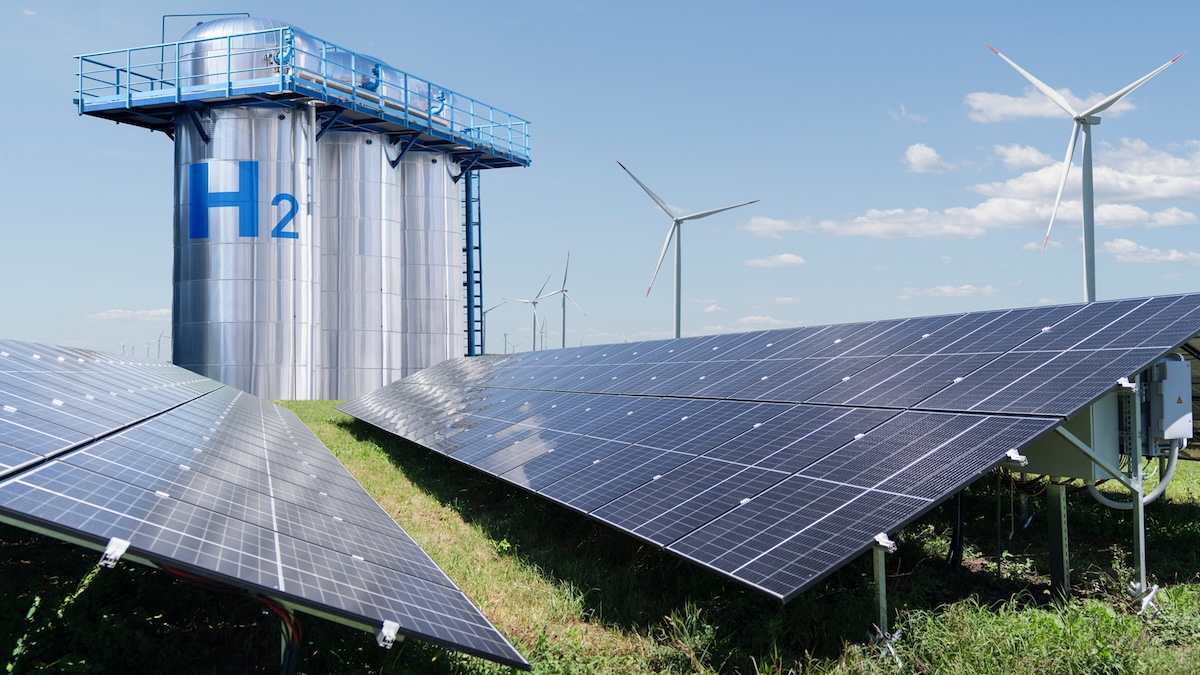
A group of scientists from the Fraunhofer ISE Institute in Germany have achieved an important milestone in the production of green hydrogen, achieving a sunlight-to-hydrogen conversion efficiency of 31.3% in real outdoor conditions. This achievement, published in the journal Communications Engineering, represents a significant advance over previous systems, which used to be between 20% and 30% efficient outdoors. In essence, they have created a hybrid module called HyCon that very efficiently integrates two mature technologies.
Un grupo de científicos del Instituto Fraunhofer ISE en Alemania han logrado un hito importante en la producción de hidrógeno verde, logrando alcanzar una eficiencia de conversión de luz solar a hidrógeno del 31,3% en condiciones reales al aire libre. Este logro, publicado en la revista Communications Engineering, representa un avance significativo respecto a los sistemas anteriores, que solían rondar entre el 20% y el 30% de eficiencia en el exterior. En esencia, han creado un módulo híbrido llamado HyCon que integra de manera muy eficiente dos tecnologías maduras.
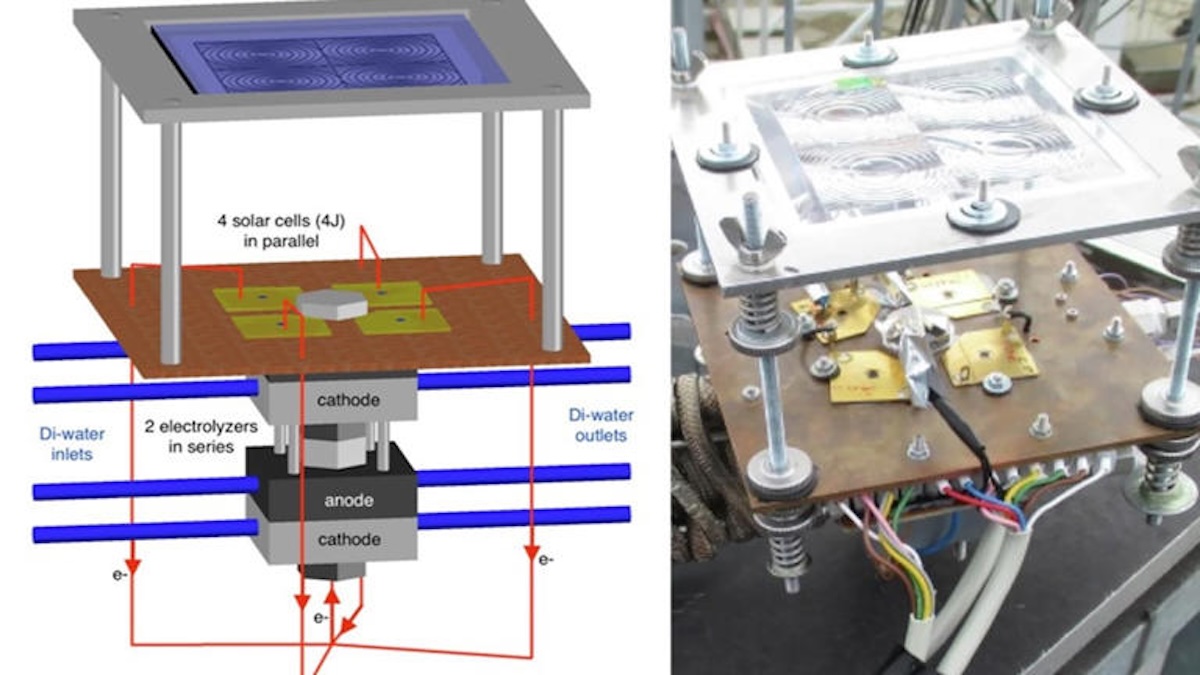
They use a technology called CPV (concentrator photovoltaic). A set of Fresnel lenses concentrates direct sunlight up to 226 times onto tiny 4-junction (4J) solar cells made of III-V semiconductors (such as GaInP/GaAs and GaInAsP/GaInAs). These cells are the most efficient in the world at converting light into electricity, reaching up to 47.6% efficiency under concentrated light. With concentrated light, they generate a voltage of more than 4 volts, enough to break the water molecule.
Utilizan una tecnología llamada CPV (concentrador fotovoltaico). Un conjunto de lentes Fresnel concentra la luz solar directa hasta 226 veces, sobre unas minúsculas celdas solares de 4 uniones (4J) de semiconductores III-V (como GaInP/GaAs y GaInAsP/GaInAs). Estas celdas son las más eficientes del mundo para convertir luz en electricidad, alcanzando hasta un 47,6% de eficiencia bajo luz concentrada. Con la luz concentrada, generan un voltaje de más de 4 voltios, suficiente para romper la molécula de agua.
Source
The electricity generated by the solar cells is connected directly to two proton exchange membrane (PEM) electrolyzers connected in series. This direct connection eliminates the need for intermediate power electronics, reducing energy losses in conversion. To make the efficiency so high, researchers take advantage of the waste heat from the solar cells. This heat is used to heat the water that feeds the electrolyzers, since hot water needs less electrical energy to split into hydrogen and oxygen.
La electricidad generada por las celdas solares se conecta directamente a dos electrolizadores de membrana de intercambio protónico (PEM) conectados en serie. Esta conexión directa elimina la necesidad de electrónica de potencia intermedia, reduciendo las pérdidas de energía en la conversión. Para que la eficiencia sea tan alta, los investigadores aprovechan el calor residual de las celdas solares. Este calor se utiliza para calentar el agua que alimenta los electrolizadores, ya que el agua caliente necesita menos energía eléctrica para dividirse en hidrógeno y oxígeno.
The result of this integrated system, tested in Freiburg over 13 summer days, was a peak efficiency of 31.3% in converting solar energy into chemical energy stored in hydrogen. This development is very promising, but it is important to understand its current context and the challenges it faces. It is crucial to note that the system is at a low technological maturity level, meaning that it is a proof-of-concept prototype in a relevant environment, but is still far from a market-ready product.
El resultado de este sistema integrado, probado en Friburgo durante 13 días de verano, fue una eficiencia pico del 31,3% en la conversión de la energía solar en energía química almacenada en el hidrógeno. Este avance es muy prometedor, pero es importante entender su contexto actual y los desafíos que enfrenta. Es crucial destacar que el sistema se encuentra en un nivel de madurez tecnológica bajo, lo que significa que es un prototipo de prueba de concepto en un entorno relevante, pero aún está lejos de un producto listo para el mercado.
Source
Although the efficiency is a record, the hydrogen produced by this system is still expensive. It is estimated that its cost could be between 3.50 and 6.00 dollars per kilogram, compared to 1.50-2.50 dollars per kilogram for gray hydrogen produced from natural gas. To be competitive, the system not only has to be efficient, but also durable, scalable, and capable of operating many hours per year. The same scientists recognize that for solar hydrogen to be competitive, high efficiency is not enough.
Aunque la eficiencia es un récord, el hidrógeno producido por este sistema sigue siendo caro. Se estima que su coste podría estar entre 3.50 y 6.00 dólares por kilogramo, frente a los 1.50-2.50 dólares por kiloggramo del hidrógeno gris producido a partir de gas natural. Para ser competitivo, el sistema no solo tiene que ser eficiente, sino también duradero, escalable y capaz de operar muchas horas al año. Los mismos científicos reconocen que para que el hidrógeno solar sea competitivo, no basta con la alta eficiencia.
The cost of the system (CAPEX) must be reduced, its operating hours increased and its long-term stability ensured under real conditions, which include variations in light, temperature and other environmental factors. In short, the achievement of the Fraunhofer ISE is a fundamental step that demonstrates that it is possible to produce hydrogen directly from the sun with unprecedented efficiency. However, the path to a commercially viable and widespread solution still requires overcoming important barriers of cost, durability and scalability.
Se debe reducir el coste del sistema (CAPEX), aumentar sus horas de operación y asegurar su estabilidad a largo plazo en condiciones reales, que incluyen variaciones en la luz, temperatura y otros factores ambientales. En resumen, el logro del Fraunhofer ISE es un paso fundamental que demuestra que es posible producir hidrógeno directamente del sol con una eficiencia sin precedentes. Sin embargo, el camino hacia una solución comercialmente viable y extendida aún requiere superar importantes barreras de coste, durabilidad y escalabilidad.
More information/Más información
https://interestingengineering.com/energy/germany-solar-sunlight-hydrogen-fuel
There has been impressive development made in the quest to produce clean energy. The conversion of 31.3% of the sunlight into hydrogen is an astonishing feat of engineering. While cost and scalability continue to be two challenges that must be overcome, advances such as these will help the green hydrogen industry get significantly closer to achieving a viable means of producing hydrogen as part of a low-carbon future. Nice summary!
0.00 SBD,
0.75 STEEM,
0.75 SP