How to Test Light-Dependent Resistors?
A light-dependent resistor (LDR) is an electronic component that adjusts its resistance according to changes in light intensity. It is widely used in optoelectronic technology, optical communication, photogrammetry, automatic control, and smart lighting systems. With the development of industrial automation and intelligent devices, the use of LDRs in industrial production, scientific experiments, and precision instruments has become increasingly common. To ensure stable device operation and accurate measurement data, it is necessary to conduct scientific and systematic testing of LDRs. This article provides a comprehensive introduction to the definition, working principle, required materials and tools, and both static and dynamic testing methods of LDRs. It also further analyzes commonly used detection methods such as automatic light modulation technology, the AC method, and the POM method.
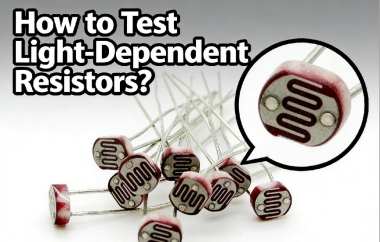
I. What is a Light-Dependent Resistor?
A light-dependent resistor (photoresistor or LDR) is a light-sensitive component whose core function is to convert light signals into changes in electrical resistance. Its working principle is based on the photoconductive effect of semiconductor materials: when light strikes the photosensitive material, the energy from photons excites charge carriers, increasing the material’s conductivity and thereby reducing its resistance. In a dark environment, the number of charge carriers decreases, and the resistance increases. This characteristic, where resistance changes with light intensity, allows LDRs to serve as core components in light-controlled switches, light measurement instruments, and automatic dimming systems.
LDRs have several advantages, including high sensitivity, short response time, and a wide range of resistance change. Therefore, they are widely used in industrial control, automatic lighting systems, and laboratory optical measurements. Depending on the material and application, the dark resistance of an LDR is usually in the megaohm range, while under bright conditions it can drop to several hundred ohms or even lower. Its simple structure and low cost make it an indispensable fundamental component in the field of optoelectronic detection.
Additionally, the performance of an LDR is influenced by the type of material, packaging form, and environmental factors such as light wavelength, illumination, and temperature. In engineering applications, scientific testing methods are necessary to ensure stable performance and long service life. This necessity is the main focus of the following sections of this article.
II. Testing Materials and Tools
Before testing an LDR, it is necessary to prepare professional testing materials and tools to ensure accurate and reproducible measurements. The testing materials mainly include a stable light source and the LDR to be tested. The light source should have adjustable intensity and, whenever possible, maintain consistent wavelength and illumination to ensure stable testing conditions. Common testing tools include digital multimeters or high-precision ohmmeters to measure both the dark resistance and bright resistance of the LDR. Oscilloscopes and signal generators are used for dynamic response testing, allowing the recording of resistance changes in response to light variation. For high-precision measurements, constant current or constant voltage power supplies can provide stable bias, while standard lux meters can be used to calibrate the light source and enable quantitative testing and comparison. This combination of tools can meet the requirements of both basic resistance measurements and dynamic response analysis, providing reliable data for LDR testing.
Get more details: < a href="https://www.smbom.com/news/46392">How to Test Light-Dependent Resistors?