Reactors vs Inductors: What's the Difference?
In the field of electronic components and power systems, reactors and inductors are two commonly used types of components, and they play a critical role in circuit design and power applications. Although both are related to inductive elements, electromagnetic energy storage, and AC characteristics, there are clear differences in their definitions, working principles, characteristics, and practical applications.
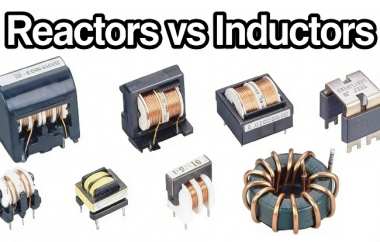
I. Definition
A reactor (Reactance) is a component used in AC circuits to change the phase relationship between current and voltage, thereby adjusting the impedance of the circuit. Reactors include both inductors and capacitors, with inductors also referred to as inductive elements. By introducing appropriate reactance into an AC system, reactors can control the current amplitude, stabilize system voltage, and achieve impedance matching and harmonic suppression in complex circuits.
An inductor (Inductor) is an energy storage component that can store and release energy in a magnetic field through self-induction. Inductors are typically made of wire wound into coils or solenoids. When current flows through them, a magnetic field is generated around the coil, enabling energy storage. Inductors are widely used in filtering, voltage stabilization, isolation, and power management circuits, making them fundamental and essential components in electronic design.
II. Working Principle
The working principle of a reactor is based on the ability of capacitors or inductors to adjust the phase of current and voltage in AC circuits. Capacitors store and release electric charges to alter the phase relationship between voltage and current, thus regulating impedance. Inductors store and release magnetic energy, similarly affecting the phase difference between current and voltage. In AC systems, reactors adjust circuit impedance in this way, enabling current control, voltage stabilization, or harmonic suppression.
The working principle of an inductor relies on Faraday’s law of electromagnetic induction. When current flows through a coil, the magnetic field generated is stored within the inductor. As the current changes, the magnetic field also changes, producing an induced electromotive force in the inductor. This induced voltage resists rapid changes in current, causing a phase difference between current and voltage. Because of this, inductors can perform filtering, current stabilization, and energy management functions in electronic circuits.
Get more details: Reactors vs Inductors: What's the Difference?