Relay vs Transistor PLC: What's the Difference?
In the field of industrial automation control, the output unit of a programmable logic controller (PLC) is the key interface that connects the control system with on-site actuators. Common output types mainly include relay output, transistor output, and thyristor output. Among them, relay output and transistor output are the most widely used, and they differ significantly in working principles, performance characteristics, and application scenarios. This article systematically explains the core differences between relay-output PLCs and transistor-output PLCs.
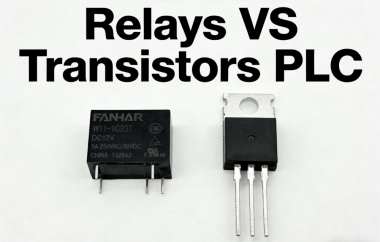
Relay output is a mechanical contact switch. Inside the PLC, the CPU energizes a small relay coil, which drives metal contacts to open or close, thereby controlling the external load circuit through these contacts. Because the contacts and the coil are isolated by mechanical movement and an air gap, complete electrical isolation is achieved. The output side is a “dry contact” and does not provide its own power supply.
Transistor output is a semiconductor, non-contact switch. Inside the PLC, the CPU uses an optocoupler for isolation to drive the conduction and cutoff of a transistor (such as a MOSFET or BJT), and controls the on-off of the external load current using semiconductor characteristics. Although there is optocoupler-based signal isolation between the input and output, the output stage itself does not have the physical isolation contacts that a relay provides.
Get more details: Relay vs Transistor PLC: What's the Difference?