How Software Rescue Helps Prevent Costly Delayed Tech Decisions

We have all been there. You are in a meeting, looking at a feature that needs to be shipped yesterday. The development team tells you there is a "quick and dirty" way to do it, or the "right" way that takes two weeks longer. The pressure is on, the investors are watching, so you choose the quick fix. You tell yourself you will go back and clean it up later.
But "later" rarely comes.
This scenario is the birthplace of technical debt, and while it might seem like a small compromise in the moment, it is one of the most dangerous threats to the longevity of your business. We have seen promising startups capsize because they ignored the leak in the hull for too long.
Today, we are going to dig deep into the real price of procrastination, explore the software project rescue strategies that can save your product, and look at how industry leaders like Jhavtech Studios are turning struggling projects into success stories.
How Delayed Tech Decisions Increase Long-Term Costs
It is easy to look at a development budget and only see the line items for new features. However, the invisible line item, the cost of poor code quality and delayed updates, is often the one that breaks the bank.
When you delay upgrading a library, ignore a refactor, or patch a bug without fixing the root cause, you are taking out a loan. And like any loan, you have to pay interest. In the software world, this interest comes in the form of slower development cycles, higher defect rates, and frustrated developers.
Recent industry data paints a stark picture. According to a 2024 report by CIO Dive, legacy tech upgrades cost the average business as much as $3 million annually. Even more alarming, research from Pega indicates that global enterprises waste over $370 million every year solely due to technical debt. These are not just numbers on a spreadsheet; they represent resources that could have been used for innovation, marketing, or hiring.
If your burn rate is accelerating while your output slows down, you are likely paying high interest on your technical debt. This is usually the stage where a dedicated software project rescue mission becomes not just an option, but a necessity to stop the financial bleeding.
The Domino Effect: Development Bottlenecks and Legacy System Challenges
The financial cost is just the tip of the iceberg. The operational cost is often where the day-to-day pain is felt most tailored.
Development Bottlenecks
Imagine trying to build a skyscraper on a foundation that was only meant for a two-story house. Every new floor you add requires massive reinforcements, causing delays. In software, this manifests as development bottlenecks. Simple features that used to take two days now take two weeks because the code is brittle. Developers spend more time reading and deciphering old, spaghetti code than they do writing new functionality.
Legacy System Challenges
As your technology stack ages, it becomes incompatible with modern tools. You might want to integrate a new AI feature or a modern payment gateway, but your legacy system simply cannot support it without a massive overhaul. You end up building "wrappers" and "adapters" that only add to the complexity.
This creates a vicious cycle. The harder it is to work with the code, the more developers dislike working on it. Pragmatic Coders reported that 58% of developers have considered quitting their jobs due to frustration with legacy tech stacks. Losing your best talent because of bad code is a hidden cost that no spreadsheet can fully capture.
Common Mistakes Business Leaders Make in Technical Planning
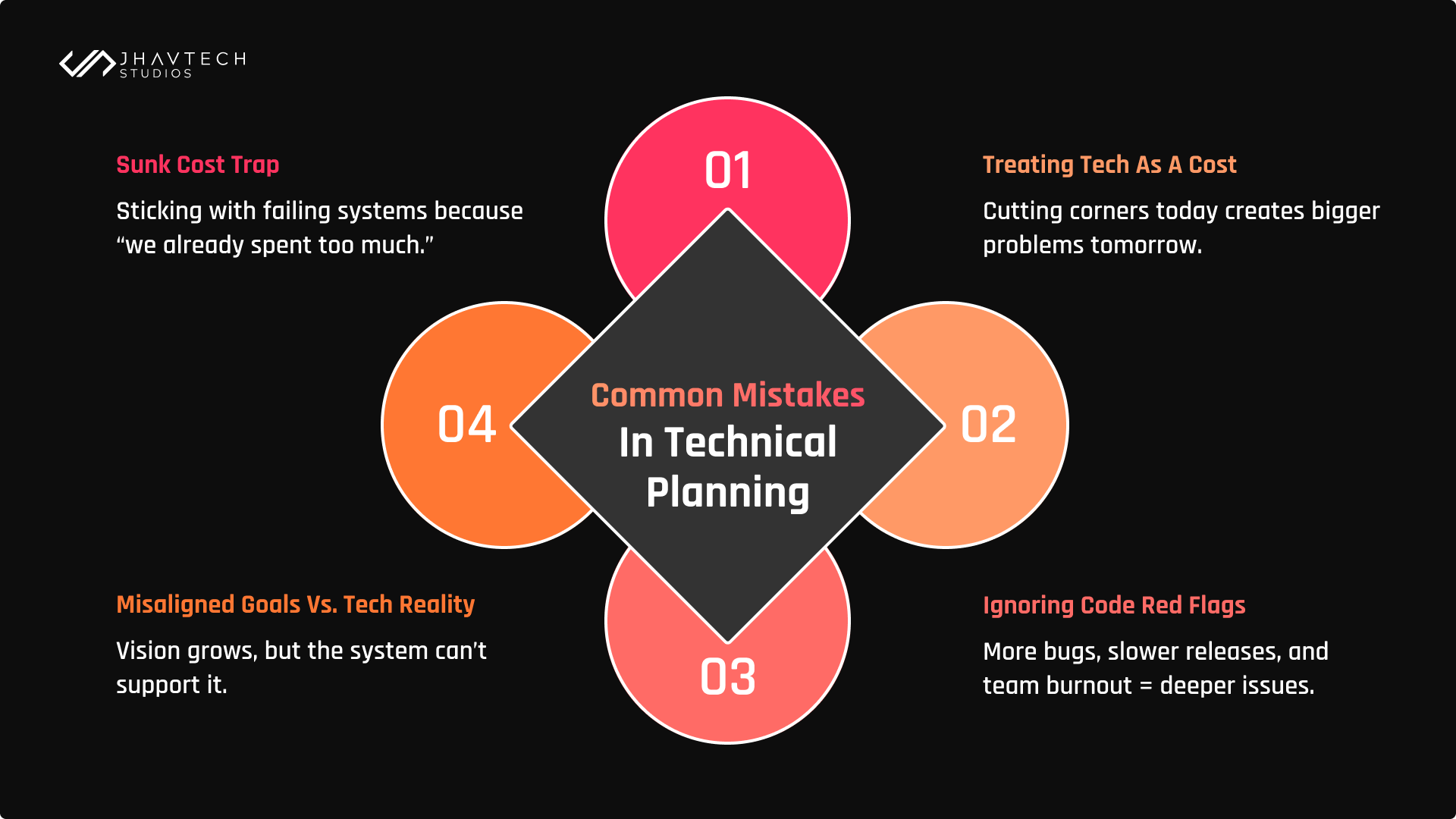
Why do smart business leaders fall into this trap? In my experience, it rarely comes from a place of malice or incompetence. It usually stems from a misalignment between business goals and technical realities.
Here are a few common mistakes business leaders make in technical planning:
The Sunk Cost Fallacy: "We have already spent $200,000 on this platform, we can't just change direction now." This mindset involving sunk cost fallacy keeps you tethered to a sinking ship. Sometimes, the most cost-effective move is to bring in a software project rescue team to assess if the code is salvageable or if a strategic rebuild is actually cheaper in the long run.
Treating IT as a Cost Center, Not a Core Asset: When you view development solely as an expense to be minimized, you incentivize shortcuts. You prioritize speed over quality, unaware that speed today equals paralysis tomorrow.
Ignoring the "Smell" of the Code: You might not read code, but you can read signs. If every release introduces new bugs, or if your team is constantly working overtime just to keep the lights on, your technical planning is failing.
Strategies to Stabilize Struggling Development Projects
If you are nodding along to these descriptions, do not panic. It is possible to turn the ship around. Implementing strategies to stabilize struggling development projects requires a shift in mindset and often, outside help.
The Assessment Phase
You cannot fix what you do not understand. The first step in any stabilization effort is a ruthless audit of the current state. This involves expert code reviews, security vulnerability scans, and architecture mapping. You need to know exactly where the bodies are buried.
Refactoring vs. Rewriting
One of the biggest decisions you will face is whether to refactor (clean up the code little by little) or rewrite (burn it down and start over).
Refactoring is less risky but takes longer to see results.
Rewriting allows for modern technology adoption but carries the risk of stalling business operations.
A skilled software project rescue partner can help you navigate this decision matrix, often recommending a hybrid approach where critical modules are strangled off and replaced one by one.
Turning Crisis into Opportunity with Jhavtech Studios
When your internal team is burnt out or lacks the specific expertise to untangle a mess, bringing in specialists is a game-changer. This is where Jhavtech Studios shines. We have carved out a niche specifically in software project rescue, helping businesses recover from missed deadlines, unstable software, and abandoned code.
Our approach is refreshing because it is rooted in transparency. One of the biggest killers of rescue projects is a lack of communication. Jhavtech Studios mitigates this with weekly meetings and bi-weekly demos. You are never left wondering if the work is actually getting done.
Consider the scenario of an automotive offer-tracking company that was struggling to get their web app live. They brought in Jhavtech Studios, and the team did not just patch holes; they built functionality to display pricing data and compare functions, ensuring the platform went live and functioned exactly as planned. This is the essence of software project rescue: it is not just about fixing bugs; it is about delivering the business value that was promised.
Why You Might Need Software Project Rescue
How do you know it is time to call in the cavalry? Look for these red flags:
Missed Deadlines: Timelines keep shifting, and "done" never actually means done.
Team Issues: Communication has broken down, and there is a lack of trust between management and engineering.
Unstable Software: Your users are finding more bugs than your testers.
Abandoned Code: Your original developer left, and no one knows how the system works.
If you identify with these symptoms, a software project rescue service is likely your best path forward.
A Roadmap to Recovery
Recovery does not happen overnight, but with the right partner, it follows a predictable path. Jhavtech Studios utilizes a four-step process that serves as a great model for any rescue effort:
Comprehensive Project Evaluation: We analyze what has been done to identify the root cause of the failure.
Clear Roadmap and Action Plan: You get a plan with quantifiable objectives. No vague promises.
Methodical Implementation: We execute the plan while maximizing resources.
Regular Progress Reports: You stay in the loop, ensuring no nasty surprises.
This structured approach eliminates the chaos that usually surrounds failing projects. It transforms a source of stress into a manageable, execution-focused operation.
Conclusion and Final Thoughts...
Delaying technical decisions is a seductive trap. It offers the illusion of speed and savings today, only to demand a heavy ransom tomorrow. The costs are real, ranging from the hundreds of millions wasted globally on technical debt to the very real risk of losing your competitive edge due to development bottlenecks.
However, a struggling project does not have to be a death sentence for your product. By recognizing the signs early, avoiding common leadership mistakes, and being willing to invest in professional software project rescue, you can salvage your investment.
Companies like Jhavtech Studios prove that even the most tangled codebases can be unraveled and turned into robust, scalable assets. Don't let technical debt sink your vision. Assess your situation, make the tough calls, and if you need help, reach out to experts who know how to navigate the storm. After all, the only thing more expensive than a software project rescue is a software project failure.