Spa Steps for Large or Elevated Spas: When You Need More Than Two Tiers
Not all spa steps are created equal — and more importantly, not all spas sit at the same height. The step set that works perfectly for a compact two-person spa will leave a taller family spa or swim spa difficult and unsafe to enter. Getting the right number of tiers isn't a style decision; it's a safety and usability one.
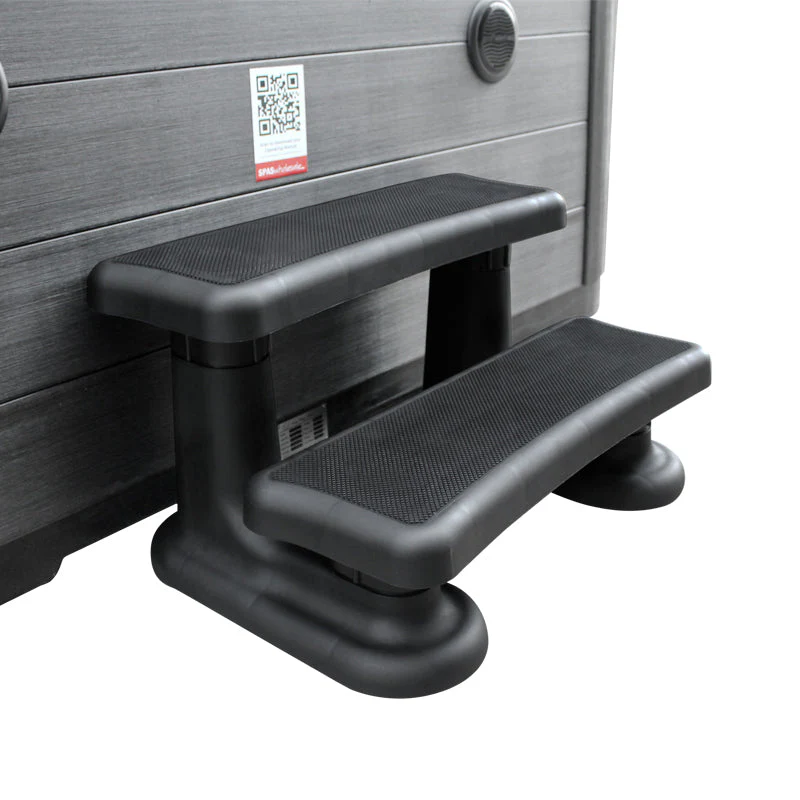
Here's how to work out what your spa actually needs, and when two tiers simply aren't enough.
Why Spa Height Varies So Much
The height of a spa cabinet — measured from the ground to the top of the spa wall — depends on the size and design of the unit. Compact spas tend to sit lower. Larger family spas and six-to-nine-person models are deeper and sit higher off the ground. Swim spas, which have significantly more water volume and depth, sit higher still.
Broadly speaking:
- Compact spas (2–4 person): Cabinet height typically 76–85cm
- Family and large spas (5–9 person): Cabinet height typically 85–91cm
- Swim spas: Cabinet height typically 120–152cm
These differences are not trivial. A 76cm cabinet is manageable with a two-tier step. A 91cm cabinet is a long way to step up from a standard two-tier. A 120cm+ swim spa requires a proper multi-tier step set — attempting to enter without adequate steps is both uncomfortable and genuinely risky on a wet surface.
The Problem With Undersized Steps
When the step height doesn't match the spa height, one of two things happens. Either the top step sits too far below the spa rim, leaving a large gap that requires an awkward high step to enter and exit. Or people improvise — using a single step, a milk crate, or stepping directly from the cabinet lip to the ground — which is how slip and fall injuries happen around spas.
Wet feet on any surface increase slip risk significantly. Wet feet on a step that's not the right height, combined with the need to swing one leg over a high cabinet wall, increases that risk further. The right step set eliminates this combination by making the entry and exit a controlled, natural movement at a manageable step height at each tier.
How to Measure for the Right Step Tier Count
The starting point is measuring your spa cabinet height accurately — from level ground to the top of the spa wall, not the lip of the shell.
As a general guide:
Two tiers suit spa cabinets up to approximately 75–80cm. Each step covers roughly 30–40cm of height, so two tiers work comfortably for compact low-profile spas.
Three tiers suit spa cabinets in the 85–100cm range — which covers the majority of family and large spa models. The 3-tier Eterna Steps bring users from ground level to spa cabinet height in three manageable steps, with each step at a comfortable rise that suits most adults without needing to stretch or lift.
Four tiers are suited to taller spa cabinets and swim spas. For spas sitting above 100cm, or for swim spas where the cabinet reaches 120cm+, the 4-tier Eterna Steps provide the coverage needed. Four tiers also make a meaningful difference for households with older adults, children, or anyone with limited mobility — the smaller rise per step requires less physical effort on each transition.
The Swim Spa Consideration
Swim spas deserve specific attention because their height is genuinely in a different category from standard spas.
A swim spa cabinet sitting at 120–152cm — common across the Spas Wholesale swim spa range — is approximately chest height for most adults when standing on the ground. Entering without proper steps requires climbing rather than stepping, which is neither dignified nor safe. A four-tier step set brings that entry height down to a manageable series of transitions that can be performed safely with wet feet.
The width of swim spa steps also matters. Swim spas are wider than standard spas, which means the entry and exit point is often further from the edge of the cabinet. Steps that are positioned correctly relative to the swim spa's entry point — not just placed approximately nearby — make the entry process consistent and predictable every time.
What Else to Check When Buying Steps for a Taller Spa
Slip resistance. The slip-resistant surface on each step is more important, not less, the taller the spa. On a two-tier setup, a slip at the top step is a short fall. On a four-tier setup for a swim spa, the consequences of a slip are more significant. Check that the slip-resistant surface covers the full step area, not just a strip at the front edge.
Stability. Taller step sets have more leverage working against them. A step set that wobbles slightly on a two-tier arrangement becomes a real concern at four tiers. The Eterna Steps are designed with a wide base footprint and sturdy frame construction — confirm that the steps sit level and stable before first use, and periodically check that the base hasn't shifted or settled.
Step depth. The depth of each step (front to back) determines how much foot surface area you have to land on. Deeper steps are more forgiving, particularly when descending from the spa with wet feet. This matters more on taller configurations where the descending movement is more pronounced.
Positioning. Place steps where you naturally want to enter and exit — which is usually at the corner of the spa nearest the access point to the deck or patio, not necessarily the nearest point to where you're standing. A step set that's slightly repositioned for natural entry flow is worth the few minutes it takes to find the right spot.
A Quick Reference
| Spa Type | Typical Cabinet Height | Recommended Steps |
|---|---|---|
| Compact 2–3 person | 76–85cm | 2-tier or 3-tier |
| Family 5–6 person | 85–91cm | 3-tier |
| Large 7–9 person | 88–91cm | 3-tier or 4-tier |
| Swim spa | 120–152cm | 4-tier |
Spas Wholesale stocks spa entry steps in 2-tier, 3-tier, and 4-tier configurations — all in the Eterna black finish, with slip-resistant surfaces and weather-resistant construction. Available for delivery across Australia.