Why Sports Probability Is Information, Not Certainty
Why Sports Probability Is Information, Not Certainty
A practical guide to reading forecasts, percentages, model updates, small samples, and uncertainty without treating a prediction as a promise.
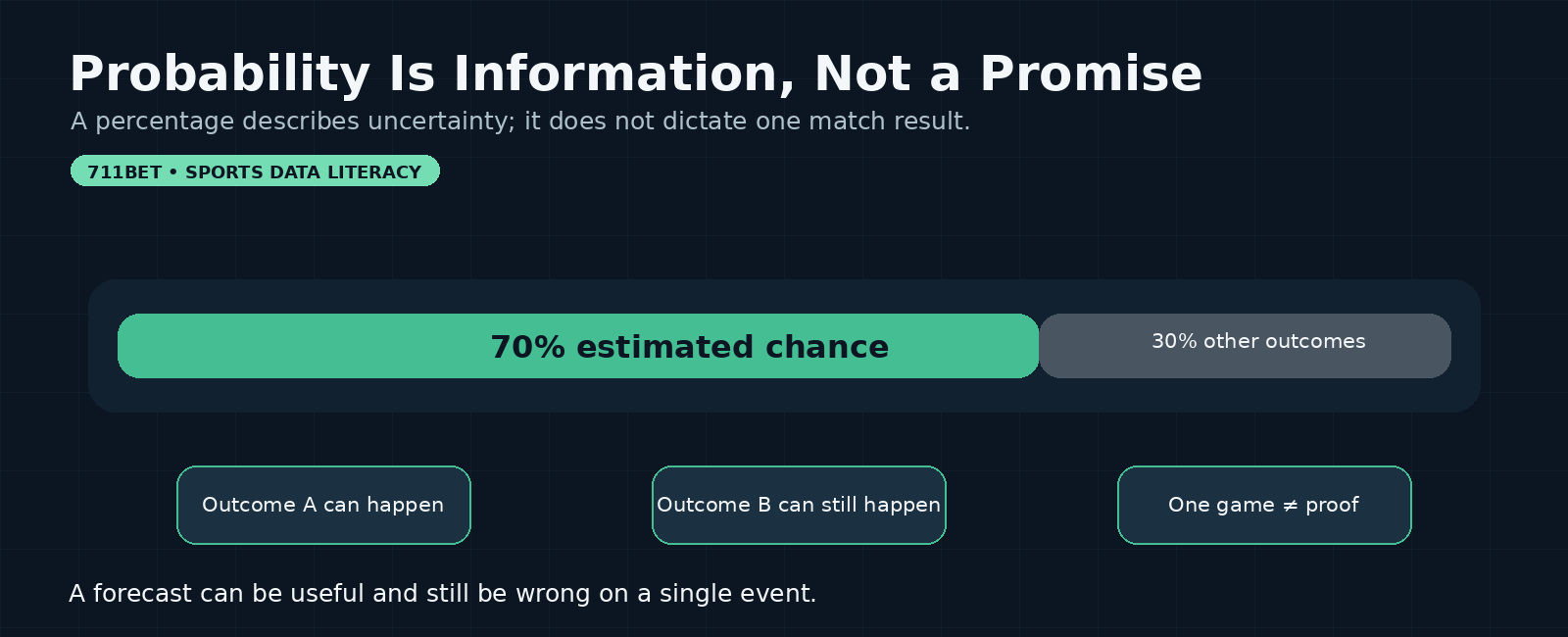
A 70% Chance Is Not a Guaranteed Result
Sports analysis often compresses a large amount of information into one small number: 55%, 70%, 82%, or some other estimated chance of an event. That number can look decisive, especially when it sits beside a team name or match graphic. But a probability is not a command telling the future what must happen. It is a way of describing uncertainty using the information and assumptions available at the time.
OpenStax describes probability as a number between 0 and 1 that reflects the degree of uncertainty associated with an event. In sports language, a 70% estimate means the event is considered more likely than not under the model or method being used. It does not mean the event has already happened seven-tenths of the way, and it does not mean the remaining 30% can be ignored.
That distinction is central to responsible sports-data reading. The 711Bet information hub is most relevant here as a contextual example of a site where readers may encounter odds, sports markets, or explanatory material. Whatever interface presents the number, the mathematical rule is the same: probability is information about uncertainty, not certainty itself.
Why a Likely Outcome Can Still Lose
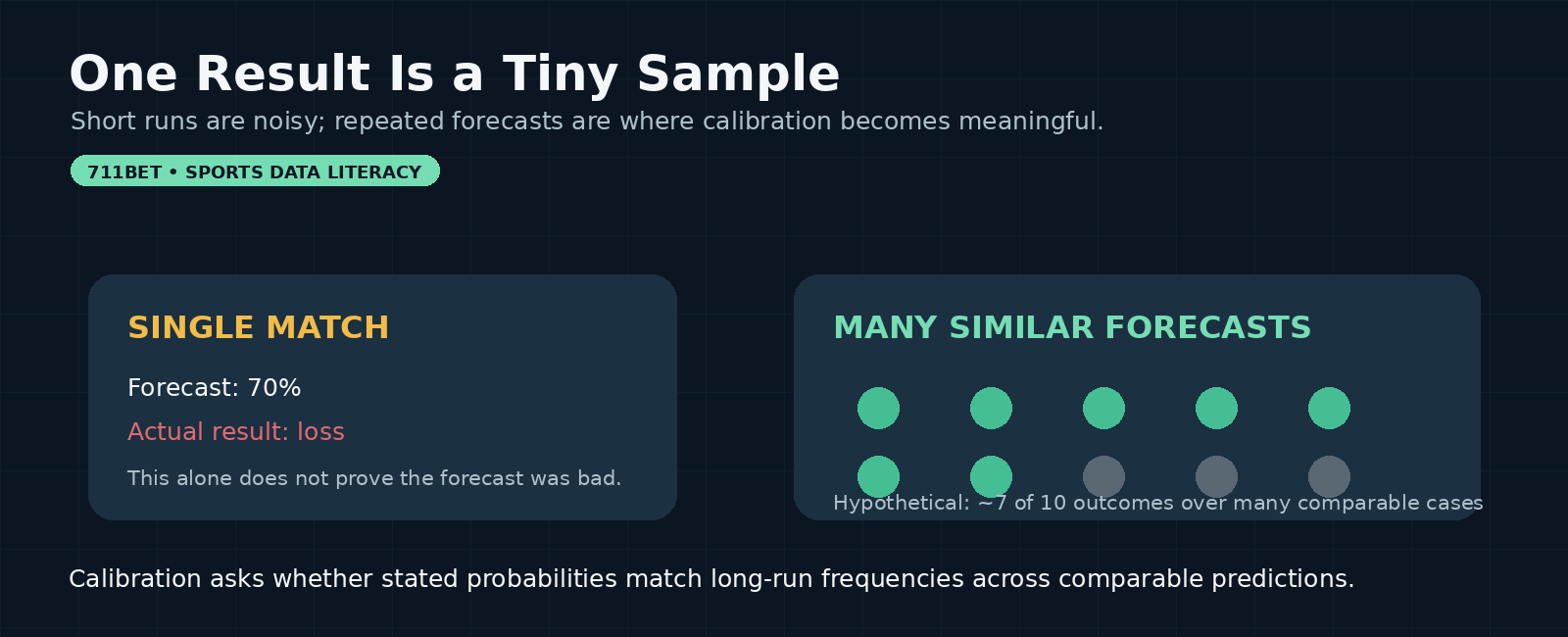
Imagine a hypothetical basketball model that assigns Team A a 70% chance of winning. If Team A loses tonight, the result may feel like a contradiction. It is not. A 30% chance of losing was part of the original forecast. Unlikely outcomes are still allowed outcomes.
This is one of the hardest habits in probability literacy: judging a forecast only by whether one prediction was right or wrong. A forecaster who says 90% and misses once is not automatically worse than a forecaster who says 51% and happens to be correct once. Single events contain too much randomness to tell us much about the quality of a probability model by themselves.
The more useful question is whether many forecasts behave as advertised. When events assigned roughly 70% probability occur about 70% of the time across a sufficiently large set of comparable predictions, the model is said to be well calibrated. Scikit-learn's probability-calibration documentation uses this same idea: predicted probabilities should correspond meaningfully to observed frequencies over repeated cases.
Probabilities Depend on Inputs and Assumptions
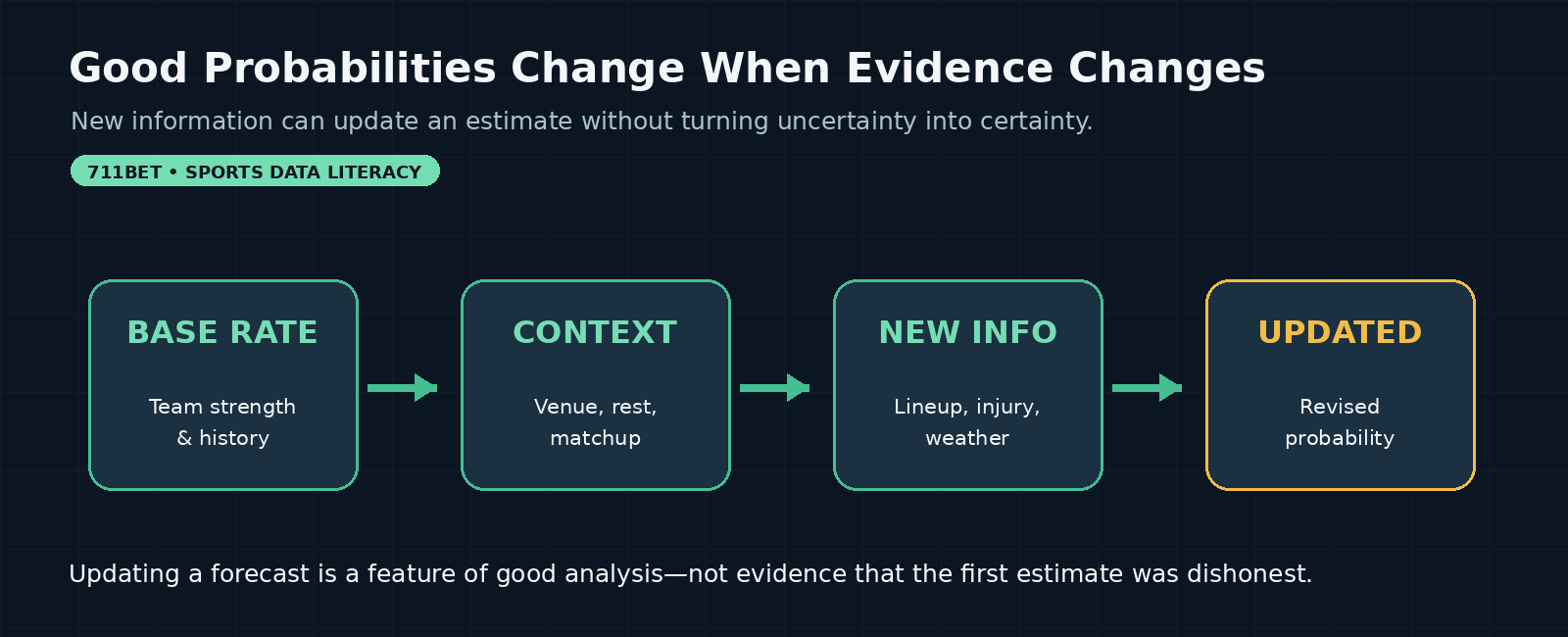
A sports probability is never floating in empty space. It is produced from inputs. Those inputs might include historical performance, player availability, rest, venue, matchup characteristics, recent form, or other variables. Different models can use different data, weight the same data differently, or make different assumptions about how much the past predicts the future.
That is why two respectable analysts can publish different percentages for the same game. One model may be more sensitive to recent performance. Another may lean more heavily on long-run team strength. A third may incorporate a new lineup report sooner. The disagreement does not necessarily mean one side is manipulating the number; it can reflect different evidence, methods, timing, or uncertainty estimates.
A useful sports-information page should therefore avoid presenting a percentage as a self-explanatory fact. The 711Bet sports guide, for example, is a better contextual destination for readers when the purpose is to understand sports-market terminology and changing odds, rather than to treat a displayed number as a promise about the final result.
New Information Should Change a Good Forecast
Probabilities should move when relevant evidence changes. Suppose a model was built in the morning and an important player was later ruled out. If that information materially affects the matchup, a revised estimate may be more defensible than leaving the old number untouched just for the sake of consistency.
This is a normal feature of probabilistic reasoning. NIST describes probability distributions as a way to represent information and uncertainty about quantities of interest. In practice, a sports forecast is also a snapshot of knowledge at a particular moment. New evidence can change that state of knowledge.
The important communication question is whether the update is understandable. If a probability changes from 62% to 54%, readers benefit from knowing that new information entered the analysis or that the model was recalculated. A changing percentage should not automatically be read as indecision; sometimes it is exactly what a responsive model should do.
Small Samples Create False Confidence
Sports produce short streaks constantly: three wins, four losses, a hot shooting week, an unusually quiet scoring run. Those sequences are real, but the sample may be too small to justify a strong conclusion. Random variation can make ordinary performance look extraordinary for a while.
This matters when evaluating prediction systems. A model that goes 8-for-10 over one weekend may simply have experienced a favorable run. Another that goes 4-for-10 may have encountered several low-probability upsets. Neither record is enough by itself to establish long-run quality.
Larger samples do not magically remove every bias, but they make calibration and error patterns easier to evaluate. Instead of asking only how many predictions were correct, analysts can examine whether 60% forecasts, 70% forecasts, and 80% forecasts behave consistently over time and whether the method becomes overconfident in certain situations.
Confidence Is Not the Same as Certainty
People often use confident language when talking about sports because confidence is emotionally satisfying. Probability analysis works differently. A model can be confident relative to another option while still acknowledging meaningful uncertainty. Even an 85% estimate leaves room for an outcome that occurs roughly 15% of the time under the model's assumptions.
Good probability communication makes that residual uncertainty visible. It avoids phrases such as guaranteed, cannot lose, lock, or certain when the underlying event is genuinely uncertain. It also distinguishes between the model's estimated probability and the real-world outcome, which remains unknown until the event occurs.
For readers, a useful mental translation is simple: replace “this will happen” with “given this evidence and model, this is the estimated chance.” That small change in wording prevents a percentage from becoming a false promise.
Four Questions to Ask When You See a Sports Probability
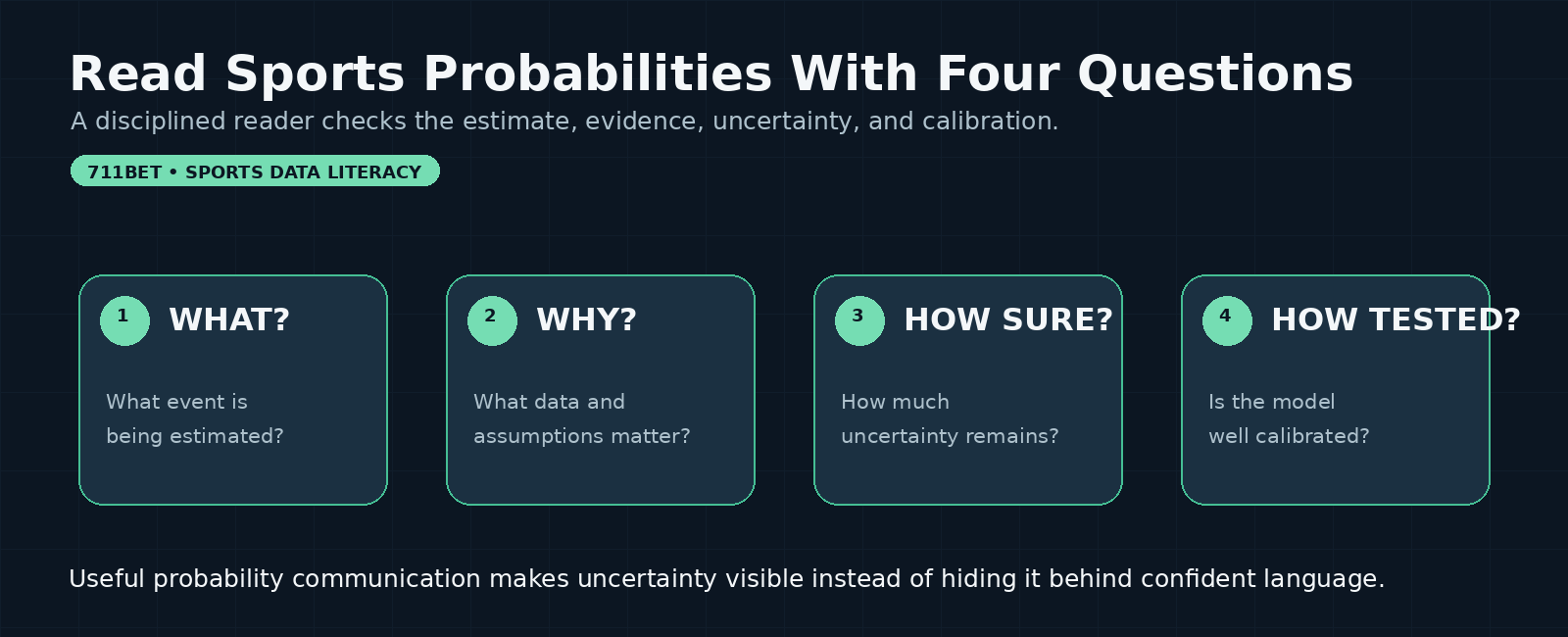
First, ask exactly what event the percentage refers to. Is it the chance of winning the match, covering a point spread, reaching a scoring threshold, or something else? A number without a clearly defined event is easy to misunderstand.
Second, ask what information could be driving the estimate. You may not have access to the full model, but basic context—such as timing, lineup news, or whether the figure is pre-match or live—can materially affect interpretation. Third, ask what uncertainty remains. A high percentage is still a probability, not a guarantee.
Finally, ask how the method performs over many predictions. Calibration, sample size, and transparent updating are more informative than a screenshot of one winning forecast. The 711Bet editorial overview is a relevant final reference for understanding the site's stated role as an independent information resource, but the broader lesson applies anywhere sports probabilities appear: evaluate the information, not the confidence of the presentation.
Final Takeaway
Probability is valuable precisely because sports are uncertain. It gives analysts a disciplined language for saying one outcome appears more likely than another while leaving room for surprises, new evidence, model error, and ordinary randomness.
The healthiest way to read a sports percentage is neither to dismiss it nor to obey it. Treat it as an estimate built from information. Ask what it measures, what evidence supports it, what could change it, and whether repeated forecasts are well calibrated. A good probability does not eliminate uncertainty. It describes uncertainty more honestly.
Sources & References
• OpenStax, Principles of Data Science — Chapter 3: Probability theory and uncertainty.
• OpenStax, Principles of Data Science — Section 3.4: Probability Theory.
• Scikit-learn User Guide — Probability calibration.
• NIST — Measurement Uncertainty and NIST/SEMATECH e-Handbook of Statistical Methods.
• Steemit FAQ — Plagiarism, Spam, and Abuse guidance.