Static Control Flooring for Data Centers, Labs, and Electronics Facilities
Introduction
Static control flooring — also called ESD flooring or anti static flooring — is engineered to conduct electrostatic charge safely to ground instead of letting it build up on people and equipment. It’s specified anywhere static discharge could damage electronics, disrupt sensitive instrumentation, or create a hazard around flammable materials: data centers, electronics manufacturing floors, labs, cleanrooms, and operating rooms.
The one thing to understand up front is that ESD flooring is a system, not a product. The flooring itself, the adhesive underneath it, the ground connection, and the footwear worn on it all have to work together. Get one piece of that wrong and the system doesn’t perform, no matter what the flooring’s data sheet claims on its own.
Axis Interior Systems has installed static control flooring across data centers, labs, and electronics facilities throughout Ohio, Kentucky, and Indiana for more than 30+ years in commercial flooring — see our static control flooring services for more on how we approach these projects. Here’s what actually goes into specifying it correctly.
Why Static Damage Is a Bigger Risk Than It Feels Like
A person walking across an ordinary floor in dry conditions can build up a static charge of several thousand volts — and most people can’t feel a discharge below roughly 3,000 volts.
That’s the problem. Modern electronic components can be damaged by discharges of a few hundred volts, and for the most sensitive parts, even less. A technician can destroy a component without ever noticing anything happened. Worse, a lot of ESD damage is latent — the part passes testing, ships out, and fails weeks later in the field, which makes it expensive and genuinely hard to trace back to a floor someone walked across.
Conductive vs. Dissipative: The Distinction That Drives Everything
Static control flooring falls into categories based on electrical resistance, and this distinction determines what’s appropriate for a given space.
Conductive — Resistance range of 2.5 × 10⁴ to 1 × 10⁶ ohms. Used in explosive or flammable atmospheres and munitions handling, where charge needs to drain away as fast as possible.
Static dissipative — Resistance range of 1 × 10⁶ to 1 × 10⁹ ohms. The right fit for electronics assembly, data centers, and labs — most ESD applications fall here.
Anti static — Resistance above 1 × 10⁹ ohms. Reduces charge generation only, with no controlled ground path — more of a baseline than a true ESD solution.
Conductive flooring drains charge to ground fast — which is desirable around flammable materials, but can be a shock hazard where personnel might contact energized equipment. Static dissipative flooring bleeds charge away more slowly and in a controlled way, which is the right fit for most electronics environments and what facilities working to ANSI/ESD S20.20 typically specify.
One thing worth flagging: “anti static” is often used as a marketing term rather than a technical one. A topical anti static treatment reduces how much charge builds up but doesn’t provide a reliable path to ground, and it wears off over time. It is not a substitute for a properly specified ESD floor system — worth watching for if a substitution gets proposed mid-project.
The Standard That Governs ESD Flooring: ANSI/ESD S20.20
ANSI/ESD S20.20 is the primary US standard for ESD control programs, and for flooring specifically, the requirement that matters is on the system — the floor and footwear combination together need to keep a person’s body voltage below 100 volts.
That framing matters: a compliant floor paired with ordinary street shoes will not meet the standard on its own. Related test methods worth knowing:
ANSI/ESD STM7.1 — resistance measurement of the floor material itself
ANSI/ESD STM97.1 — resistance measurement of the floor/footwear/person system together
ANSI/ESD STM97.2 — body voltage generation of the floor/footwear system
It’s worth specifying which standard applies and requiring post-installation testing against it in the contract. A floor that passes on paper but fails once footwear enters the equation is common enough that verification shouldn’t be optional.
Material Options for Static Control Flooring
ESD vinyl tile and sheet. The most widely used option. Conductive elements are dispersed throughout the material rather than applied to the surface, so performance doesn’t wear off. Sheet with heat-welded seams is preferred anywhere a fully seamless surface is also required, such as cleanrooms.
ESD rubber. Durable and comfortable for technicians standing long shifts, with good chemical resistance — at a higher material cost than vinyl.
ESD epoxy and resinous systems. Seamless and chemically resistant, well suited to manufacturing floors that also need to survive spills and equipment traffic. A conductive grid installs beneath the coating and ties into ground.
ESD carpet tile. Common in control rooms and network operations centers adjacent to sensitive areas, where acoustics and comfort matter more than raw ESD performance.
Raised access flooring with ESD laminate. Still the standard in traditional data centers where under-floor air distribution or cabling routing is needed.
The Ground Path Is Where Projects Usually Go Wrong
An ESD floor that isn’t properly grounded is, functionally, just a floor. A few details that make the difference:
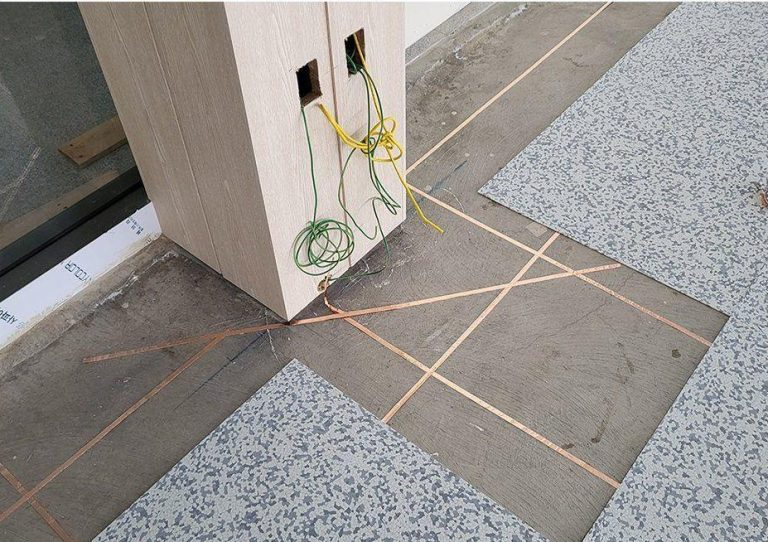
Conductive adhesive is generally required — standard adhesive can insulate the flooring from the substrate and break the electrical path entirely
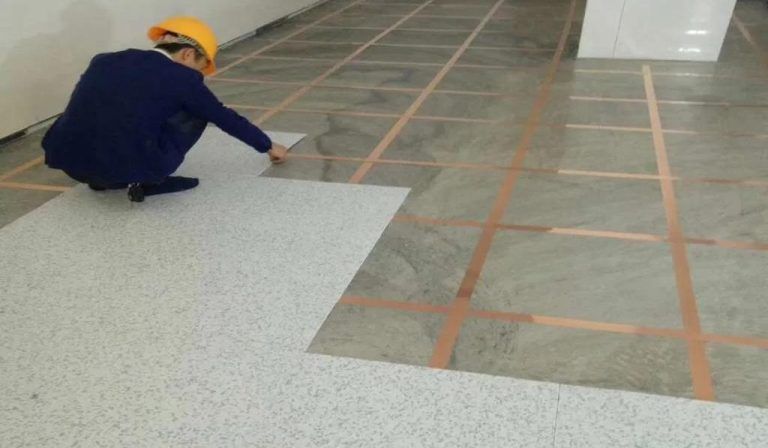
Copper grounding strips need to be laid in the adhesive at a specified frequency and connected to building ground
Ground connections should be documented and remain accessible for future verification
Testing should happen after installation, not just at the material selection stage — specify the number and location of ground connections and require resistance testing to STM7.1 on project completion
Anti Static Flooring for Server Rooms and Humidity Considerations
Static generation rises sharply as relative humidity drops, and data centers and server rooms often run drier than most commercial spaces — which increases charge accumulation right where it matters most.
ESD flooring should be specified to perform at the facility’s actual low-humidity operating condition, not just at a standard test humidity. Some products that test well at 50% relative humidity degrade noticeably at 12%. It’s worth requesting performance data at the humidity your server room or data center will actually run at, and writing that number into the specification directly rather than assuming standard test conditions apply.
Maintaining ESD Flooring Performance Over Time
Specifying and installing an ESD floor correctly is only half the job — performance can degrade over years of use if maintenance doesn’t account for it. A few things worth building into a facility’s ongoing plan