🚀 79 Votes. 50 Authors. And Still 64% Voting Power Left.
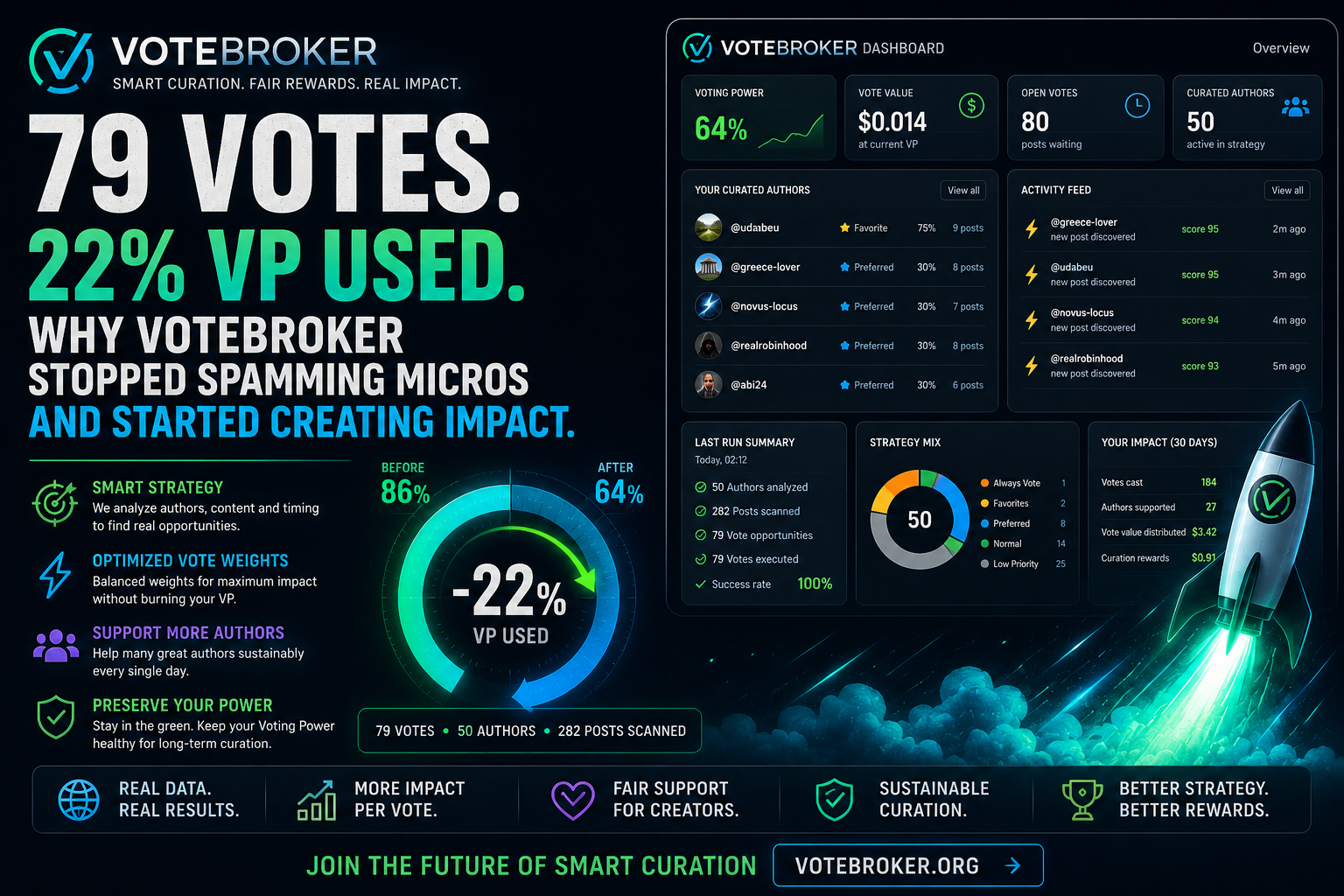
Today, VoteBroker had its first larger real-world test.
The idea behind VoteBroker was never to simply distribute as many votes as possible.
Other tools can do that too.
The real question was:
Can you support a large number of authors without destroying your own Voting Power?
Today, we got our first real answer.
The Numbers
- 50 authors analyzed
- 282 posts scanned
- 79 vote opportunities identified
- 79 votes successfully broadcast to the blockchain
And after all of that, Voting Power dropped from roughly 86% to only 64%.
Honestly, that's significantly better than I expected.
The Real Problem
Most auto-voting tools follow a simple pattern:
- Find post
- Vote
- Find next post
- Vote
- Repeat
The problem is obvious.
Eventually your Voting Power collapses and every vote becomes less valuable.
You may support many authors, but the impact of each individual vote becomes almost meaningless.
What VoteBroker Does Differently
VoteBroker does not try to vote everything.
Instead it first evaluates:
- Which authors belong to your strategy?
- How important are they?
- How many eligible posts currently exist?
- How much Voting Power is available?
- What vote weight makes sense?
Only then is a vote plan created.
The goal is not maximum activity.
The goal is sustainable impact.
The Result
- ✅ Large numbers of authors can be supported simultaneously
- ✅ Voting Power remains healthy
- ✅ Vote weights remain meaningful
- ✅ The process is fully automated
For me, this was the first proof that the underlying strategy actually works.
What Surprised Me
Interestingly, my first problem was the exact opposite.
The system was too conservative.
Some votes were only using 1% weight.
Technically correct.
Practically useless.
A good curation strategy must not only be efficient.
It also has to create visible support for the people receiving the votes.
Finding that balance took several iterations.
What's Next?
The foundation is now running:
- Vote-DNA Analysis
- Strategy Generation
- Author Prioritization
- Vote Planning
- Blockchain Broadcasting
- Analytics Dashboard
- Daily Fee Settlement Automation
The next step is making the data more visible.
- Who receives support?
- How does Voting Power evolve over time?
- Which authors generate the most engagement?
- Which strategies perform best long term?
VoteBroker is slowly evolving from a simple voting tool into a complete curation platform.
Your Thoughts?
I'd love to hear how other Steem users currently handle curation.
Do you use auto-voters?
Do you manually curate?
Would you rather support a few authors with large votes or many authors with smaller votes?
And most importantly:
What would a tool need to do before you would trust it with your Voting Power?
VoteBroker
Smart Curation. Fair Rewards. Real Impact.