History of the Taj Mahal
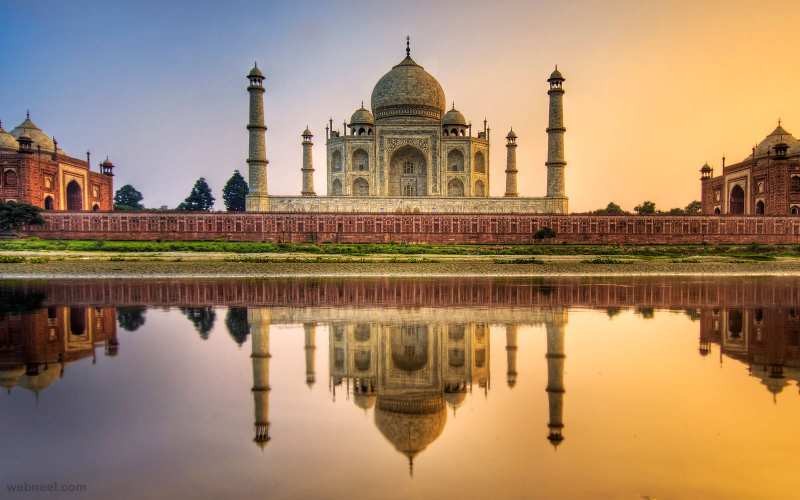
When the Taj Mahal is first seen from the light of the vast South Darwaza, it seems that the Taj can be touched by crossing the arch. But as much progress goes as per-active, the Taj moves slowly, gradually highlights (Qureshi) - four minarets in its four corners, and the red stone mosque and the 'Mehman Khan '. If you go a bit further then it will be noticed that in the middle of the fountain the quadrangle four 'Charbag' gardens, the middle of the large pond, the reflection of Taj in its water. Then the speech was stopped, the mind was lost in the Mohammedan magic The construction has ended nearly 370 years ago, millions of people have come to see Taj - everyone has come back with an inelegant feeling.
Eleven years after Taj's construction was completed, French tourist François Berniene wrote that it is one of the wonders of the world, far ahead of the Great Pyramid of Egypt. In the era, it was not a matter of summoning the 'World Heritage', but the Taj Mahal was considered one of the wonders of the world three hundred and thirty years ago. We know many things about the Taj Mahal, and many more information is unknown. What is known is that the Taj Mahal is the tomb of the beloved Begum Mamtaz Mahal (Rauja-e-Munbbara) of Shahabuddin Muhammad Shahjahan, after which the name is Tajmahal. Khurram, the third son of emperor Jahangir, was born in 1592. The grandfather grew up as the jewel of Akbar and Nayan Jahangir's eyes. Even his mother is not close to Jagtat Gossei (Bilkis Makani), son of grandson Vidhu grandfather Rokeya Sultana Begum. Although well-versed in warfare, he had many other interests, such as architecture, jewelery and crafts.
At the age of 15, he was married to Arjumand Banu Begum, the grandson of the highest court of the Darbar of Umrah, Etmedabad. The astrologers did not have a good day in the counting, after waiting five years for marriage, they were married in Dhanmondi 1612. After marriage, Arjumand Banu's new name is Mamtaj Mahal. Khurram also got the title of 'Shahjahan' after the success of the battle of Babar and Dakshina after a few years. The ties of the two were deep, Shahjahan used to go wherever he was, Mumtaz accompanied him - even during the stay in Mabar, Gujarat or Burhanpur for the war, Mumtaz was with him. During this time in Burhanpur in 1631 (ie, only three years after the Shahjahan emperor in 1628), Mumtaz died in a sudden death of his 14th child. The emperor was so broke that he could not mind in the rajakas for long. Jahanara, daughter of sixteen eldest daughter, kept her father. Momtaz was buried temporarily in the allocation of Zainabad Ahuqan from a few kilometers from the Shahi Fort in Burhanpur. After returning to Agra, Shahjahan decided to build a tomb for his Begum. According to contemporary details, the selection of the place, the appointment of architects and ecologists, the concept of monastery, ornamentation - in each case, the work started according to the emperor's order.
The Jamuna river, which has made a big turn from the bottom of the fort to the west, is a great mansion of the King of Man (Singh) of King Man Singh Singh Kachhwahah, who is a Maharattoo of the emperor. According to the name of the castle, the area is called Kaptpura. Umrah Raja (later Mirza Raja), who was then entitled to donate the land, knowing the attitude of the emperor of Jaysingh. However, the construction of a sacred tomb in the land not found in the donations received or taken as donation of Islam is not mandated, Haveli of Raja Bhagvan Das and Maa Singh's younger brother of Man Singh, Rupghsi Varagi of Atgha Khan Bazar and Haveli of Suraj Singh's son were handed over to the four Haveli Jaysingh. The documents that have been found from this document are a copy of the original document, being transferred from the 'Cavalry' archive of Jaipur and now it is protected in the bureau's State Handbook. There is no mention of whether there was any temple in this land. Apart from this, none other than Swami Ram Singh (nineteenth century) was the worshiper of Shiva, only the second person of the Kachwahah dynasty, all were priests of Mother Goddess. From a colorful design of the City Palace Museum of Jaipur, it is known that in 1735, there were 42 houses, gardens or mausoleum for the members of the royal family and the Amir-Umrah in the court. Two other documents from the arch of 'Archway' are also revealed that Jaysingh has performed the full responsibility of excavating Marble from Makharna mine and sending it to Agra.
The name of the Taj Mahal is not written officially anywhere. According to the instructions of Shahjahan during the reign of Prince and according to his plans many monumental monuments were constructed - such as two beautiful all-rounds on the banks of Ajamgarh, Shahibag palace in Amadabad, Diwani-mango, Dewani Khas and Hamam in Shahi Khela of Burhanpur, and some parts of the Lahore fort. The identity of Munusanar is available. So there is no doubt that he will have a direct impression of his thinking in building and projecting Taj.

The mausoleum of Mughal emperors was created before, like the tombs of Humayun in Delhi and Akbar's grave in the second half of Agra. But Shahjahan wanted to shape his thoughts in a different way. The three mausoleum is built in the middle of the garden but Taj is built in the north of the garden, on the bank of the river.
Though it is not officially mentioned in the charge of designing the Taj design, we are fairly sure that the Chief Architect of Taj is Ustad Ahmad Lahori. From the words 'Dewan-e-Muhindis' written by Lutfullah Muhindis, it is known that his father Ustad Ahmad earned fame as architect, technician, mathematician and astronomer, and he was not only the Taj Mahal, but also the architect of Shahjahanabad and Lalkalla in Delhi. The emperor was pleased with his work and gave him the title of 'Nadir-ul-Aasr' (the best of the world). Laharti helped Ustad Hamid Designer Md. Abdul Karim took up the responsibility of constructing the design according to Jahangir. Jahangir gave him the title of Mamur Khan (architect khan). To help him, Makhmat Khan The main structure is a bamboo brick made of special spices, a white-colored boulder over it. The main attraction of the monument is about 35 meters high dome. According to some sources, the responsibility for the construction of dome was entrusted to Turkish architect Ustad Isha and Ustad Afandi. There is no doubt about its authenticity as there is no written support available. Heavy copper plated copper of about nine'm long gold water coming from the middle of the lotus flip over the dome. Whether it is the gold ornaments of Lahore's goldsmith Kazim Khan.
The beauty of Taj's main reason is the decoration above the high door arch on the wall and four sides. The row of flowers on the bottom of the wall, very carefully relieving the flower tree - seems so breathtaking that it would look like to touch. Although flowers seem to be recognized, it is not well known. The name of the creator of Nashek Shaili Arabic script, which is inscribed on the brink of the arch, has been known only because he has written his name in two places and inside the outer wall, in fact, the name of the only scribe of this great court house and no other date or date is written. At the beginning of the reign of Jahangir, two brothers and two brothers from Siraj came to the Mughal court. The elder brother Molla Shukrala Sirajji was given the title of Afzal Khan and was elevated to the post of Chief Minister, in the special confidence of Shahjahan. He was known as the younger brother Abdul Haq Siraji Lipidi, who used to use his script in the south of the Akbar's tomb in Secunderabad. After getting the title of Amanat Khan, he was promoted to the post of Shahjahan's chief scribe.
Inside the southern entrance of the mausoleum, under the magnificent dome of the Taj, in the darkness and darkness, the mirror dome encroaching on two tomb at the first, It is said that it took ten years to complete the work of 'Pacchinter' or 'Pietra-Dura' for flowering plants, making jars on these eight stones and pieces of various color gem-stone pieces. The work of this strange 'Inale' from Tibet to Tarquez, Safiar from Kashmir, Agate from Gujarat, Karnalian from Arab country, Zadar from Kashgarh, Badakasam from Lapis Lajuli, Sri Lanka and Myanmar was completed. This works of small and big flowers on the rectangular rectangle just below the dome, and around two meters high netting surrounding them, this work has provided a completely different dimension. According to some sources, the work was done by Delhi's renowned Minkar Chirigilal. And many others, the artisans from Florence in far-flung Italy, taught the artisans of the country to work in 'Inline' with various colored stones. Most European travelers, mainly seeing this work, thought that the Taj was designed by a European.
A French gold artist, Augustus de Bordeo, worked for several years in Jahangir's court. Seeing a new type of throne he made, Jahangir gave him the title of 'Homerand'. But in 1632, Taj died before the construction began.
After the construction of Taj was completed, the Emperor made proper arrangements for his maintenance. In the vast area on the southern side, along with Taj's design, the karavansararai and katra (market) for retail and wholesale business, which are arranged for the regular cleaning and business of Taj from the rents and many income from rent to many villages. But after the Shahjahan disfigurement and house arrest after a few years, the Taj is gradually being neglected. Once it was known to have arranged aurangzeb to stop water from the roof, there is no evidence that he gave special attention to the mausoleum of his mother. However, in Begumpur, Aurangabad, he found that Taj followed the design of his chief Begum Dilars Banu's tomb, Bibi-ka-Makwara. More trouble came in the eighteenth century - First of all, the Syed brothers of Delhi, who used to loot the precious pearls, which they used to wear on the tomb of Mamtaz on Friday, in 1719. After that, in 1761, the Jatha looters took away the thick silver thread of Taj. After that, after the rebellion of 1857, there were arrangements for army buses in 'Jiloukhana', in the garden, and the 'Mahamnakhan' on the eastern side was arranged for the army officers before the entrance of Taj. The garden is destroyed, the precious stones of the fountains made of metal, the jali and the grave are taken away, and the gold plate is removed from the copper plate. Its weight or several kilos as of now Later, with the special effort of the Viceroy Lord Curzon, Taj returned much of his old glory. However, the most lasting damage to the Taj has been in recent times, when a huge refinery of petrol is built in Mathura. It is not possible to meet the damage caused by the white powder of Taj, due to the chemical glaucoma. I do not know how long the water will remain and the duration of the sunlight flowing in Kalol Kapolite.
From the fancy of a powerful emperor, the emperor gradually transformed the poetry of Taj Mahal into a symbol of tears in Birah. Shahjahan has many qualities, but he does not know whether he has written poetry, but it is undeniable that he has been able to make his nineteen year old woman in perpetual shape. It can be said that the Taj has seen - and I do not see anything.
Integrated from Anandbazar magazine
voted and resteemed by red rose
THANK YOU FOR WAITING ME TO BUILD UP MORE POWER - YOUR POST IS BEING UP VOTED NOW AND RESTEEMED.
I APOLOGIZE FOR THE DELAY
good work 0.04
come again
thank you
welcome to steemit @lovlu, best regards..
hopefully you feel at home here. 😊
@originalworks
The @OriginalWorks bot has determined this post by @lovlu to be original material and upvoted it!
To call @OriginalWorks, simply reply to any post with @originalworks or !originalworks in your message!