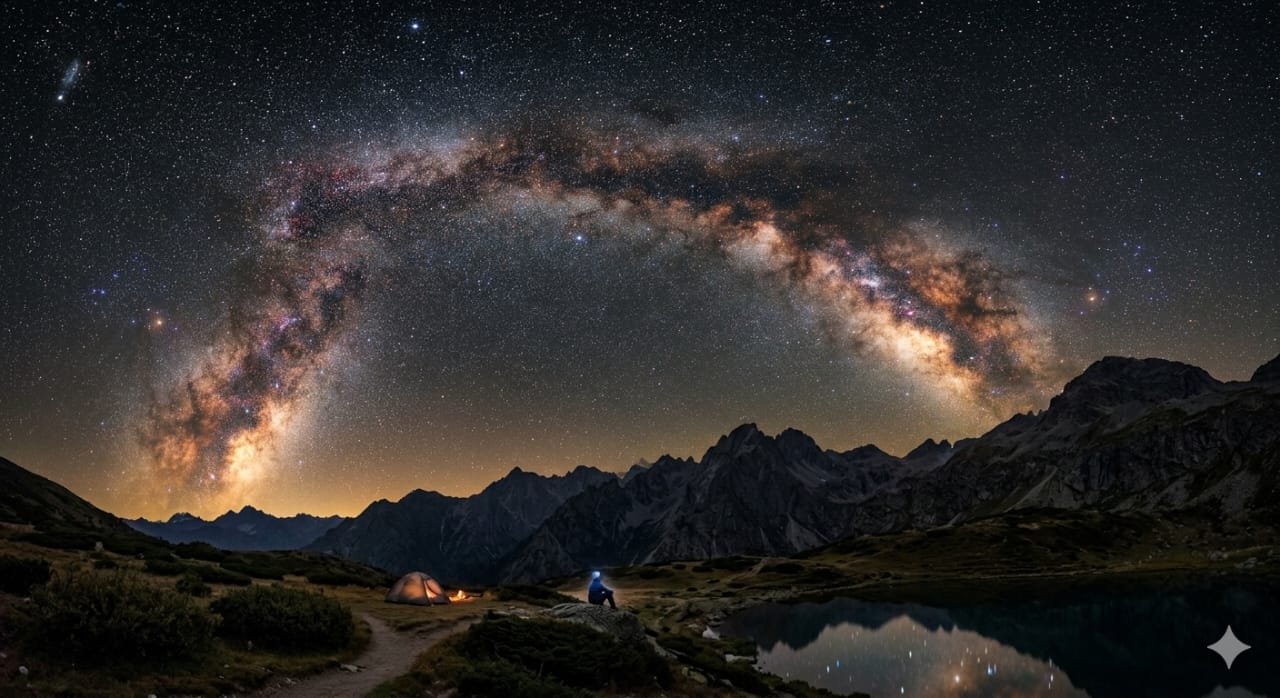
Our Milkyway Galaxy
Our Solar System, as well as billions of other stars, planets, and other celestial objects, are all part of the vast cosmic system known as the Milky Way Galaxy. It is a barred spiral galaxy, which means that it has spiral arms that extend outward from a central bar of stars. The Milky Way was given its name because it appears to be a faint, milky band of light stretching across the night sky when seen from Earth. This glowing band is actually the combined light of countless distant stars that are too faint to be seen individually with the naked eye.
The Milky Way is a huge galaxy. It is estimated to be about 100,000 to 120,000 light-years in diameter and around 1,000 light-years thick in its disk. The distance that light travels in a year, called a light-year, is about 9.46 trillion kilometers. This indicates that the size of the galaxy cannot be imagined, and it would take more than 100,000 years to travel from one end to the other even at the speed of light. Within this vast structure, astronomers estimate there are between 100 billion and 400 billion stars, along with countless planets, nebulae, and other cosmic materials.
At the center of the Milky Way lies a supermassive black hole known as Sagittarius A*. With a mass that is millions of times greater than that of our Sun, this black hole pulls heavily on the gas and stars in its vicinity. The motion of nearby stars and the radiation emitted by material falling into them can both indicate the presence of black holes, despite the fact that they cannot be directly observed. The central region of the galaxy, called the galactic bulge, is densely packed with stars and is one of the most energetic parts of the Milky Way.
The galactic disk, the spiral arms, the bulge, and the halo are some of the most important parts of the structure of the Milky Way. The majority of the galaxy's stars, gas, and dust, including our Solar System, are located in the disk. Within the disk are spiral arms such as the Orion Arm, where Earth is situated. Nebulae, glowing gas clouds, and bright young stars populate these active star formation regions known as arms. As previously stated, the central, rounded region crammed with older stars is the bulge. The galaxy is surrounded by the halo, a spherical region of globular clusters and dark matter, an opaque substance that accounts for a significant amount of the galaxy's mass. In one of the Milky Way's spiral arms, about 27,000 light-years away from the center, is our solar system. It travels around the center of the galaxy at a speed of about 220 kilometers per second. The Solar System takes about 225 to 250 million years to complete a full orbit around the galaxy, despite its incredible speed. A galactic year is the name given to this time period. Earth has completed only about 20 of these orbits since its formation about 4.6 billion years ago. In the universe, the Milky Way is not the only star. It is part of a group of galaxies known as the Local Group, which includes more than 50 galaxies. The Andromeda Galaxy is the largest and spiral galaxy that is closest to the Milky Way. The Milky Way and Andromeda will collide in about 4 to 5 billion years and eventually merge to form a new, larger galaxy. Despite its dramatic magnitude on a cosmic scale, this event will not necessarily destroy individual stars or planetary systems due to their vast distances. The Milky Way's role in the study of the universe is one of its fascinating aspects. Astronomers are able to observe its components and structure in great detail because we live inside it. However, this also comes with some difficulties because the galaxy's gas and dust can make it difficult to see faraway areas. To overcome this, scientists use different types of telescopes, including radio, infrared, and space-based observatories, to study the galaxy in various wavelengths of light.
Additionally, the Milky Way contains a wide variety of astronomical phenomena. Nebulae are clouds of gas and dust in which new stars are born, and star clusters are groups of stars held together by gravity. Within the galaxy, supernovae, which are the sudden deaths of massive stars, enrich the interstellar medium with heavy elements that are necessary for the formation of planets and life. Cosmic rays, mysterious dark matter, and magnetic fields fill the galaxy, all of which contribute significantly to its structure and development. Scientists gain insight into the formation and evolution of galaxies in general by comprehending the Milky Way. The Milky Way is thought to have been formed by the gradual merging of smaller galaxies and the accumulation of gas and dust around 13.6 billion years ago, shortly after the Big Bang. It has developed into the complex structure we see today over billions of years. In conclusion, the Milky Way Galaxy is a vast and dynamic system that serves as our cosmic home. Its immense size, intricate structure, and diverse components make it a subject of endless fascination and study. The Milky Way provides a glimpse into the grandeur and complexity of the universe, from the billions of stars it contains to the enigmatic black hole at its center. Our comprehension of this galaxy continues to deepen, shedding light on brand-new mysteries and broadening our perspective on the universe.