The Steem Curation Spectrum: How stakeholder goals shape voting
Successful Steem curation depends on two imperatives: (i.) collect curation rewards; and (ii.) protect and grow the price of Steem. The relative importance of each goal depends on the size of the account.
Introduction
In Steem's early days, buckets of digital ink were spilled over the question of "how to curate". Thinking back on it all these years later, though, it seems that all of those articles approached the subject from the perspective that there is a single "right" way to curate. Yes, individual preferences may differ, but according to those authors the "good" curator simply looks for the articles with flowery words, original work and pretty pictures, and rewards them appropriately.
What was lacking, or at least the thing that I don't remember seeing, is the recognition that different stakeholders will naturally have different baked-in incentives. In today's article, I'm going to look at two competing goals that most curators probably share, but I'm going to discuss the way that they differ for curators with different sized investments.
Let's start with an analogy. It is said that the United States Federal Reserve has a dual mandate. Namely, the Federal Reserve is supposed to control inflation at the same time as maximizing employment levels throughout the American economy. Sometimes, there is a tension between these goals, and the Federal Reserve bankers have to perform a sort of a balancing act.

Image by Google Gemini
Steem curators face a similar balancing act. On one hand, the curator wants to maximize their curation rewards during each 7-day payout cycle. On the other hand, however, the curator wants to protect and grow the value of their investment. Depending on the size of the curator's investment, the importance of these goals varies dramatically. In this article, I'm going to describe a framework for understanding the curator's incentives, and then take a look at how this framework should impact the curator's voting decisions.

The dual curation imperatives
A couple nights ago I put together some tables and charts that begin to show the relationship between account size and curation incentives. Basically, after a certain minimum size, the larger the account the more it should care about long term value and the less it should care about curation rewards.
So, let's start with a table:
| Steem Power (SP) | Category | Rewards Posture | Value Posture | Growth/Rewards Index |
|---|---|---|---|---|
| 0-600 | Below Minnow | 0.01 | 0.01 | 0.00 |
| 600-6,000 | Minnow | 0.99 | 0.01 | 0.01 |
| 6,000-60,000 | Dolphin | 0.50 | 0.50 | 1.00 |
| 60,000-600,000 | Orca | 0.25 | 0.75 | 3.00 |
| 600,000-6,000,000 | Whale | 0.10 | 0.90 | 9.00 |
| More than 6,000,000 | Blue Whale | 0.01 | 0.99 | 99.00 |
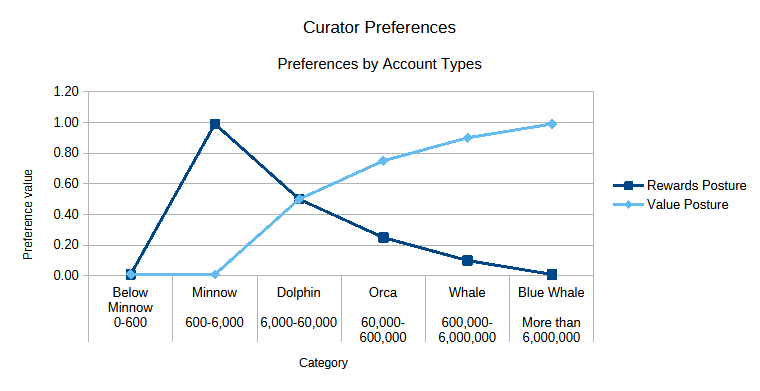
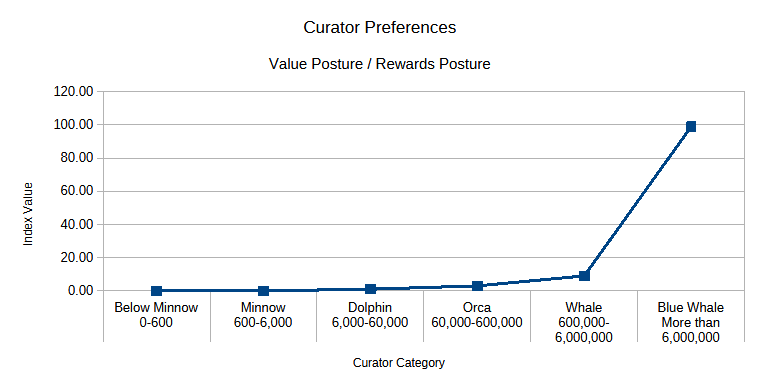
The first and second column define the account size. The third column (Rewards Posture) shows a value between 0 and 1 that indicates how important rewards are to that sized account, as a curator. The fourth column (Value Posture) shows a value from 0 to 1 that suggests how much the account would care about defending and growing the STEEM value. The last column (Growth/Rewards Index) is the Value Posture divided by the rewards posture - the relative importance of the two goals for an account of that size.
Are these numbers right? Doubtful, 'cause I completely made them up, but the general trend is almost certainly correct, so I think they're useful to reason with. Here's what they look like in a visual:
Rewards and Value Posture by account size
This post shows the independent importance of rewards and value as it relates to the size of the curation account.
Value Posture / Rewards Posture by account size
This ratio shows the relative importance of value vs. growth. In this model, value is 99 times more important than rewards to a Blue Whale sized account, and value is 1/100 as important as rewards to a Minnow sized account.
Putting it together
So, what we can conclude from this is that the curation strategy for a small account should probably be radically different from a curation strategy for a large account. The small account only needs to vote for the posts and comments that they think will attract rewards. In contrast, the large account wants to vote for things that will defend and grow the value of STEEM. Somewhere in the middle is the most complicated, because these account sizes need to think about both goals.
I'm going to use the example of the @ranchorelaxo account. I have no idea who owns this, but it's a convenient example because it's a really big account that has been around since early in Steem's history. This account currently has about 2 million SP - $140K at today's prices. At STEEM's all-time high, that same 2 million SP would have been worth about $16 million. I can only guess at how many rewards they have cashed out, but I very much doubt if those rewards have offset a decline of that size.
Clearly, an account of this size benefits much more if STEEM's value grows than if they collect some percentage of rewards while the value of their core investment collapses.
In the following sections, I'm going to look at two areas of curation strategy, according to the size of the account. The areas are: vote timing & predictability, and vote selection.
Vote timing & predictability
By driving curator profitability, the large accounts can drive ecosystem growth. |
|---|
Timing
I've already covered vote timing in an earlier post: # As a rule of thumb, the optimal voting time is before 5 minutes. And, even that post suffered from the defect that I mentioned in the introduction. It assumed that all voters are seeking to maximize rewards.
So, for vote timing up to maybe a Dolphin or Orca sized account, that post was correct. The optimal vote time is no later than 5 minutes, and the math says that it's actually some time earlier than 5 minutes.
But, what I missed in that post is that larger accounts should not be primarily focused on rewards. For larger accounts, starting somewhere around Orcas, the optimal time is probably later. With the @thoth.test account, I'm intentionally voting after about 20 minutes so that followers and smaller accounts have plenty of time to "front run" it and collect curation rewards. This is because the entire Thoth project is intended to create a vehicle that protects and grows STEEM's value.
Note that there's a significant point here. The value-oriented curation strategy doesn't just vote for the author. The value-oriented curator also votes to direct rewards to smaller curators who have identified attractive content. These are the people who actually buy STEEM and put it to use. By driving curator profitability, the large accounts can drive ecosystem growth. This point is important, and I don't think I've seen it discussed before.
In recent years, the number of Minnow sized accounts has declined from about 5,700 to about 5,000. I believe that large-sized value curators could reverse this trend by making it easy for smaller accounts to profit from buying STEEM.
How do you make people want to buy STEEM? You make it easy for them to profit from owning it. Late and predictable votes from a large voting account do that.
Predictability
By waiting 20 minutes before voting, Thoth makes its votes predictable, and creates an opportunity for even smaller accounts to get curation rewards. That won't work if the votes aren't always going to the same accounts, though. Fortunately, if a value curator wants to make their vote predictable, it is still possible.
For example: there's no reason why a curator couldn't create a daily blog post saying, "Here are the posts and comments that I'm going to vote for tomorrow". This would let smaller curators profit from their STEEM purchases, and it might even increase engagement on the selected posts.
Plus, the value curator could even collect or burn rewards from the daily blog post.
Vote Selection
In a nutshell, here's my theory of vote selection:
- Small accounts should vote for the posts that they think will get votes from bigger accounts.
- Big accounts should vote for the posts that defend and grow value for the blockchain.
The details of what that actually means is up to the individual voter.
This topic is where most of the past articles about curation strategies focus their attention, "Read every word... check for plagiarism... check for AI masquerading as a person, look for authors who display 'authenticity', etc."
My objection to this view of curation hasn't changed since 2016. It simply does not scale. How effective would Google be as a search engine if they insisted on having a human review every web site before putting it into their index? Assigning curation rewards is basically just Page rank on the blockchain. Human input needs to be part of it, but not all of it. Let's take a quick look at what automated tools do better, by looking at some of the screening that Thoth has implemented:
- Thoth can screen based on the strength of an account's follower network.
- Thoth can screen based on post engagement scoring.
- Thoth can screen based on recent Hive activity.
- Thoth can screen based on bot delegations.
- Thoth can screen based on wallet size (in SP).
- Hopefully, Thoth will eventually be able to screen for plagiarism and AI impersonation (yes, I know an AI screening for an AI, but still...)
All of these things, and others, might be important to a value curator, and they're much easier to check with automated tools. It would be ridiculously inefficient to check these things manually.
So, in the end, yes - the larger accounts with a value focus should look for the traditional things: original ideas with an attractive presentation, but that's just the table stakes. Larger accounts should also lean heavily on automation and find ways to reward the smaller curators whose collective investments can power the blockchain economic system.
Whether the smaller curators are manual curators or automatons, the job of the larger curator is to teach them what to vote for by reinforcing good choices and ignoring or penalizing bad ones.
Discussion
Delegation bots
Not mentioned so far is the phenomenon of delegation bots. As of a few days ago, Steem's leading delegation bots owned about 6% of Steem Power, but they controlled (through delegations) about 36%. This turns the incentive map above on its head. The account with Dolphin or Orca incentives controls Whale sized stake for voting purposes.
There's not really a good answer to this except to recognize it and hope that larger delegators will demand that their delegation services focus on value more than rewards. So far, that hasn't really happened, but hope springs eternal. ;-)
Thoth is my attempt to create a new paradigm where a delegation bot provides profitable returns along with an emphasis on value-based curation. I hope other options emerge to join it.
Powering up
Another thing that curators have rewarded, for as long as I've been here, is authors who power up their rewards. In my view, this is a mistake. Creating content that is worth reading/viewing is a time consuming process. Doing curation well is a time consuming process. Also, many/most authors may not even want to be curators.
If we want our curators to be effective, we should want Steem Power to find its way from an author's hands to a curator's hands. If an author wants to power-up and curate, that's great, but their primary contribution is the material that they contribute in their posts. One of Steem's original selling points was that it could reward content creation as a form of investment, but post payouts aren't very useful to an author if they can never cash out until they stop writing.
Burning rewards and voting for past-payout article
Reward burning
The #burnsteem25 initiative seems to be mostly fizzling out, but Thoth still participates in it, and some other automated initiatives have emerged: #burnsteem100, @steemburnup, and the Steem Oasis community are examples. I estimate that I'm currently dedicating 8-10% of my voting power to these initiatives. What percentage, if any, do you think that a value curator should dedicate to initiatives like these?
I don't have an answer, but in general, I think it should be higher when prices and usage are low and lower when prices and usage are high.
Permanent payouts
One of the things that authors have asked about since Steem's earliest days is a permanent payout window. Tools like @thoth.test and EverSteem from @etainclub have now proved that - with a little creativity - a permanent payout window is already possible. New tools can easily be devised. So, given that more than 99% of the blockchain's content has passed the payout window, what percentage of a value-curator's stake should go to curation of past-payout articles?
Conclusion
Winding up, the main claim I wanted to make here is that there are predictable incentives for curators with different account sizes. As a result of these incentives, curation strategies should be devised with those size differences in mind.
An overlooked implication from this observation is that larger accounts can drive value by making sure that smaller accounts can profit from their STEEM buys. This can be accomplished by voting late and by voting predictably.
A secondary claim, that I also think is important is that we should get away from the idea that only humans can curate effectively. IMO, automated curation is critical if Steem wants to scale to levels that it hasn't achieved in the past.
This is an interesting write up as a student I have to read through it line by line,I love reading.
But I believe that I will benefit from this particular idea that you share.
The picture there shows that of law and order in my country.
I love this, thank you sir for sharing
Thank you for sharing on steem! I'm witness fuli, and I've given you a free upvote. If you'd like to support me, please consider voting at https://steemitwallet.com/~witnesses 🌟
Thank you, @sduttaskitchen!
It's a pleasure to have the opportunity to read such informative content!
Great post! Featured in the hot section by @punicwax.