Percy Bysshe Shelley and his work "A Defence of Poetry"
At the beginning of the theoretical study "A Defence of Poetry" Shelley assumes that poetry is "inborn in man" and is an "expression of imagination". But there is a principle in man, and perhaps in all senses capable of acting, which acts differently from the harp and creates not only a melody but also harmony through the internal reconciliation of the induced sounds and movements with the impressions that cause them. As a self-centered social thinker, Shelley assumes that from the moment two human beings co-exist together, they begin to develop social relationships or those laws through which society builds. Thanks to them, the pleasure of feeling, virtue - from feelings, beauty - from art, truth - from reasoning and love - from human relations is created: In the early stage of art, every person observes the rhythm that is more or less which is closest to the one who gives him the greatest pleasure; but varied grades are not yet sufficiently pronounced to feel except in those cases where the ability to get closer to the wonderful (that is, we will allow it to name the relationship between the greatest pleasure and the cause) is extremely large. Those in which it exists in the highest degree are taken in the most general sense of the word; and the pleasure of their special ability to express the impact of nature and society on their inner life, is passed on to others, and seems to be doubling that. At the dawn of human society, every author is necessarily a poet, says Romantic Shelley, because the language itself is poetry; and to be a poet means to perceive the truth and the beauty, in other words, the wonderful one contained, first of all, in the relation between existence and perception, and secondly between perception and expression. In his view, poets are not only artists of language and music, of dance and architecture, of sculpture and painting: they are the founders of laws, founders of societies, inventors of crafts and teachers, who approach the beauty and truth that awareness of the forces operating in the invisible world called religion.
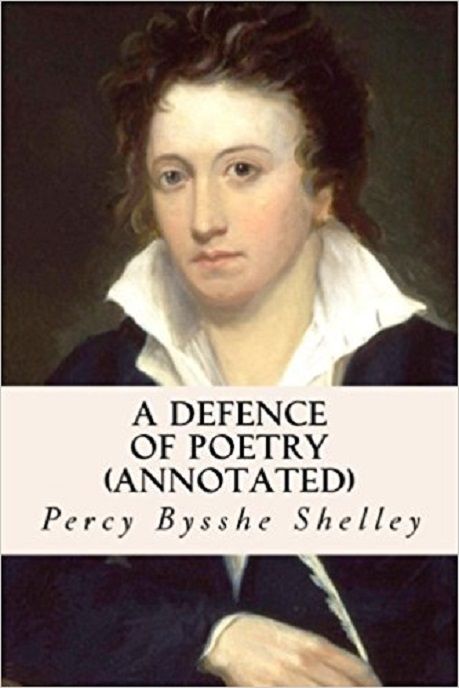
Shelly declares that the poet in his nature includes and unites the two roles of the legislator and the prophet. The poet "not only sees the present clearly, but also discovers the laws that govern it, but also grasps the future in the present ..." The author of the study spoke a typical romantic concept of the poet's mission - The poet is part of the eternal, infinite and unified the beginning of the world; for his thoughts there is no place, time, or plurality. Observing the proper harmonious alternation of the sounds in the language of the poets, as well as the connection of language and music, have led to the use of a measure of speech or a certain system of traditional forms of harmony in the language. But in order to achieve the harmony that is the soul of poetry, the poet is not obliged to adapt his language to these traditional forms, says Shelley . Every great poet inevitably brings in his version something new in comparison with his predecessors. The division of poets and prose writers is a gross mistake. The division between philosophers and poets simply does not exist. Plato was naturally a poet - the truth and splendor of his imagery and the melody of his tongue have reached the highest degree that one can imagine. As a zealous follower of Godwin's ideas, Shelley assigns social converters a place among the poets: All who revolutionize public thought are necessarily assumed not only to create something new, or because their words reveal the eternal correspondence of things through images that are part of the truth of life, but also because they create through a harmonious and rhythmic language that contains within itself the main elements of poetry; and it is the echo of eternal music of being. Shelley brings an important distinction between the scope of the historical study and the perimeter of the impact of the poetic work: A poetic work is a picture of life depicted so that it has eternal truth. The difference between a story and a poem lies in the fact that history is a series of separate events relating only to time, place, circumstance, cause and effect; and the poem creates action in accordance with the invariable beginnings of human nature as they exist in the artist's mind, suspicious of the consciousness of all other human beings ... The story of the individual facts is a mirror that darkens and distorts what should be beautiful ; poetry is a mirror that transforms into beauty what looks distorted.
Shepherd Shelley opposes "the objection that poetry is immoral". Ethics brings to light the elements that poetry creates and offers models of virtues in civil and family life ... Poetry acts on other, divine ways. It awakens and enriches the mind of man, making him a successor of thousands of strangers until then thinking of him. Poetry drives the curtain that conceals the beauty of the world and shows the familiar objects with the features of the unknown ... "Poetry develops in us the noble pursuit of transferring to the other, to understand and love it:" The great secret of any morality is love or exiting the limits of its own nature, and the merging of the wonderful that exists in the alien - not our - thought, action or personality. To be genuinely good, one must have a strong and comprehensive imagination; he must be able to imagine that he is in the place of another and of many others; the pains and joys of his likeness must become his own. Imagination is the great weapon of moral perfection; and poetry contributes to the investigation by influencing the cause. Every big poetry is infinite, he says, it's like the first acorn that contains the germ of all the future oaks. We can remove the envelopes one after the other and never reveal the true beauty of the meaning that lies within them. A great poem is an eternal spring of wisdom and beauty; and when a person or an epoch exhausts all of her divine emanation, which they are able to perceive, others come after them and they discover in them a new and new beauty that they did not expect and could not imagine. At the end of "A Defence of Poetry," the English romantic poet announces the poetry of the most faithful precursor, companion and follower of the awakening of every great nation to make a gracious change in their ideas or public order- At such times, our ability to perceive and convey to others the deeply emotional perceptions of man and nature ... The most famous writers of our time measure the grandeur of human nature and penetrate into its depths with all-round and unusual insight, and they themselves may be most astonished at its manifestations because they are not as manifestations of their own spirit as the spirit of the era. The poets are the priests of the insidious inspiration; the mirrors reflecting the giant shadow that the future throws over the present; the words that express what they themselves do not understand; the battle tubes that call on a struggle, but do not feel what they inspire; the power that moves others, but it itself remains motionless. The poets are the unrecognized legislators of the world.
Fantastico!simplemente fantastic
Thank you :)