The Bell And The Hush part one
Part One: The Fading
CHAPTER 1
The Night the Bell Cracked
In the village of Thistlewick, everyone agreed that the Harrowmere twins had been born on the strangest night in memory.
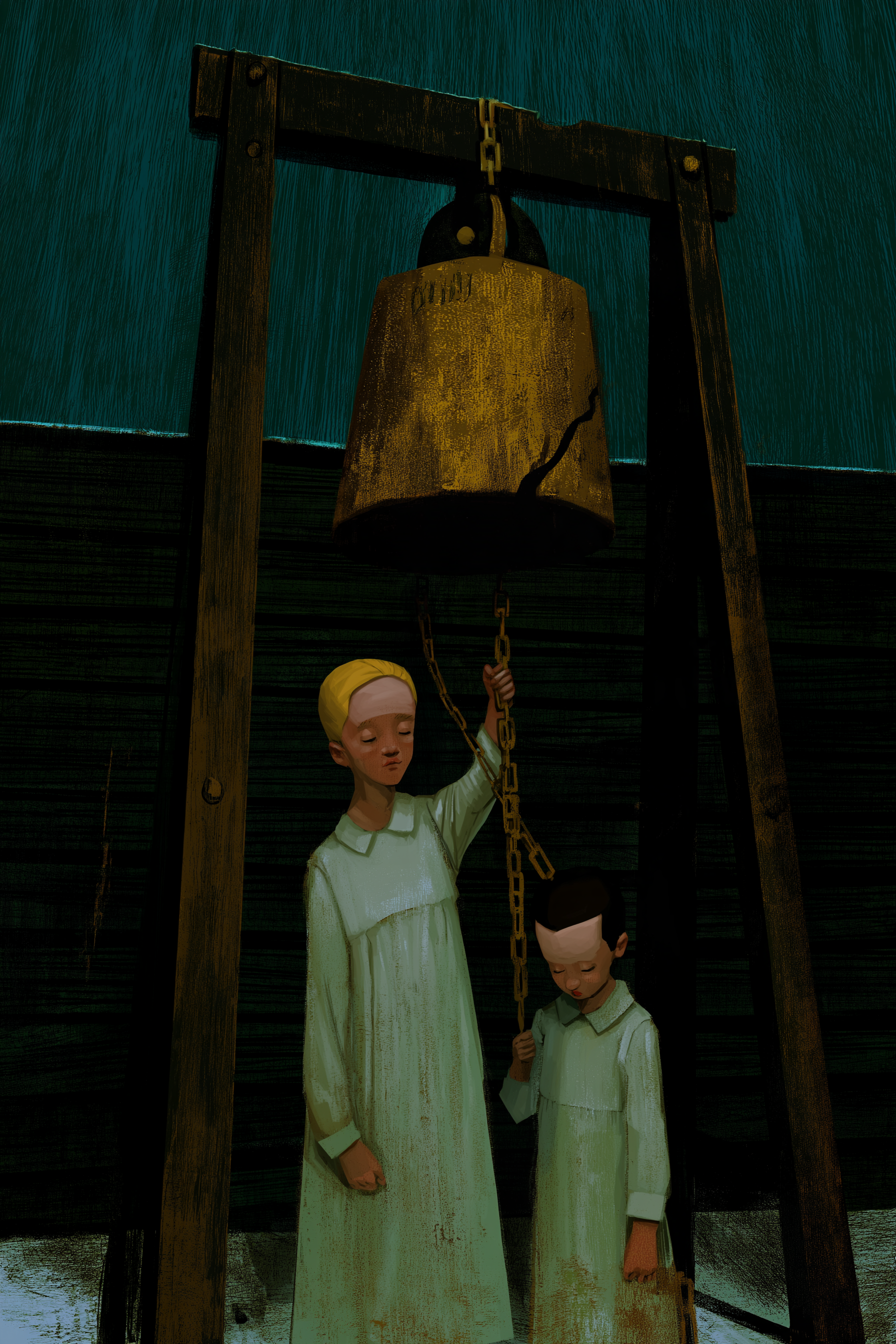
It had been sixteen years ago to the day. The great Sun Bell of Solenne, which had rung at dawn and dusk for a thousand years, had cracked from lip to crown. Its last note was so wrong that every dog in the valley howled until morning, and milk curdled in the pails, and old Mrs. Tarrow swore the moon had flinched. In the Harrowmere cottage, at the very moment of that terrible sound, two babies arrived. One came out laughing and the other came out silent, and neither of them ever quite stopped being that way.
Now Maren Harrowmere sat on the cottage roof with her bare feet dangling over the eaves, humming to herself. The hum made the air around her glow a faint gold, like the last inch of a candle. She had learned years ago to do it only when nobody was looking.
“You’re doing it again,” said her brother from the chimney’s shadow.
Fenn Harrowmere was hard to see even in daylight. He had a way of standing where the light was thinnest, so that people sometimes walked into him and apologized to the wall. His hair was as dark as Maren’s was fair, and his face, when he forgot to guard it, was startlingly open, a face made for listening.
“It’s our birthday,” said Maren. “I’m allowed.”
“It’s also the evening the color went out of the Milligans’ barn.”
She stopped humming. He was right, and she hated that he was right.
Over the last few weeks the world had been draining, slowly, like a watercolor left in the rain. The Milligans’ barn had been red and was now the pink of old gums. The hills had been green and were now the gray-green of dishwater. Even the sunsets had come out thin, the way tea does when you reuse the leaves. Nobody else in Thistlewick seemed to see it. Ask them and they would say, “Well, it’s autumn,” and go on with their washing.
“Gran says it’s just autumn,” Maren said, without conviction.
“Gran hasn’t slept in a week.”
That was true too. For seven nights their grandmother Odalys had sat up at the kitchen table with a great ledger open in front of her, writing names in her small, cramped hand, then reading them aloud under her breath, over and over, like a woman counting stitches. Names of neighbors. Names of cousins. Names of the dead. When Fenn had asked what she was doing, she had said, “Practicing,” and given him a slice of honey cake, and that had been the end of it.
Below them, the village square lay in the dusk. A stray cat with a torn ear, Pepper, who slept on the Milligans’ wall and belonged to no one, was watching the lane with her ears flat. Somewhere a shutter banged. Then it did not bang again, and the silence that followed had a strange, tight, listening quality, like the pause before a sneeze.
The evening bells did not ring.
Maren looked at the church tower. The bellrope hung still. “Fenn,” she said. “Who rings the vespers?”
“Old Tobin. He never misses.” Fenn stepped out of his shadow at last, and his face had changed. “Maren, listen.”
A sound crept up the valley road, soft and long: shhhhhhh. Like a great hand smoothing a bedsheet. Like the sea turned to a whisper. A fog came with it, thick and colorless, rolling between the hedgerows, and it swallowed the far end of the lane as though the lane had never been there.
The stray cat fled. Every dog in the village began, very quietly, to whimper.
It was the first time in years that Maren had seen her brother afraid. He gripped the roof-tiles with both hands.
“Whatever’s in that fog,” he whispered, “isn’t making the noise. The noise is what it does.”
CHAPTER 2
Erased
The fog took the Milligans’ barn first.
It did not burn the barn or knock it flat. The barn simply became less true. Its edges softened, then its boards went blank as paper, then the whole shape of it thinned and thinned until there was only a rectangle of flat gray on the hillside where a barn had been. Old Milligan came out onto his porch with his pipe, looked at the empty field, and said, in a puzzled voice, “Now, what was I going to do with that field?”
He had forgotten the barn had ever existed. He had forgotten the pipe was lit.
“Down,” said Fenn hoarsely, and pulled his sister off the roof. They hit the vegetable patch in a tumble of turnip tops and ran for the kitchen door.
The cottage was blazing with light. Every lamp their grandmother owned was lit, and she was moving through the rooms like a general, snatching down shawls, stuffing bread into a satchel. Odalys Harrowmere was a small, hard woman with white braids and a face like a walnut, and in sixteen years neither twin had ever seen her hurry.
She did not ask what they had seen. She did not say, I was afraid this would happen. She said only, “How long?”
“It’s at the Milligans’,” said Fenn. “It’s taken the barn. Gran, it took the barn.”
“Then we’ve minutes.” She pressed something cold into Maren’s palm: an iron key on a leather cord, plain and heavy and old. Into Fenn’s hand went a folded letter, sealed in wax. “You will not read that until you are far from here. You will go north to the port of Ferrowgate. You will ask for the Lantern Wardens.”
“Gran, what’s happening?”
Odalys knelt, joints cracking, and took both their faces in her rough hands. Up close her eyes were wet, and she held them a moment too long, as though memorizing.
“I have kept your names for sixteen years,” she said. “I kept them safe from things that eat names. Now I need you to keep each other’s. Whatever happens, say it out loud. Every day. Promise me.”
“Promise what?”
“Promise.”
“We promise,” said Maren, and Fenn nodded, white to the lips.
The lamps guttered. The fog pressed itself against the windows, and where it touched the glass, the glass went pale and thin and strange.
Odalys stood. She smoothed her apron and turned to face the front door with a straight back. Her voice, when it came, was steady as a paving stone.
“Go out the back. Through the garden and over the wall. Now.”
“I’m not leaving you!” Maren’s voice cracked.
“You are.” Something flashed in the old woman’s face, love and fury together. “Fenn. Take her.”
Fenn took his sister’s hand. Later he would not be able to say whether he had chosen to, or whether his body had chosen for him. He only knew that he was dragging Maren through the kitchen, past the bread-crock and the stove and the honey cake set out for the birthday, out into the cold garden where the roses hung gray.
Behind them the front door swung inward. They heard the fog pour in like water into a boat.
The last thing they heard was their grandmother’s voice, ringing out clear and fierce across the dark: “You’ll not have them!”
Then the cottage was quiet, and when Maren looked back over the garden wall, it was a rectangle of gray.
She opened her mouth to scream. Fenn’s hand came down over it. His other hand rose, and the darkness around them thickened like ink in water, and every sound Maren made, every wild, tearing, animal cry of grief, went nowhere at all.
He held her for a long time in that pocket of silence, while the fog.
Ill do part 2 if want it. Xxx