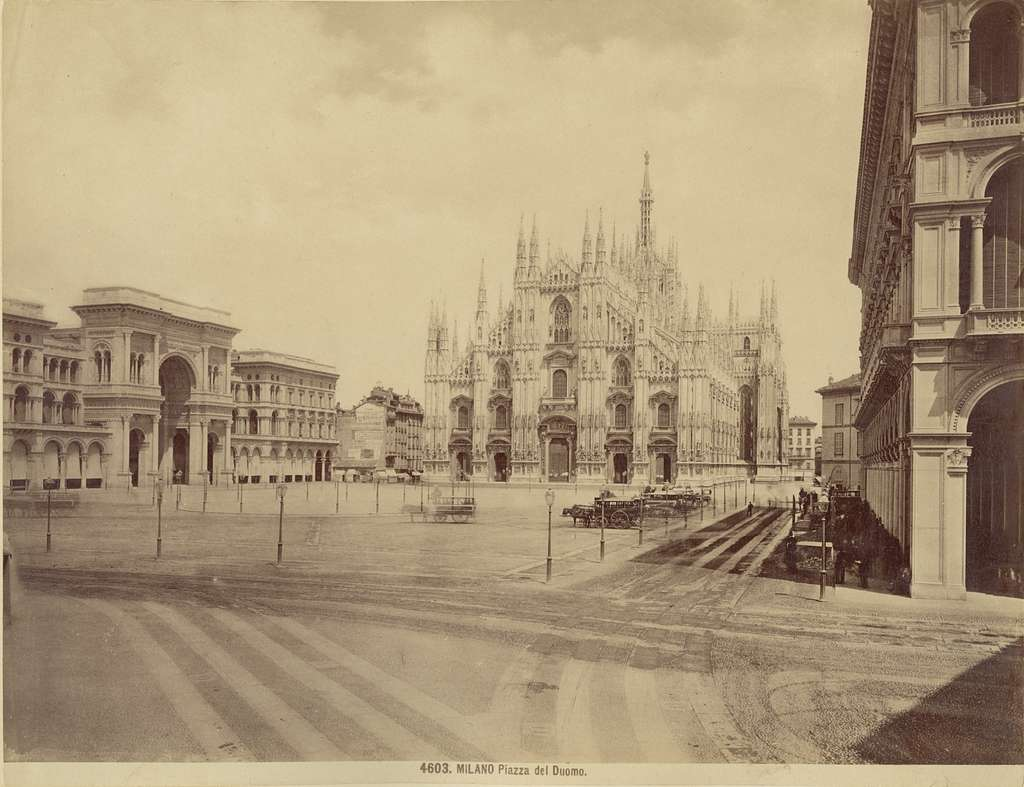
Tartarian Buildings and Architecture. 13
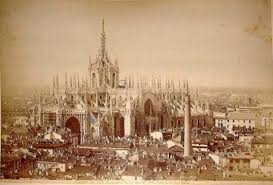
This historical photograph shows the Duomo di Milano (Milan Cathedral) in Milan, Italy, and was taken in the late 19th century, likely around 1882–1885.
Location and Perspective
The image was taken from an elevated vantage point, specifically from the bell tower of the Church of San Carlo al Corso (completed in 1638), looking west toward the cathedral.
Key Landmark: The Santa Radegonda Chimney
The prominent tall, thin column visible on the right is actually the chimney of the Santa Radegonda thermoelectric plant.
• Significance: Opened in 1883, this was the first power plant in continental Europe.
• Demolition: Its presence is a key dating clue, as it was demolished in the early 20th
century (c. 1926) when the area was transformed for the Odeon cinema.
Dating the Photo
• The Cathedral: You can see scaffolding around the main spire, as construction and restoration on the Duomo's complex Gothic exterior continued throughout the 19th century.
• The Era: Photos from this specific series by photographers like Giacomo Brogi are typically dated between 1880 and 1890, capturing the transition from the industrial revolution to modern Milan.
The building in the photograph is the Duomo di Milano (Milan Cathedral). Its construction was a monumental undertaking that spanned nearly six centuries.
When Was It Built?
• Groundbreaking: Construction officially began in 1386 under the direction of Archbishop Antonio da Saluzzo and the Duke of Milan, Gian Galeazzo Visconti.
• Intermittent Progress: For hundreds of years, work stalled due to lack of funds, wars, and political shifts.
• Completion: While the main facade was finished in 1813 by order of Napoleon Bonaparte, the cathedral was not officially declared "complete" until the final bronze door was installed on January 6, 1965.
How Was It Built?
• Materials: Unlike most buildings in the region that used terracotta brick, the Duomo was constructed with a brick core covered in rare, pink-hued Candoglia marble.
• Logistics (The Canals): To move the massive marble blocks from the quarries in Val d’Ossola to the landlocked city center, a specialized network of canals (the Navigli) was dug. These allowed barges to transport stone directly to the construction site.
• The "Cathedral Factory": The project was managed by the Veneranda Fabbrica del Duomo, an organization founded in 1387 that still exists today to maintain the building.
• Expertise: Over 78 different architects and engineers from across Europe were consulted. This international collaboration brought "International Gothic" influences to Italy, utilizing complex flying buttresses to support the immense height and weight of the marble walls.
This prolonged process was so famous that it inspired the Milanese expression "lungo come la fabbrica del Duomo"—meaning something that seems never-ending.