Tartarian Buildings and Architecture. 16
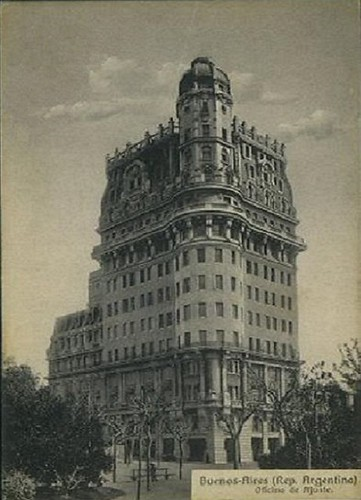
This iconic building is the Railway Building (also known as the Edificio de Ferrocarriles), located in Buenos Aires, Argentina.
Where is it?
• Address: At the corner of Avenida Paseo Colón and Adolfo Alsina.
• Neighborhood: It is situated in the Monserrat neighborhood, a historic area of the city.
• Current Use: Today, it is part of the Ministry of Economy of Argentina.
When was it built?
• Construction: It was built circa 1907–1910.
• Significance: At the time of its completion, it was considered one of the city's first "skyscrapers".
• Original Purpose: The building was originally designed as offices for various British-owned railway companies operating in Argentina, including the Great Southern Railway.
The "Oficina de Ajuste" (Adjustment Office) text on the vintage postcard refers to one of the railway administration offices that was housed there.
The Railway Building (Edificio de Ferrocarriles) was a monumental undertaking for its time, representing a massive leap in scale for South American construction.
Scale of Construction
• Height: It stands approximately 80 meters (262 feet) tall. At the time of its completion, it was the tallest building in Buenos Aires and arguably all of South America, holding this title until the Galería Güemes opened in 1915.
• Floors: The structure comprises roughly 16 levels: a basement, a ground floor, 12 upper office floors, and a multi-story tower/lookout at the top.
• Footprint: The building was constructed on a complex double lot with a 7-meter slope difference between the streets, requiring advanced engineering to level the foundation.
Materials & Methods
While the exact "bill of quantities" (e.g., specific tons of steel) for the office building itself is not public record in the same way as the nearby Retiro Station (which famously used ~8,000 tons of British steel for its train shed), the Railway Building's construction was equally cutting-edge:
• Steel Skeleton: It was one of the first buildings in Argentina to use a rigid steel frame structure. This technique, imported from the "Chicago School" of architecture, allowed it to reach heights that traditional masonry could not support.
• Zinc Dome: The iconic octagonal bulbous dome is clad in zinc sheets, a material chosen for its durability and ability to be molded into complex shapes.
• Imported Components: Like most British railway infrastructure in Argentina during this period, the structural steel and ironwork were likely manufactured in England (often Liverpool or Glasgow) and shipped to Buenos Aires for assembly.
The building was designed by the British architectural firm Conder, Chambers & Thomas.
• Architects: Eustace Lauriston Conder, Paul Bell Chambers, and Louis Newbery Thomas.
• Style: They adapted the Edwardian Baroque style popular in England at the time, specifically modeling it after the Ansonia Hotel in New York City to achieve its massive, imposing presence.
• Context: This firm was the "go-to" choice for British railway companies in Argentina; they also designed the nearby Railwaymen’s Institute.
The Workforce & Labourers
While specific payroll records for this building are lost to history, the workforce that built it (c. 1907–1910) was representative of the massive immigrant wave transforming Buenos Aires.
• Demographics: The labourers were almost exclusively immigrants, primarily from Italy and Spain. In 1910, foreigners made up a huge portion of the city's construction workforce.
◦ Italians typically dominated the masonry, stone-cutting, and bricklaying trades.
◦ British specialists likely handled the installation of the imported steel skeleton and technical engineering tasks, as the structural steel was prefabricated in England (likely Liverpool) and shipped over.
• The "Navvies": While this was an office building, it was built by railway money. The term "navvy" (navigator) usually referred to the rough labourers building the tracks across the pampas. The urban workforce here would have been more skilled in vertical construction but faced similar hierarchies: British engineers at the top, immigrant labourers handling the heavy manual load.
Accidents & Risks
Unlike the railway lines themselves—which were notorious for fatal accidents involving explosives and derailments—specific casualty records for the construction of the Railway Building itself are not widely documented in public archives. However, the project was not without its scares:
• The "Leaning" Scare: There was a significant structural alarm during or shortly after construction. A local evening newspaper published a report claiming the building was tilting towards the Rio de la Plata (the river).
    ◦ This caused a public sensation, as the building was built on a ravine slope with a massive height for its time.
    ◦ While it did not collapse, this fear highlighted the risks of building such a heavy steel-framed "skyscraper" on the soft, muddy soil of the riverbank.
• General Conditions: Construction in Buenos Aires in 1910 had virtually no safety nets. Fall protection was non-existent, and "scaffolding" was often just wooden planks. Serious injuries from falls or falling materials were common daily occurrences on high-rise sites, even if they didn't make the headlines like a train crash would.