Tartarian Buildings and Architecture. 9
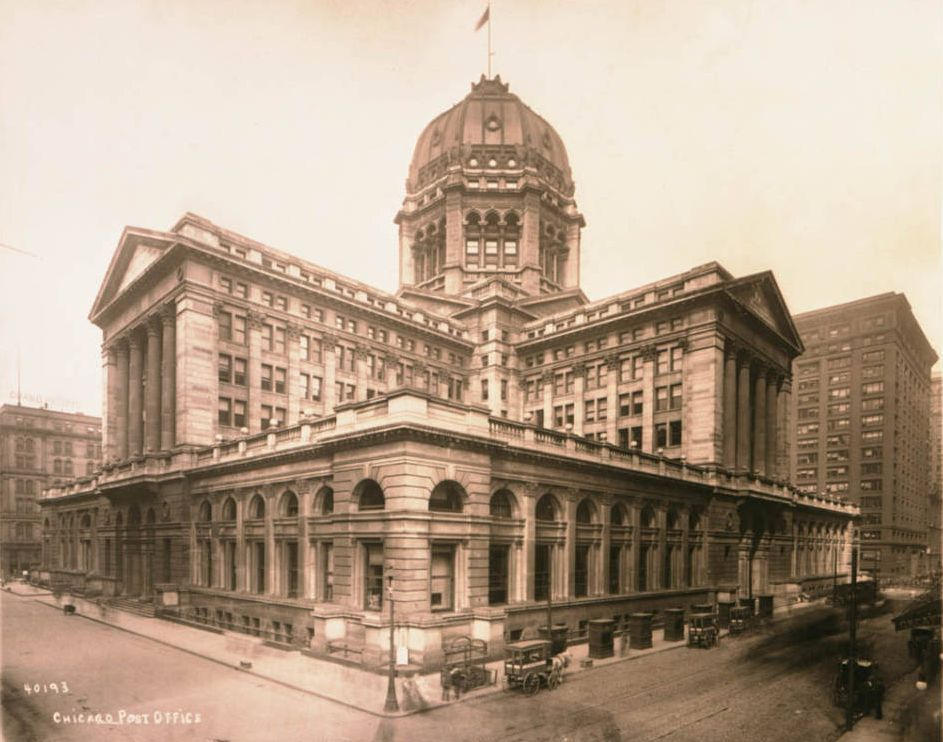
The image displays the Chicago Federal Building, also known as the Federal Building and Post Office, which stood in Chicago's Loop neighbourhood.
Building Overview
• Purpose: It was constructed to house the Midwest's federal courts, main post office, and other government bureaus.
• Design: Designed by architect Henry Ives Cobb in the Beaux-Arts style.
• Construction: Built between 1898 and 1905.
• Location: It occupied the city block bounded by Dearborn, Adams, and Clark Streets, and Jackson Boulevard.
Architectural Significance
The building was a monumental landmark, notably for its massive central dome.
• The Dome: Rising nearly 300 feet high, the gilded dome held an additional eight floors of office space.
• The Rotunda: Inside, an octagonal rotunda with a 100-foot diameter was larger than the one in the U.S. Capitol in Washington, D.C..
• Interiors: The interior was lavishly decorated with Tennessee and Vermont marble, mosaics, and gilded bronze.
Demolition and Legacy
Despite its grandeur, the building faced structural issues and became functionally obsolete by the mid-20th century.
• Demolition: The structure was demolished in 1965.
• Replacement: It was replaced by the Chicago Federal Center, which includes the modernist Kluczynski Federal Building designed by Ludwig Mies van der Rohe.
  Imperial & Global Forum +3
Chicago’s construction happened in massive waves rather than a steady trickle:
• 1872–1879 (The Great Rebuilding):
◦ Immediately after the fire, 10,000+ building permits were issued.
◦ By 1875 (just 4 years later), almost no traces of the fire remained as thousands of stone and brick structures replaced the old wooden ones.
• 1880–1899 (The Skyscraper Boom):
◦ This era saw the birth of the "Chicago School" of architecture.
◦ By 1890, the population had tripled to one million, requiring hundreds of new high-density commercial buildings.
◦ Major landmarks like the Home Insurance Building (1884) and the Auditorium Building (1889) were completed during this surge.
• 1900–1929 (The "Golden Age"):
◦ This was the city's most significant expansion for residential housing.
◦ The Chicago Historic Resources Survey identified over 17,000 buildings still standing today that were built before 1940 and carry "historic importance".
◦ A massive portion of Chicago's current housing stock—roughly two-thirds—was built before 1960.