Your App Doesn’t Need More Features — It Needs Better Maintenance

We have all been there. You are sitting in a strategy meeting, looking at your user retention numbers, and someone suggests the inevitable: "We just need to add that one new AI-driven feature, and users will flock back." It is the classic "more is more" trap. In the race to dominate the App Store or Play Store, businesses often treat software like a Christmas tree, constantly hanging new ornaments on branches that are already starting to sag.
But here is the hard truth that many developers and agencies won't tell you: your app is likely suffocating under the weight of its own "cool" features. While you are busy building a shiny new interface, the foundation is cracking. Users do not leave apps because they are missing a feature; they leave because the app crashed, took six seconds to load, or felt "clunky."
If you want to win in today's digital economy, you need to shift your mindset. Your app doesn't need more features. It needs a commitment to the boring, unsexy, and absolutely vital world of app support and maintenance.
The Feature Fallacy and the Death of Performance
There is a psychological phenomenon in software development where we equate "new" with "valuable." However, a study by Standish Group found that nearly 64 percent of software features are rarely or never used. Think about that for a moment. More than half of the code you are paying to develop is likely just digital clutter.
Every time you add a feature without a solid plan for app support and maintenance, you are accumulating technical debt. This debt acts like high-interest credit card spending. Eventually, the interest (bugs and slow performance) becomes so high that you can no longer afford to pay down the principal (new innovation).
In 2024 and 2025, we saw a massive shift in user expectations. According to recent performance benchmarks, a one-second delay in mobile load times can impact conversion rates by up to 20 percent. This is why mobile app performance optimization is no longer a luxury; it is a baseline requirement. If your app is bloated with unused features that slow down the core functionality, you aren't building a product; you are building a liability.
Why Maintenance is the Ultimate Competitive Advantage
When you prioritize app support and maintenance, you aren't just "fixing things." You are protecting your investment. At Jhavtech Studios, we often see clients who have spent hundreds of thousands on initial development, only to watch their user ratings plummet because they ignored the post-launch phase.
Maintenance is actually a form of proactive growth. It allows you to refine the user journey and ensure that the features people actually use are working flawlessly. By focusing on stability, you create a sense of trust with your audience.
The Hidden Danger of Security Neglect
One of the most critical aspects of keeping an app alive is staying ahead of threats. Cyber attacks on mobile applications increased significantly over the last year, with many targeting outdated libraries and unpatched vulnerabilities. This is where application security updates come into play. A regular maintenance schedule ensures that your security protocols are updated to match current threats, protecting both your business reputation and your users' sensitive data.
Understanding the Real Cost of App Maintenance vs New Feature Development
Many founders balk at the price of a monthly support retainer. They see it as an "extra" expense. However, when you look at the cost of app maintenance vs new feature development, the math tells a different story.
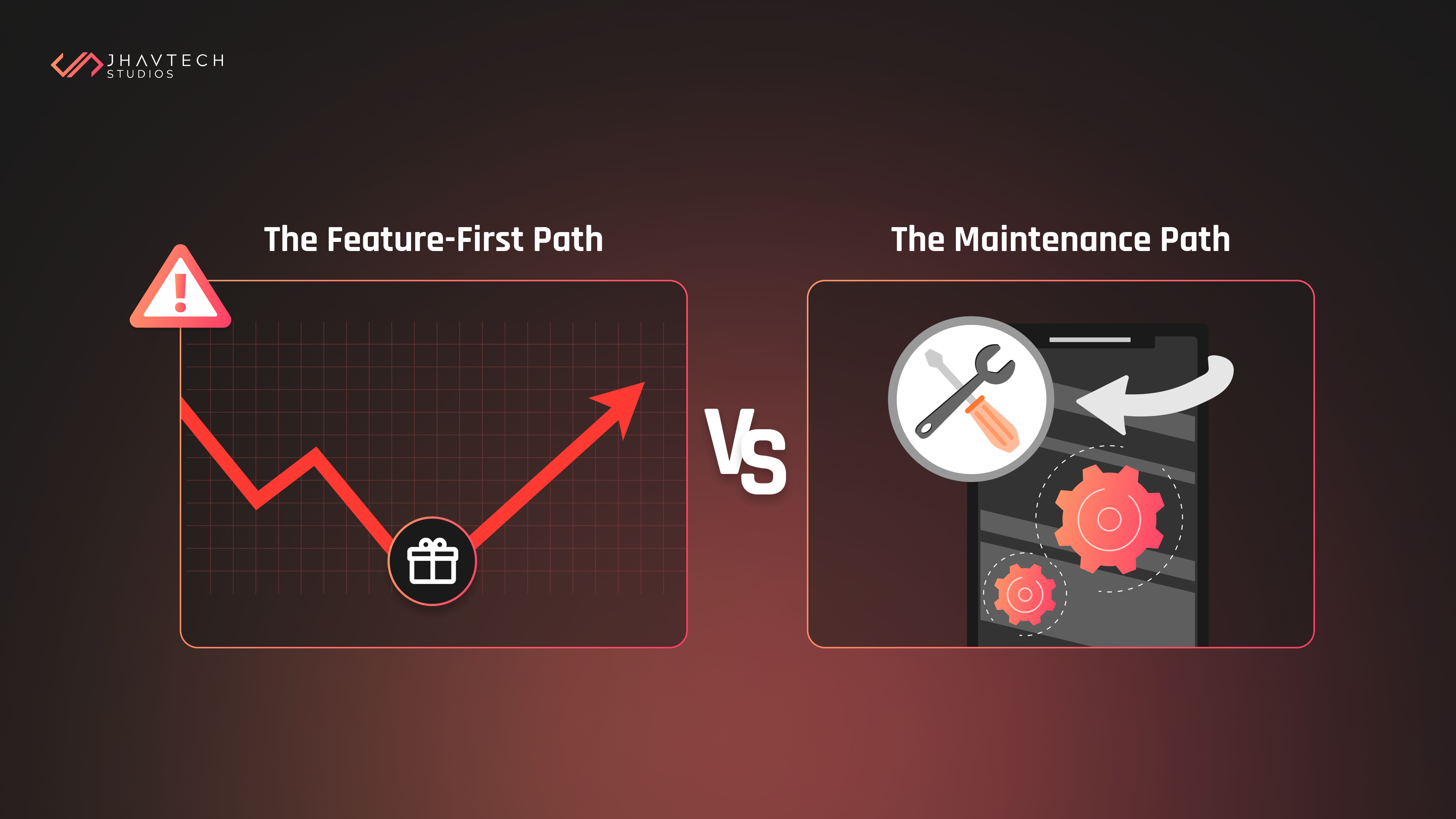
Developing a new feature from scratch involves design, coding, testing, and deployment. If that feature is built on a shaky foundation, it will likely require three times the amount of work to stabilize later. On the other hand, investing in app support and maintenance prevents these "emergency" costs. It is much cheaper to change the oil in a car every few months than it is to replace the entire engine because it seized up on the highway.
When the Foundation Crumbles: Software Project Rescue
Sometimes, the neglect has gone on for too long. We have encountered companies that ignored maintenance for years, resulting in a codebase that is essentially a house of cards. When an app reaches the point where every new update breaks three other things, you are entering the territory of a software project rescue.
This process involves stepping in to stabilize a failing system, untangling messy code, and restoring functionality. It is a stressful and expensive place to be. You can avoid this entirely by ensuring that app support and maintenance are part of your monthly roadmap from day one. It is about being a good steward of your technology.
The Role of a Professional Code Review
If you are unsure where your app stands, the best place to start is with a comprehensive code review. This is not about pointing fingers at previous developers; it is about an objective analysis of your software's health. A professional review identifies bottlenecks, security gaps, and areas where the code is inefficient.
By identifying these issues early, your team can integrate fixes into their regular app support and maintenance routine. This proactive approach ensures that your app remains scalable. As your user base grows, your infrastructure needs to grow with it, and you cannot scale chaos.
Legacy App Modernization Services for Startups
For many startups, the "Move Fast and Break Things" mantra of the early 2010s has left behind a trail of broken code. As these companies mature, they realize their MVP (Minimum Viable Product) was never meant to handle 50,000 concurrent users.
This is where legacy app modernization services for startups become essential. Modernization isn't about throwing the whole app away; it is about updating the underlying architecture to modern standards while keeping the business logic intact. This falls under the broader umbrella of app support and maintenance, as it ensures the software remains compatible with new operating systems and hardware.
Data-Driven Proof: Maintenance Lowers Long-Term Costs
A study by the IDC suggests that for every dollar spent on software development, businesses often spend up to three dollars on maintaining that software over its lifecycle. If you try to bypass this, you aren't saving money; you are just delaying an inevitable bill.
Furthermore, Google and Apple have become increasingly aggressive about removing "abandoned" apps from their stores. If your app hasn't been updated to support the latest iOS or Android version, you risk being delisted entirely. Consistent app support and maintenance ensure that you remain compliant with store policies, keeping your digital storefront open for business.
Final Thoughts... Quality Over Quantity
In the world of software, vanity metrics like the number of features often overshadow the metrics that actually matter: uptime, speed, and user satisfaction. Your app is a tool designed to solve a problem for your users. If the tool is broken or difficult to use, it doesn't matter how many bells and whistles you add to it.
Stop chasing the next big feature and start investing in the health of what you have already built. Prioritizing app support and maintenance is the smartest financial and strategic move you can make for your digital product. It is the difference between an app that fades into obscurity and one that remains a staple on a user’s home screen for years to come.
Remember, a simple app that works perfectly is always more valuable than a complex app that barely works at all. Take care of your code, and your code will take care of your business.