Steem's underappreciated superpower: Rewarding all value creators
The Siren Server
Here's a diagram by ChatGPT that attempts to illustrate the Siren Server concept from Jaron Lanier's Who Owns the Future.
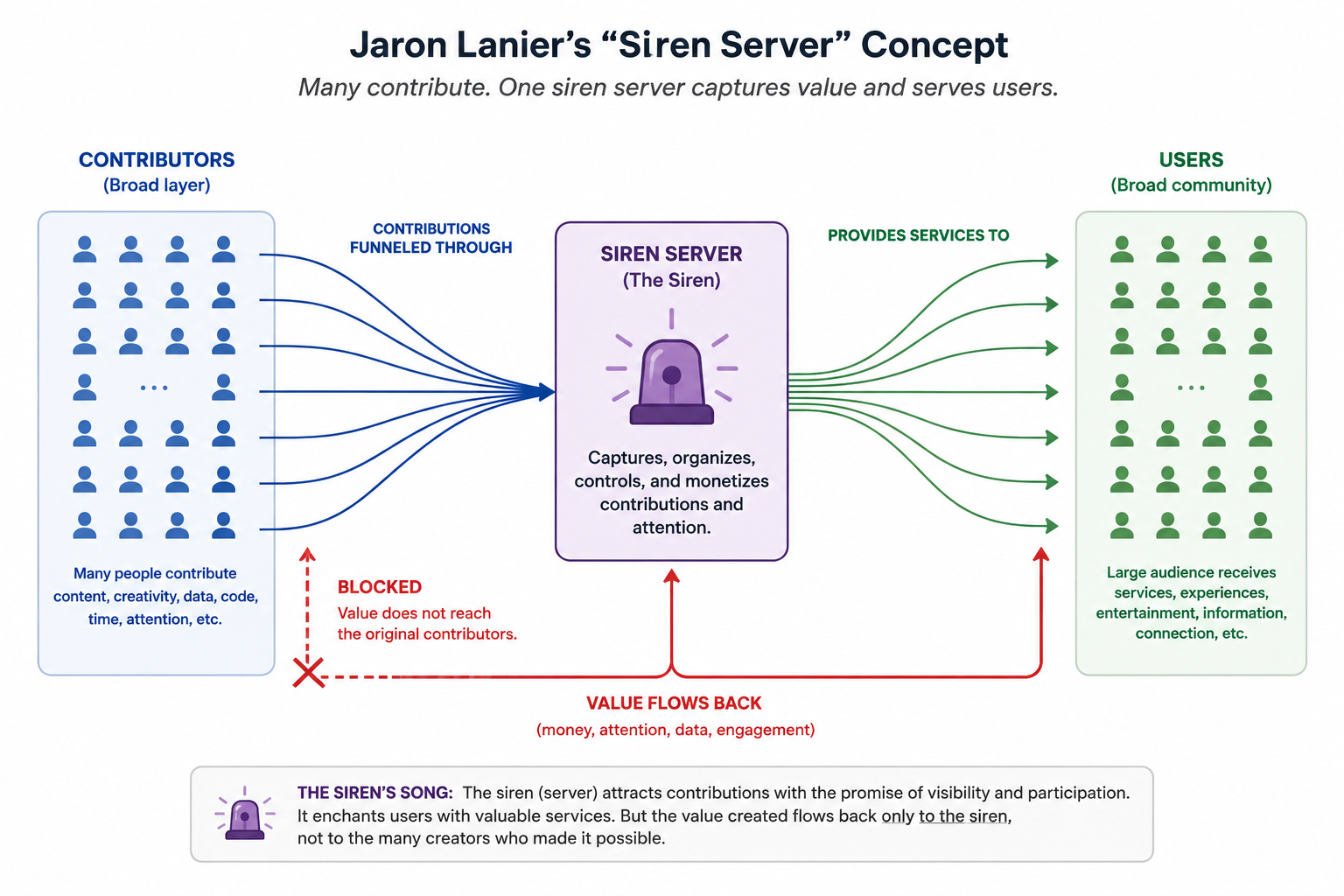
I haven't read Who Owns the Future, but this illustration reflects my understanding of the concept from Lanier's interviews and articles on the subject.
To make the diagram, I gave ChatGPT four points that I wanted to highlight:
Create a diagram to illustrate Jaron Lanier's "Siren Server" concept. Key points that I want to see:
- A broad layer consisting of numerous contributors all get funneled through;
- A single "siren server" which then provides services to;
- A broad user community;
- Value flows back to the siren server, but it's blocked from reaching the original contributors.
Creating dysfunctional incentives
According to Lanier, this is not just a technical problem, but it's also an economic and ethical problem. As the diagram shows, the "Siren Server" entices contributions with the offer of free services and human connections, and it harvests the value of those contributions without returning anything to the actual creators. Lanier argues that this is fundamentally unjust and that it hollows out the economic middle class. The provider of the "siren server" captures a disproportionate share of value, and the creators get starved.
The solution
To address this problem, Lanier introduces a concept known as digital dignity or data dignity. Lanier describes it like this:
In a world with data dignity, digital stuff would typically be connected with the humans who want to be known for having made it. In some versions of the idea, people could get paid for what they create, even when it is filtered and recombined through big models, and tech hubs would earn fees for facilitating things that people want to do. Some people are horrified by the idea of capitalism online, but this would be a more honest capitalism. The familiar “free” arrangement has been a disaster.
As I understand it, "data dignity" is really just an accounting problem. It's a complicated, hard-to-solve, accounting problem - but still an accounting problem. If someone creates something and that creation produces value, the creator should get a proportionate share of the value.
In this respect, Steem's beneficiary rewards are interesting because they allow rewards to be directed not just for content creation, but for any activity that contributes to the value of the platform.
With today's social media giants, that accounting is not happening (To be fair, Twitter and YouTube make some effort with their content monetization programs).
The Steem Connection
The Steem Whitepaper has actually recognized this challenge from the very beginning:
Steem recognizes that the value of all user contributions (posts and votes) is greater than the sum of the parts. A single comment is worth next to nothing, but a collection of millions of curated posts is worth many millions (or possibly even billions) of dollars. A single vote provides little curation value, but billions of votes represents very effective curation. Content without curation is of limited value. If it had access to all the content of the internet but not the links between that content, Google would struggle to produce useful search results. It is the linkage between information that gives it significant value.
Because everyone benefits, everyone should pay. In other words, no individual user should be expected to pay for anything, but instead should be paid for everything they do that brings value to Steem. All we need to do is ascertain which user contributions bring a social network value and which ones don’t.
Steem's progression towards data dignity
Already in the 2016 whitepaper, we saw that Steem had a goal in mind to compensate all value-providers in an ecosystem, but the vision was incomplete. It included authors (creators) and voters (evaluators), but anyone else bringing value to the ecosystem was SOL.
Also, the limited payout window put a ceiling on how much value the authors and voters would be able to reclaim.
Hardfork 18 (2017) was a first step towards addressing this gap,
Blogs & Websites can now earn via Steemit and implement a preferred allocation of Payout Rewards to earn some additional revenue.
(This hardfork also disabled proof-of-work mining, which I think we should bring back, but that's a topic for another day.)
Hardfork 21 (2019) introduced another step.
At the request of the Witnesses, we have included code in this release that would add a long term funding mechanism for the SteemDAO/SPS. If this hardfork is accepted by the Witnesses, 10% of overall inflation (pulled from the rewards pool) would be used to fund proposals made through the SteemDAO/SPS.
However, creating the mechanism and solving the accounting problem are two different things. Steem gained the ability to direct rewards to arbitrary value creators, but it never established a framework for ensuring that rewards actually go to the value creators. The accounting problem remains.
Further, the beneficiary reward was initially envisioned to help with dapp funding, but delegation bots quickly gave investors a path to preempt and smother rewards for other value creators. And for the Steem DAO, we have never really learned how to match the outflow with the value-added.
Which brings us to today
So, here we are today with a blockchain that hasn't been updated in six years. If Steem is going to grow and thrive, it needs to be free for participants. It also needs to do a better job than the siren servers of directing rewards to all value creators in the ecosystem. One of the most powerful tools that Steem has to differentiate itself from the "Siren Server" platforms is its ability to reward value creators in a decentralized manner.
The Steem DAO is basically off the table, because there are only a handful of stakeholders who can influence that decision-making, so that leaves the vast majority of us with only one lever (beyond posting and voting) - beneficiary rewards. The good news is that there is an infinite variety of ways that beneficiary rewards can be harnessed, if we just get a little bit creative. A few examples:
- Obviously, I have to mention Thoth in an article like this. Thoth is an Open Source AI delegation bot that checks historical content on the blockchain and creates a summary post about the articles that it identifies. It directs beneficiary rewards to the authors who created the posts and to the delegators who support its operation. This is an improvement over previous generations of delegation bots because it doesn't require investors to spam the blockchain and it opens up a new reward stream after 7 days for authors.
- Steem-Atlas is using beneficiary rewards the way they were originally imagined, as a way to fund dapps.
- Recently, I proposed inclusion of a beneficiary reward clause in a Steem-specific photo license, which would enable photographers to derive long-term value from their value-creation.
- A "resteem with comment" could be implemented by front-ends with an attached beneficiary setting so that viral posts could direct a share of rewards back to the original author.
- Front ends could set a default beneficiary in replies to direct some rewards back to the original author, again enabling authors to get some rewards from posts that generate engagement.
- All of these are just scratching the surface. Google Gemini actually came up with the "proof of sighting" protocol, as a very sophisticated example of the limitless possibilities ("deep research" paper here).
Wrap-up
By turning beneficiary rewards from a simple 'dapp tax' into a targeted accounting tool for network value, we can transition Steem towards a more honest version of web capitalism like the one that Lanier proposed.
A Steem strategy that only incorporates the use of posts and votes is an incomplete Steem strategy. For investors and developers, I'm convinced that creative use of beneficiary rewards should be priority one.
If (and only if) rewards flow to the actual people who create value, Steem will get more people who create value.
An open question is how to measure the creation of value, but that will depend on the particular use of the beneficiary rewards, so it will vary between cases. This is beyond the scope of today's essay.
What creative use of beneficiary rewards can you imagine?
For those who prefer audio/video, here's an "explainer" video that was generated from this article by NotebookLM:
100% of author rewards on this comment are directed towards @null for burning.
안녕하세요. 오늘(2026.06.01) 기준 @jsup 2.0 후원 보팅 현황입니다.
jsup 2.0 - 업보팅을 다시 위대하게
jsup 2.0 - make your upvote great again
@jswit -> @remlaps : 180.0sp
@jsup에 임대하시면 매일 업보팅을 받으며, 23일후부터 매일 큐레이션/패시브 보상을 받습니다. 후원 내역이 있을 경우 임대량에 합산되어 보팅됩니다. 개발자(@joviansummer) 지원 보팅 외에 수수료가 없어 수익률도 우수합니다. 많은 관심 부탁드립니다. 감사합니다.
Thanks for your vote on my post,it really a motivation for me has a new member on steemit,I will be glad to have ur mentorship and teaching to move ahead on steemit.