Layer 1 vs Layer 2 Blockchain: A Guide to Token Creation
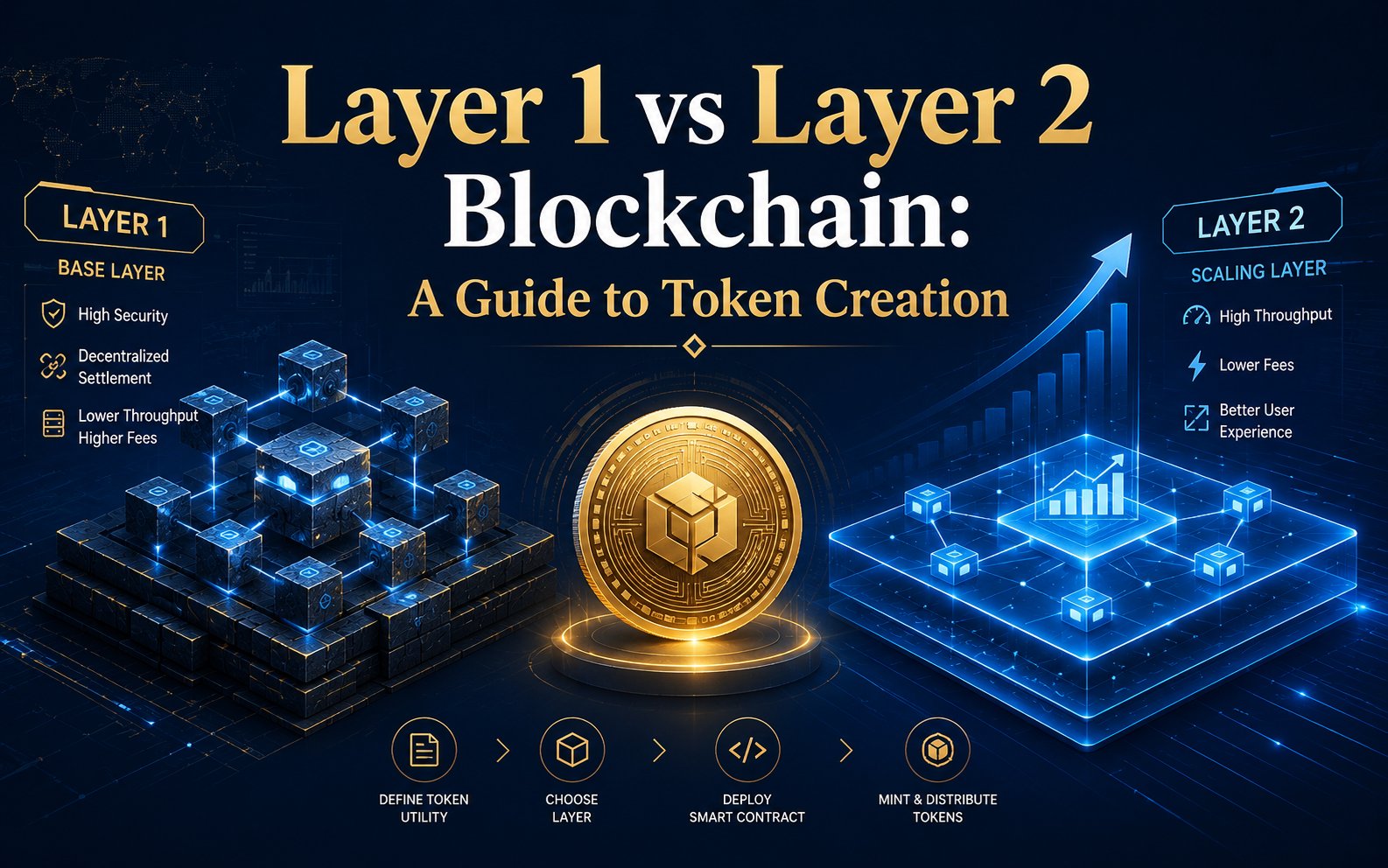
Creating a crypto token starts with a deceptively simple question: Which blockchain should host it? The answer affects transaction costs, user experience, smart contract architecture, wallet compatibility, liquidity, security, and long-term scalability.
For businesses exploring crypto token creation, the choice often comes down to a Layer 1 blockchain or a Layer 2 network built on top of another blockchain. Layer 1 networks provide their own consensus and settlement infrastructure. Layer 2 networks process activity separately and use an underlying Layer 1 for important security or data functions. Ethereum's current scaling strategy places rollups at the center of its approach, with Layer 2 networks processing transactions away from Mainnet while using Ethereum as their settlement and security foundation.
The right choice depends on the token's purpose, expected activity, technical requirements, target users, and growth plans. There is no single network architecture that suits every token.
What Are Layer 1 and Layer 2 Blockchains?
A Layer 1 blockchain is a base blockchain that maintains its own consensus, validators, transaction execution, and settlement environment. Ethereum, Solana, and Bitcoin are examples of Layer 1 networks, although they serve different technical purposes and have different architectures.
A Layer 2 blockchain operates above an underlying Layer 1. Ethereum describes Layer 2 as a group of scaling solutions that handle transactions away from Ethereum Mainnet while deriving security from the underlying network. Rollups bundle transactions and post relevant data or proofs back to Ethereum.
This distinction matters for token creation because the blockchain determines how the token is issued, transferred, integrated with applications, and accessed by users.
A project launching an ERC-20 token on Ethereum Mainnet is making a different architectural decision from a project deploying an EVM-compatible token on an Ethereum Layer 2.
Layer 1 Token Creation Explained
Creating a token on Layer 1 means deploying the token directly on the base blockchain.
Ethereum is one of the most established examples. Its ERC-20 standard defines a common interface for fungible tokens, covering functions such as balances, transfers, approvals, and allowances. Standardization helps wallets, exchanges, decentralized applications, and other smart contracts interact with compatible tokens.
A Layer 1 deployment can make sense when the project values direct settlement on the base network and wants to operate within an established ecosystem.
For example, a project targeting Ethereum-native applications may choose Ethereum Mainnet because its users already hold ETH, use Ethereum-compatible wallets, and interact with Ethereum-based applications.
The trade-off is that the token shares the Layer 1's transaction environment. During periods of high demand, transaction costs can increase and affect user activity. Ethereum's documentation notes that scaling is needed because demand can create congestion and higher gas costs on Mainnet.
Layer 2 Token Creation Explained
Layer 2 networks address scalability by moving much of the transaction activity away from the underlying Layer 1.
Rollups are a major example. Optimistic rollups execute transactions outside Ethereum Mainnet and submit transaction data or commitments back to Ethereum. They use fraud-proof mechanisms as part of their security model.
Zero-knowledge rollups use validity proofs to demonstrate that off-chain computation was performed correctly. Ethereum's documentation describes ZK-rollups as systems that execute transactions outside Layer 1 and submit state information and cryptographic proofs to Mainnet.
For token creators, this can provide a more cost-conscious environment for frequent transactions. A gaming token, loyalty asset, consumer application token, or high-frequency payment asset may benefit when users need to make many transactions.
Ethereum currently reports that rollups are around 5 to 20 times cheaper than Ethereum Layer 1, although actual costs vary by network, transaction type, and market conditions.
When Should a Project Choose Layer 1?
Layer 1 can be a strong choice when the token needs direct access to a mature base-layer ecosystem.
A project may prefer Layer 1 when:
- Its users already operate on that network.
- Its transactions are relatively infrequent.
- Direct base-layer settlement matters.
- The project needs access to established liquidity.
- Its applications are already concentrated on the network.
-The team prioritizes a direct blockchain architecture.
A financial application with substantial transaction value, for example, may place greater emphasis on settlement characteristics and ecosystem infrastructure than on minimizing every transaction fee.
The decision should also account for the token's expected transaction pattern. A token that users transfer once a month has different infrastructure requirements from one used in thousands of daily in-game transactions.
When Should a Project Choose Layer 2?
Layer 2 can make more sense when transaction frequency and user cost are major concerns.
Consider a consumer application where users need to interact with a token frequently. Even small transaction costs can become noticeable when users perform many actions.
Ethereum's scaling documentation explains that Layer 2 networks can batch transactions and distribute the cost of submitting data to the base layer across many users.
This creates an attractive environment for applications where transaction volume matters.
Layer 2 can also offer EVM compatibility. Ethereum notes that EVM-compatible optimistic rollups allow developers to use familiar Ethereum programming languages, libraries, testing tools, and deployment infrastructure.
For teams already building with Solidity, this can reduce the architectural changes required when moving applications to an appropriate EVM Layer 2.
Token Standards Can Influence the Decision
The selected blockchain determines more than where the token lives. It also influences how the token is represented and what functionality developers can implement.
Ethereum's ERC-20 standard remains widely used for fungible assets. On Ethereum-compatible Layer 2 networks, developers can often use familiar Solidity-based tooling and token patterns.
Other Layer 1 ecosystems have different token architectures.
Solana, for example, uses its Token Program and Token Extensions for token creation. Its documentation describes functionality covering mint creation, token accounts, mint authority, freeze authority, and extensions.
Solana's Token Extension Program can also support specialized functions. Its documentation includes features such as default account states and permanent delegation.
This shows why blockchain selection should happen before finalizing token architecture. A project should first define what the token needs to do, then select a network whose technical model supports those requirements.
Cost and Scalability Considerations
Transaction cost is one of the most visible differences between Layer 1 and Layer 2 environments, but it should not be the only consideration.
Ethereum's current scaling roadmap focuses on making rollup data cheaper and increasing overall capacity. The network's documentation reports that the Dencun upgrade introduced blob storage in March 2024, which rollups have used to reduce transaction costs.
For a token project, lower transaction costs can improve user accessibility. This is particularly relevant for applications involving frequent transfers, rewards, micropayments, gaming interactions, or large user populations.
Still, the actual cost depends on network conditions, transaction complexity, data requirements, and the specific Layer 2.
Founders should compare realistic transaction scenarios rather than relying on a single advertised fee.
Security Differences Matter
Security requires careful evaluation on both Layer 1 and Layer 2.
A Layer 1 token relies on the security model of its underlying blockchain. Developers still need to secure the token contract, administrative keys, treasury wallets, upgrade permissions, and application infrastructure.
Layer 2 introduces another layer of technical dependencies.
Teams need to evaluate:
- Sequencer design
- Bridge architecture
- Data availability
- Proof systems
- Upgrade controls
- Withdrawal mechanisms
- Smart contract permissions
- Emergency procedures
Ethereum notes that some rollups still rely on centralized sequencers and that decentralizing sequencer and prover responsibilities remains an important area of development.
This does not mean Layer 2 networks are inherently unsafe. It means founders should understand the specific security assumptions of the network they select.
Liquidity and Exchange Access
Liquidity is another factor that can influence blockchain selection.
A token needs accessible markets where users can buy, sell, or use it. Choosing a blockchain with a relevant decentralized exchange ecosystem can simplify early market development.
A project should examine:
- Available DEX infrastructure
- Existing token pairs
- Stablecoin availability
- Wallet support
- Trading activity
- Bridge infrastructure
- Exchange compatibility
- Institutional infrastructure
A token deployed on a technically capable network does not automatically gain liquidity.
Market access needs to be planned separately.
For multi-environment strategies, liquidity can also become fragmented. A project with the same economic asset on several networks needs to consider how liquidity and token supply are coordinated.
Layer 1 vs Layer 2 for Different Token Use Cases
Different token models can favor different architectures.
Utility Tokens
Utility tokens used frequently inside applications can benefit from lower-cost environments. Layer 2 can be attractive when the application generates many user transactions.
Governance Tokens
Governance tokens may prioritize ecosystem compatibility and broad participation. The choice depends on where governance activity occurs and whether voting transactions need to happen frequently.
Gaming Tokens
Gaming projects often generate many small transactions. Lower transaction costs can make Layer 2 attractive for certain game economies.
Payment Tokens
Payment-focused projects need to prioritize transaction costs, settlement speed, wallet access, liquidity, and regulatory considerations.
Tokenized Assets
Tokenized real-world assets can have different requirements. Compliance controls, transfer restrictions, investor verification, custody, and jurisdictional requirements can influence blockchain selection as much as transaction costs.
Should You Create a Token on Layer 1 or Layer 2?
The decision should begin with the product rather than the blockchain.
Before selecting a network, founders should answer several practical questions:
Who will use the token?
User location and existing wallet behavior can influence network selection.
How frequently will users transact?
High-frequency applications may place greater value on lower transaction costs.
What token standard is required?
The token's functionality should fit the network's technical model.
Where is the target liquidity?
Existing DEX, stablecoin, wallet, and exchange infrastructure can reduce launch friction.
What security model does the project need?
Teams should understand both the blockchain's native security and any additional infrastructure.
Does the project need Layer 2 scalability?
If transaction demand is low, the additional architecture may not provide enough value to justify its complexity.
A Practical Token Creation Framework
A structured token development process can reduce architectural mistakes.
1. Define Token Utility
Identify exactly what the token does inside the product.
2. Estimate Transaction Demand
Model expected users, transaction frequency, and transaction complexity.
3. Compare Blockchain Architecture
Evaluate Layer 1 and Layer 2 networks based on security, cost, tooling, liquidity, and ecosystem support.
4. Select the Token Standard
Choose the appropriate token framework based on the network and required functionality.
5. Develop the Smart Contract
Build supply, transfer, access-control, vesting, staking, governance, or other required functions.
6. Test and Audit
Use automated testing, testnet deployment, code review, and independent security assessment where appropriate.
7. Plan Deployment and Liquidity
Prepare wallets, liquidity infrastructure, token distribution, explorers, and application integrations.
8. Monitor After Launch
Track transactions, holders, liquidity, contract interactions, user activity, and security events.
Final Thoughts
Layer 1 and Layer 2 networks solve different problems within blockchain architecture. Layer 1 provides the underlying settlement and consensus environment, while Layer 2 can increase transaction capacity and reduce costs by processing activity outside the base layer. Ethereum's current roadmap places strong emphasis on Layer 2 scaling, while continuing to develop the base network as the settlement and data layer.
For businesses planning crypto token creation, the better choice is the network that matches the token's actual requirements. A project should evaluate utility, transaction volume, security, liquidity, wallet support, development tooling, and long-term ecosystem needs before deployment.
The goal should not be to choose the newest or cheapest blockchain. It should be to create a token architecture that supports the product, users, security model, and growth strategy from the first deployment onward.