What Makes a Crypto Token Ready for Wallets, DEXs, and Real Users?
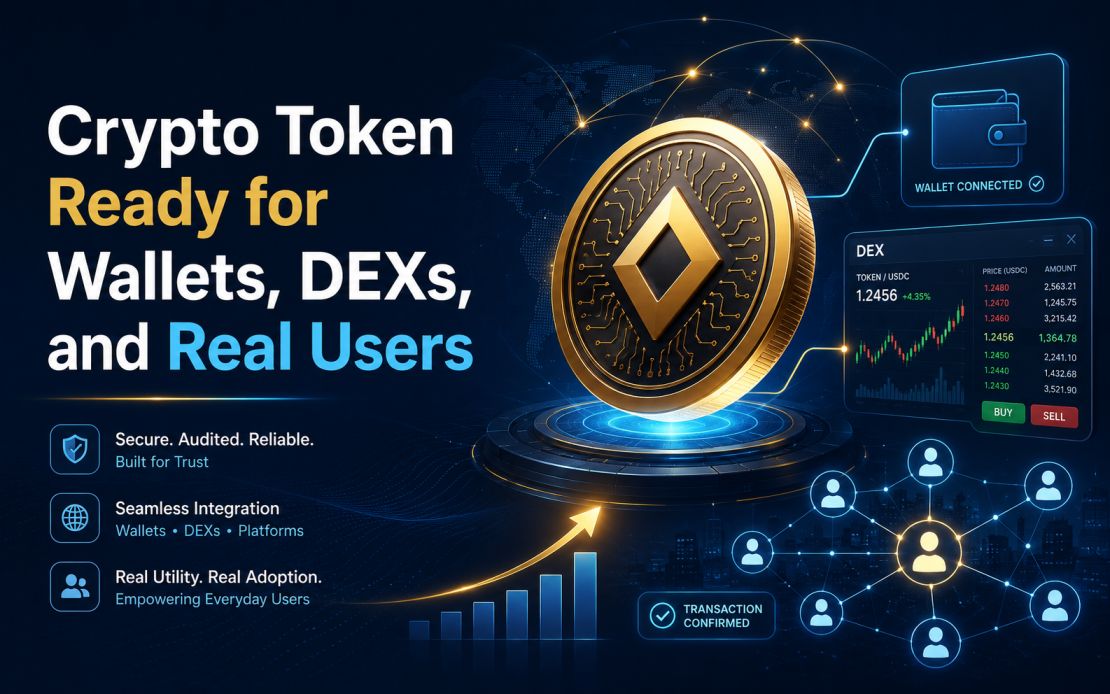
Creating a crypto token is technically easier than ever. A development team can deploy a token contract on a public blockchain in a relatively short time. Yet deployment is only the beginning. A token that works on-chain is not automatically ready for wallets, decentralized exchanges (DEXs), or real users.
A market-ready token needs to combine technical compatibility, secure smart contracts, reliable tokenomics, liquidity, user experience, transparency, and operational controls. Wallets need to recognize and display the asset correctly. DEXs need to interact with its contract without unexpected behavior. Users need confidence that the token is legitimate, functional, and usable.
For businesses exploring crypto token development, Blockchain App Factory approaches token creation as a broader ecosystem problem rather than simply deploying a smart contract. The objective is to build an asset that can operate reliably across the infrastructure users already depend on.
What Does "Token Ready" Actually Mean?
A token is ready for real-world use when its technical and economic foundations can support interaction beyond the development environment.
Deployment confirms that a smart contract exists. It does not prove that the token has been designed for practical adoption.
A production-ready token should answer several questions:
- Can wallets correctly identify and display the token?
- Does the token follow the appropriate blockchain standard?
- Can DEX contracts interact with it safely?
- Is liquidity available for meaningful trading?
- Are token permissions and administrative controls clearly defined?
- Has the contract undergone appropriate testing and security review?
- Can users verify the official contract address?
- Does the token have a clear purpose and transparent distribution model?
These questions are interconnected. A technically sound token with no liquidity is difficult to trade. A liquid token with unclear ownership or permissions can create trust concerns. A well-designed token that lacks wallet compatibility creates unnecessary friction for users.
Token Standards Form the Technical Foundation
The first requirement is selecting and correctly implementing an established token standard.
On Ethereum and compatible networks, ERC-20 is the widely recognized standard for fungible tokens. Its standardized functions allow wallets, decentralized applications, and other smart contracts to interact with tokens through predictable interfaces.
Other networks use their own token frameworks. Solana, for example, uses the Solana Token Program and Token-2022 extensions for different token functionality, while BNB Chain supports BEP-20 tokens through its EVM-compatible infrastructure.
The important point is that a token should not be treated as an isolated smart contract. It needs to conform to the expectations of the ecosystem in which it operates.
A token that deviates from standard behavior without a strong reason can create integration problems. Wallets may display information incorrectly, decentralized applications may fail to interact with certain functions, and exchange integrations may require additional development.
For most businesses, established standards provide the strongest foundation for interoperability.
Wallet Compatibility Goes Beyond Showing a Token Name
Users usually encounter a token through a wallet before interacting with its underlying smart contract.
Wallet compatibility depends on factors such as the blockchain network, token standard, contract address, decimals, symbol, and metadata.
For example, if a user receives an ERC-20 token, the wallet needs to recognize the correct network and token contract. If the token is not automatically displayed, the user may need to import the contract address manually.
This is where clarity becomes critical.
A professional token launch should provide users with the official contract address, supported network, token symbol, decimals, and verified blockchain explorer information through trusted project channels.
The contract address should be treated as the token's primary identifier. Names and symbols can be copied by fraudulent tokens. Users should never be encouraged to identify the official asset solely by its name.
Wallet readiness also includes testing transfers between different wallet types. A token that works in a developer wallet but produces unexpected behavior in common user wallets is not ready for broad distribution.
DEX Compatibility Requires More Than Creating a Trading Pair
Listing a token on a decentralized exchange is not equivalent to simply adding its name to a website.
DEXs interact with tokens through smart contracts and liquidity pools. A token must behave predictably when users approve transfers, swap assets, and add or remove liquidity.
For a conventional ERC-20 token, functions such as approve, transfer, and transferFrom form part of the expected interaction model. Unusual transfer mechanics can affect how DEX contracts interact with the asset.
This becomes particularly important with tokens that implement:
- Transfer taxes
- Buy and sell fees
- Anti-bot restrictions
- Wallet limits
- Blacklists
- Transaction cooldowns
- Dynamic fees
- Automatic liquidity mechanisms
These features can serve legitimate purposes, but they also introduce additional complexity.
For example, a token that deducts a fee from every transfer needs to be tested carefully with liquidity pools and routing contracts. If the contract behaves differently from what the DEX expects, swaps can fail or produce unexpected outcomes.
A token should therefore be tested against its intended trading infrastructure before public launch.
Liquidity Is What Turns Availability Into Usability
A token can be technically listed on a DEX and still be practically unusable if there is insufficient liquidity.
Liquidity determines how easily users can buy or sell an asset without causing large price movements. A shallow pool can create substantial slippage, making the token difficult to trade efficiently.
This is why liquidity planning should happen before the launch rather than after the token is deployed.
The project team needs to determine which trading pair makes sense, how much initial liquidity is appropriate, who provides it, and how liquidity will be managed over time.
For example, a project launching against a stablecoin may choose a pair such as TOKEN/USDC or TOKEN/USDT, depending on its target ecosystem and available infrastructure.
The important consideration is not simply creating a pool. It is creating enough usable market depth for the expected level of activity.
Smart Contract Security Determines Whether Users Can Trust the Token
Security is one of the most important factors separating a production-ready token from a development-stage asset.
A token contract controls critical functions such as supply, transfers, ownership, permissions, and potentially treasury funds. A vulnerability can therefore create direct financial consequences.
Testing should examine issues such as unauthorized minting, incorrect access control, faulty burn logic, manipulation of privileged functions, reentrancy risks where applicable, upgrade vulnerabilities, and unexpected transfer behavior.
Administrative permissions deserve particular attention.
If the contract owner can arbitrarily mint tokens, change transaction fees, freeze wallets, or modify important parameters, users need to understand those capabilities. Hidden or poorly documented administrative powers can damage trust even when they have not been abused.
A professional development process should combine automated testing, manual code review, testnet deployment, and independent security auditing when the project's risk profile justifies it.
Tokenomics Must Be Understandable to Real Users
Technical readiness alone does not create adoption.
Users need to understand why the token exists and how its supply works.
A credible token should have transparent information about its total supply, circulating supply, allocation model, vesting schedules, treasury holdings, and planned emissions.
Suppose a project publicly announces a fixed supply but retains a contract function that allows unlimited minting. Even if that function is never used, the difference between the advertised economics and the technical capability can create trust concerns.
Tokenomics should therefore match the smart contract.
The distribution model should also be realistic. Large allocations for founders, investors, or treasury wallets can create future selling pressure if vesting and release schedules are poorly designed.
A market-ready token needs an economic model that users can understand and evaluate.
Verification and Transparency Build User Confidence
Real users need ways to distinguish an official token from imitations.
Blockchain explorers provide an important part of this process. Contract source code verification allows users and developers to inspect the published implementation and compare it with the deployed contract.
Project documentation should also clearly identify:
- Official contract address
- Supported blockchain
- Token standard
- Total and circulating supply
- Token allocation
- Vesting schedules
- Official website and social channels
- Audit information, where applicable
- Supported wallets and trading platforms
Consistency matters.
The contract address shown on the website should match the address published through official project channels. Conflicting information can create confusion and expose users to phishing or counterfeit tokens.
Real-User Testing Should Happen Before the Public Launch
A token can pass developer testing and still create problems for ordinary users.
A production readiness process should include realistic scenarios such as purchasing tokens, transferring between wallets, approving DEX contracts, swapping through liquidity pools, checking balances, and viewing transactions on blockchain explorers.
Testnet deployment is particularly useful for identifying issues before real funds are involved.
The team should also test edge cases. What happens when a user transfers the maximum permitted amount? What happens when a wallet reaches a transaction limit? What happens when a DEX swap interacts with a transfer fee?
These scenarios reveal practical problems that basic contract testing can miss.
Regulatory and Compliance Considerations Cannot Be Ignored
A token's technical readiness does not determine its legal status.
The regulatory treatment of a crypto token can depend on its characteristics, economic purpose, distribution model, marketing, underlying rights, and jurisdiction.
This matters for projects targeting users in the United States, United Kingdom, and India, where regulatory frameworks and enforcement approaches differ.
Businesses should assess applicable requirements before public distribution, particularly when tokens involve investment characteristics, financial rights, fundraising, or tokenized real-world assets.
Compliance requirements can also influence technical architecture. Some projects may require transfer restrictions, wallet eligibility controls, transaction monitoring, or other mechanisms.
These requirements should be considered during development rather than added after launch.
A Practical Crypto Token Readiness Framework
Before launching a token to real users, businesses should evaluate five major areas:
Technical readiness: The contract follows the appropriate token standard and works reliably across the intended ecosystem.
Security readiness: The contract and administrative infrastructure have undergone appropriate testing and security review.
Market readiness: Liquidity, trading pairs, and transaction conditions support the expected user activity.
User readiness: Wallet compatibility, documentation, contract verification, and user instructions are clear.
Operational readiness: The team has defined procedures for monitoring, upgrades, treasury management, incident response, and communication.
These areas work together. A weakness in any one of them can undermine the overall launch.
From Token Deployment to Ecosystem Readiness
The difference between a deployed token and a market-ready token is substantial.
Deployment creates the blockchain asset. Ecosystem readiness makes that asset usable.
A strong project therefore plans wallet compatibility, DEX interaction, liquidity, security, tokenomics, documentation, and compliance as interconnected components. This approach reduces friction for users and provides a stronger foundation for long-term adoption.
For businesses, the development process should also continue after launch. Contracts, liquidity, transactions, user activity, and security events need ongoing monitoring. Market conditions change, integrations evolve, and new risks can emerge.
Conclusion
A crypto token becomes ready for wallets, DEXs, and real users when it can operate reliably across the complete ecosystem surrounding it. Following a token standard is only the starting point. True readiness requires secure smart contract logic, wallet compatibility, DEX testing, sufficient liquidity, transparent tokenomics, verified contract information, realistic user testing, and appropriate regulatory planning.
Businesses should therefore approach crypto token development as a complete product and infrastructure project rather than a simple contract deployment exercise.
Blockchain App Factory helps businesses build customized crypto token solutions with a focus on technical functionality, ecosystem compatibility, security, tokenomics, and launch requirements. By planning these elements before deployment, businesses can create tokens designed not only to exist on a blockchain, but to function effectively in real-world markets.
The ultimate measure of a token launch is not whether the contract was deployed successfully. It is whether wallets can recognize it, DEXs can interact with it, and real users can confidently use i