Crypto Token Development in India: From Concept to Token Launch
India has become an important market for blockchain and cryptocurrency activity. According to Chainalysis 2025 Global Crypto Adoption Index, India ranked first globally, with the country placing first across the report’s retail, centralized finance, decentralized finance, and institutional activity sub-indices. Chainalysis also estimated that India received about $338 billion in on-chain crypto value during the 12 months covered by its 2025 regional analysis.
This growing activity has created opportunities for businesses exploring crypto tokens for payments, community participation, decentralized applications, gaming, loyalty programs, governance, fundraising, and real-world asset ecosystems. Yet creating a token is not simply a matter of generating a name, symbol, and smart contract. A successful token launch requires decisions around business utility, tokenomics, blockchain architecture, security, compliance, distribution, liquidity, and post-launch operations.
For businesses considering crypto token development in India, understanding the journey from concept to launch helps establish realistic technical and commercial expectations.
Defining the Purpose Before Creating the Token
The first stage of token development is not coding. It is defining why the token needs to exist.
A token should have a clearly defined role within the product or ecosystem. A Web3 gaming platform, for example, might use tokens for in-game transactions, rewards, governance, or access to specific features. A decentralized finance application may require a token for governance and protocol incentives. A real-world asset platform may use tokenized assets to represent ownership or economic rights, subject to the legal structure governing the offering.
This distinction matters because token utility influences almost every subsequent technical decision. The intended users, transaction frequency, transfer restrictions, supply model, and integrations can all affect blockchain selection and smart-contract architecture.
Businesses should therefore begin with a token specification that describes the project's purpose, target users, utility, distribution model, expected transaction flows, and ecosystem integrations. This document becomes the foundation for discussions with developers, security auditors, legal advisors, and other project stakeholders.
Choosing the Right Blockchain Architecture
Once the token's purpose is established, the next decision involves selecting the blockchain on which it will operate. There is no single network that fits every token project.
Ethereum remains an important choice for projects seeking access to established developer infrastructure, wallets, decentralized applications, and standards such as ERC-20. EVM-compatible networks can provide compatibility with existing Ethereum tooling while offering different transaction-cost and performance characteristics. Solana is another option for projects where high throughput and low transaction costs are important.
The right decision depends on the project's requirements rather than the popularity of a particular blockchain. Developers should evaluate transaction fees, throughput, finality, ecosystem maturity, wallet support, smart-contract capabilities, liquidity, developer tooling, security history, and future interoperability.
For example, a token designed for frequent low-value transactions may have different infrastructure requirements from a governance token used periodically by a DAO. Similarly, a project planning to operate across several ecosystems may require a multi-chain architecture from the beginning rather than treating cross-chain deployment as a later addition.
Designing Tokenomics Around Real Utility
Tokenomics connects the project's business model with its digital asset. It determines how many tokens exist, how they are distributed, how they enter circulation, and what economic incentives encourage participation.
A well-designed token model should address supply, allocation, vesting, emissions, utility, treasury management, community distribution, liquidity, and potential future unlocks. These elements should work together rather than being selected independently.
Consider a hypothetical Web3 infrastructure project with a fixed supply of 1 billion tokens. If 40% is allocated to the community, 20% to the team, 15% to investors, 15% to ecosystem development, and 10% to liquidity and treasury activities, the project still needs to explain when these tokens become transferable. A large allocation that becomes liquid immediately can create very different market conditions from an allocation released gradually through a multi-year vesting schedule.
Tokenomics should also reflect actual utility. A token created solely because "every Web3 project needs a token" can struggle to establish meaningful demand. By contrast, a token connected to genuine product functionality can have a clearer reason for users to acquire or hold it.
Building and Testing the Smart Contract
After the token model and architecture have been established, developers can translate the requirements into smart-contract functionality.
A standard token may require relatively straightforward functions such as transfers, approvals, balances, minting, or burning. More sophisticated projects may require vesting contracts, staking mechanisms, governance functionality, whitelisting, transaction restrictions, fee mechanisms, or other customized features.
Every additional function introduces another area that needs testing and review. The development team should therefore use structured testing throughout the development lifecycle rather than waiting until deployment.
Testing can include unit tests, integration tests, testnet deployment, edge-case testing, access-control verification, and simulations of expected user behavior. Administrative privileges should receive particular attention. Questions such as who can mint tokens, whether supply can change, who can pause transfers, and how ownership can be transferred should be explicitly documented.
Security is particularly important because smart contracts can control assets directly. OWASP's Smart Contract Top 10 identifies access-control weaknesses, oracle manipulation, logic errors, reentrancy, and input-validation problems among significant smart-contract risks.
Conducting Independent Security Audits
A successful testnet deployment does not automatically mean that a token contract is secure. Independent auditing provides another layer of scrutiny before a production launch.
An external security team can examine the contract's logic, permissions, attack surfaces, and interactions with other contracts. Depending on the project, the audit may identify vulnerabilities involving access control, price manipulation, token accounting, reentrancy, arithmetic logic, upgradeability, or unexpected transaction behavior.
The audit process should not be treated as a marketing checkbox. Identified issues should be classified according to severity, corrected, and retested. Businesses should also understand whether an audit covers the complete contract system or only selected components.
For projects handling significant economic value, security planning should extend beyond smart contracts. Wallet management, private-key protection, deployment permissions, treasury controls, frontend security, infrastructure, and monitoring can all affect the project's security posture.
Considering India's Regulatory and Tax Environment
Crypto token development in India also requires careful consideration of the regulatory environment. The technical development team and legal advisors have different responsibilities, and businesses should avoid treating a software provider as a substitute for legal counsel.
India's tax framework specifically addresses Virtual Digital Assets. The Income Tax Department states that income from the transfer of VDAs is subject to a 30% tax under Section 115BBH, along with applicable surcharge and 4% cess, and VDA transactions are reported through a dedicated Schedule VDA in ITR-2 and ITR-3.
Anti-money-laundering requirements are another important consideration for businesses operating activities that fall within India's VDA service-provider framework. FIU-IND's updated January 2026 guidelines describe obligations involving KYC, customer due diligence, ongoing due diligence, transaction monitoring, suspicious transaction reporting, and record keeping for relevant reporting entities.
The exact obligations depend on the project's activities and structure. A token development company can help implement technical controls, but businesses should obtain appropriate legal and tax advice when determining whether their token, distribution model, platform, or related services fall under specific regulatory requirements.
Preparing the Token for Distribution and Launch
Token creation is only one part of a token launch. Once the smart contract has passed testing and security review, the project needs a structured distribution plan.
Distribution may involve private allocations, community campaigns, a token sale, airdrops, ecosystem incentives, treasury reserves, or liquidity provision. Each method introduces different technical and operational requirements.
For example, an airdrop may require eligibility verification and distribution infrastructure, while a token sale can require allocation tracking, wallet connections, payment processing, KYC procedures, and claim functionality. Projects may also need vesting contracts to prevent immediately unlocked allocations from entering circulation.
The launch infrastructure should therefore be tested before the public event. Wallet compatibility, token balances, claim processes, transaction limits, frontend interactions, and blockchain explorer verification should all be checked under realistic conditions.
Planning Liquidity and Ecosystem Integrations
A token does not become useful simply because it has been deployed. Users need practical ways to acquire, transfer, hold, or use it.
Depending on the project model, integrations may include wallets, decentralized exchanges, centralized exchanges, DeFi protocols, staking platforms, payment systems, analytics tools, and blockchain explorers.
Liquidity planning is especially important for tokens that are expected to trade publicly. The project needs to determine how liquidity will be created and maintained, what trading venues are relevant, and how liquidity-related risks will be managed.
The development team may also need to provide technical documentation for exchanges or third-party platforms. Contract addresses, token decimals, network information, ownership configuration, metadata, and other technical details must be consistent across the ecosystem.
Moving From Launch to Long-Term Token Operations
The token launch should be treated as the beginning of an operating phase rather than the final development milestone.
After deployment, teams may need to monitor contract activity, manage treasury operations, support integrations, address technical issues, and release future ecosystem functionality. If the architecture includes upgradeable contracts, governance mechanisms, or administrative roles, those controls need ongoing management.
The broader market context also makes long-term infrastructure relevant. Chainalysis reported that APAC's on-chain crypto activity grew 69% year over year in the 12 months ending June 2025, reaching approximately $2.36 trillion in transaction value received. India was identified as the region's largest market in its analysis.
For businesses developing tokens in this environment, the objective should not simply be to launch quickly. The technical architecture should be capable of supporting users, integrations, security requirements, and future product development.
From Token Concept to a Functional Web3 Ecosystem
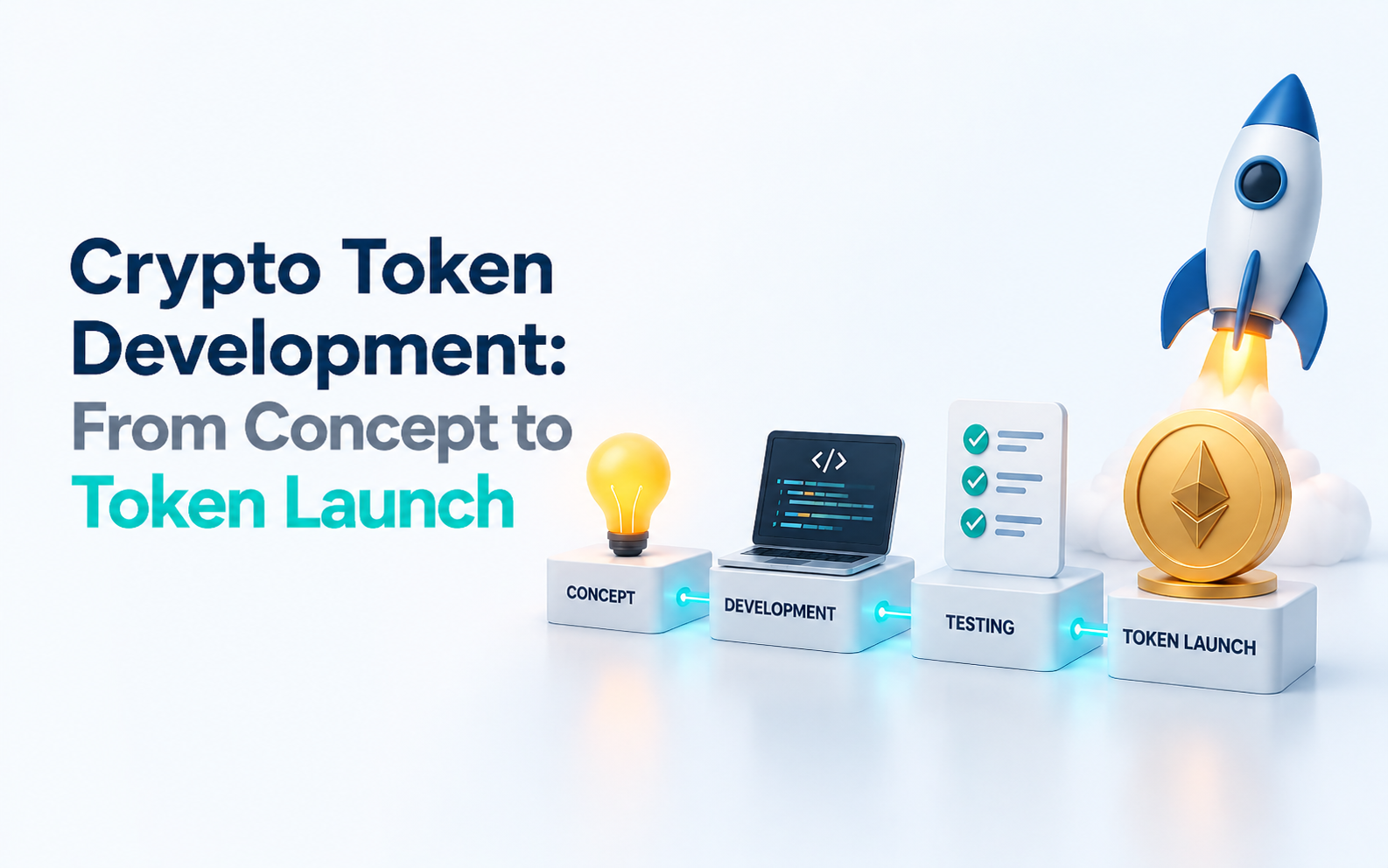
Crypto token development in India involves a sequence of interconnected decisions. The process begins with defining genuine utility, continues through blockchain selection and tokenomics, and moves into smart-contract development, testing, auditing, regulatory assessment, distribution, liquidity, and post-launch management.
India's strong crypto adoption provides a significant market context for businesses exploring blockchain-based products, but adoption alone does not create a successful token. The underlying product, economic model, technical infrastructure, security controls, and operational planning all contribute to how the token functions within its intended ecosystem.
For businesses entering this space, working with an experienced crypto token development company can bring these technical components together under a structured development process. Blockchain App Factory provides token development solutions covering token architecture, smart contracts, tokenomics implementation, multi-chain development, security considerations, and launch infrastructure based on the project's requirements.