Manufacturing Traceability: Building Smarter, More Transparent, and Efficient Production Systems
Introduction
Manufacturing operations have become increasingly complex, with raw materials, components, suppliers, production lines, quality inspections, warehouses, and distribution networks working across multiple locations. In such an environment, manufacturers need clear visibility into what was produced, which materials were used, how each product was manufactured, where quality checks were performed, and where finished products were distributed. Manufacturing traceability provides this visibility by creating a connected digital record of materials, components, production activities, inspections, batches, lots, and finished products throughout the manufacturing lifecycle. By connecting information across ERP, MES, inventory, quality, and shop-floor systems, manufacturers can create a more complete production history and improve operational transparency.
What Is Manufacturing Traceability?
Manufacturing traceability is the process of tracking and documenting the history, movement, transformation, and status of raw materials, components, subassemblies, work-in-progress, and finished products throughout the production process. A comprehensive traceability system can connect supplier information, purchase and receiving records, lot and batch numbers, serial numbers, production orders, machines, workstations, operators, process records, inspection results, rework, scrap, packaging, warehouse movements, shipments, and customer information. This creates a continuous digital chain of information from the moment materials enter a facility through production, quality control, packaging, storage, and final distribution.
Why Is Manufacturing Traceability Important?
Manufacturers need reliable production information to respond quickly to quality issues, material shortages, customer complaints, product defects, and compliance requirements. When information is scattered across spreadsheets, paper documents, production logs, ERP transactions, and quality records, investigating a problem can become time-consuming and may result in data gaps. A modern manufacturing traceability system enables organizations to determine where materials originated, which products used a particular batch, which production line manufactured affected units, which inspections were completed, and which customers received potentially affected products. By connecting these relationships digitally, manufacturers can replace slow, reactive investigations with faster and more data-driven decision-making.
Improved Quality Control
Manufacturing traceability creates a detailed history of production activities and quality inspections, allowing manufacturers to identify the specific material, process, machine, batch, or production stage associated with a quality issue. Instead of investigating an entire production operation, quality teams can narrow the investigation to the relevant production records and determine potential root causes more efficiently. This supports faster corrective action, better quality management, and greater consistency across manufacturing operations.
Faster Recalls and Product Containment
When a defective material or component is identified, manufacturers need to determine which products may be affected as quickly and accurately as possible. Lot-, batch-, and serial-level traceability allows teams to connect individual materials and components with the finished products in which they were used. This enables manufacturers to identify affected products and customers more precisely, helping reduce unnecessary product holds and making recall or containment activities more targeted and manageable.
Better Production Visibility
A connected traceability system provides manufacturers with greater visibility across production stages by tracking material consumption, production progress, quality checkpoints, machine activity, work-in-progress, finished-goods movement, and production deviations. With this information available in a connected environment, production and operations teams can better understand how work is progressing, identify potential bottlenecks, and make more informed decisions. This transforms traceability from simple recordkeeping into a valuable source of operational information.
Reduced Waste and Rework
Manufacturing defects can result in scrap, rework, returns, production delays, and increased operational costs. Traceability helps organizations determine where and when a problem occurred so production teams can investigate the underlying cause rather than repeatedly correcting the final product. By connecting material usage with production and quality information, manufacturers can identify recurring issues, improve process control, reduce unnecessary waste, and support more efficient production operations.
Stronger Supplier Management
Effective traceability extends beyond the factory floor and into the upstream supply chain. Manufacturers can connect incoming materials with supplier details, lot numbers, certificates, inspection results, and purchase records. When a supplier-related quality issue occurs, organizations can determine which materials were received, where those materials were used, and which finished products could potentially be affected. This creates greater visibility across the supplier network and supports stronger supplier quality management.
Compliance and Audit Readiness
Manufacturers often need reliable records demonstrating product origin, production history, quality controls, and supply-chain activities. Digital traceability helps organize these records so they can be accessed more efficiently during audits, customer assessments, investigations, and regulatory reviews. A structured traceability system also makes it easier to maintain consistent production records and demonstrate the history of materials and products when documentation is required.
How Manufacturing Traceability Works
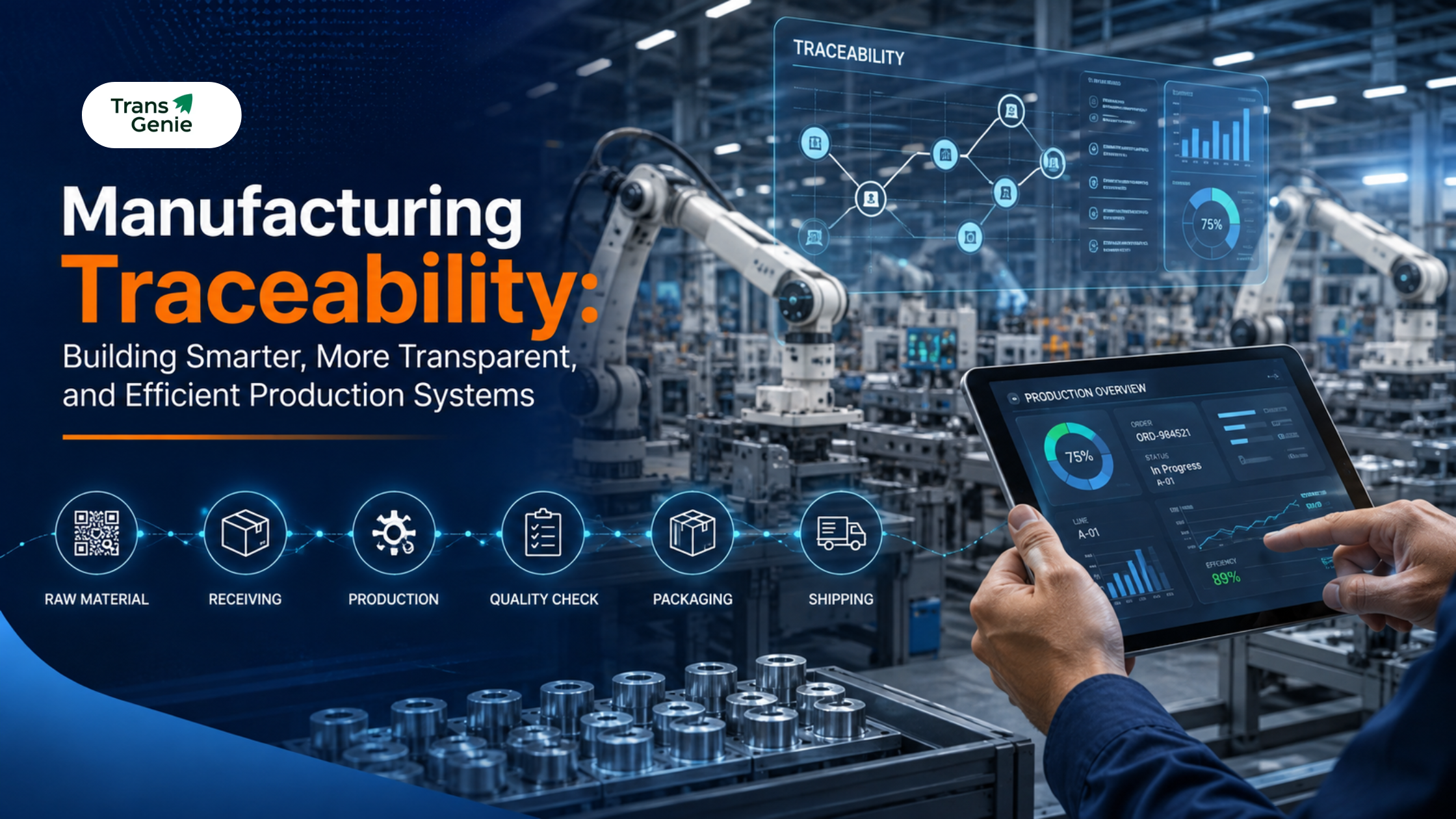
A typical manufacturing traceability process begins when raw materials are received and associated with identifiers such as lot numbers, batch numbers, barcodes, or supplier references. Materials are then allocated to specific production orders or manufacturing processes, creating a relationship between incoming materials and the products that use them. During production, information such as machines, workstations, operators, process parameters, assembly activities, and production timestamps can be recorded. Quality inspections and test results can then be linked to specific batches, lots, serial numbers, or production orders. After production, finished products are associated with their final identifiers and packaging information before moving through warehouses, distributors, and customers. This creates both backward traceability, which identifies where a product or component originated, and forward traceability, which identifies where it was used or shipped.
Digital Technologies Powering Manufacturing Traceability
Modern manufacturing traceability is increasingly supported by digital technologies such as barcodes, QR codes, RFID, IoT sensors, cloud platforms, and AI-powered analytics. Barcodes and QR codes provide practical methods for identifying materials, work-in-progress, products, and shipments, while RFID can support automated identification and tracking of tagged materials and products. IoT sensors can capture information directly from connected equipment and production environments, while cloud-based platforms can centralize traceability information across facilities, production lines, suppliers, and distribution operations. AI and analytics can further help manufacturers identify patterns, detect anomalies, analyze production data, and uncover relationships between quality issues and production conditions.
Key Challenges in Manufacturing Traceability
Although manufacturing traceability provides significant operational benefits, implementation can present several challenges. Production information may be fragmented across ERP, MES, quality, warehouse, and shop-floor systems, making integration essential for achieving end-to-end visibility. Manual data entry through paper forms and spreadsheets can introduce errors and delays, while complex products with multiple components and subassemblies require detailed product genealogy. Supplier data gaps can also limit supply-chain visibility, and older manufacturing equipment may lack modern connectivity capabilities. Addressing these challenges requires a practical strategy that combines process mapping, system integration, automated data capture, and consistent identification methods.
Digital Technologies Powering Manufacturing Traceability
Modern manufacturing traceability is becoming more efficient through connected digital technologies that help manufacturers capture, manage, and analyze production data with greater accuracy. These technologies create a digital connection between materials, production processes, equipment, quality inspections, and finished products, enabling manufacturers to improve visibility and reduce dependence on manual recordkeeping.
Barcodes and QR Codes
Barcodes and QR codes provide a simple and effective way to identify raw materials, components, work-in-progress, finished products, and shipments. By scanning identifiers at key production stages, manufacturers can record material movements and production events quickly while reducing manual data entry. This helps maintain accurate product histories and makes it easier to retrieve information when quality investigations or traceability checks are required.
RFID Technology
Radio Frequency Identification (RFID) enables manufacturers to identify and track tagged materials, components, containers, and products without requiring direct line-of-sight scanning. RFID can be particularly useful in manufacturing environments where materials and products move frequently between workstations, warehouses, and production areas. By automating identification and movement tracking, RFID can improve operational visibility and support more efficient material handling.
IoT Sensors
Internet of Things (IoT) sensors can connect manufacturing equipment and production environments to traceability systems, allowing important operational information to be captured automatically. Depending on the manufacturing process, IoT devices can provide data related to machine activity, temperature, pressure, location, and other production parameters. This connected information can help manufacturers understand production conditions, identify deviations, and create more detailed records of how products were manufactured.
Cloud-Based Traceability Platforms
Cloud-based traceability platforms can centralize manufacturing information across production lines, facilities, suppliers, warehouses, and distribution operations. By providing authorized users with access to connected traceability data, cloud platforms can improve collaboration and visibility across departments and locations. Integration with existing ERP, MES, inventory, and quality systems can further connect business and production information, creating a more complete digital view of the manufacturing lifecycle.
AI and Advanced Analytics
AI and advanced analytics can help manufacturers transform traceability data into actionable insights by identifying patterns, detecting anomalies, supporting predictive decisions, and uncovering relationships between production conditions and quality problems. However, effective AI depends on accurate, consistent, and connected operational data. Fragmented information across ERP, MES, SCADA, and shop-floor systems can limit the effectiveness of advanced analytics, making strong data integration and reliable traceability the foundation for intelligent manufacturing.
How to Build an Effective Manufacturing Traceability System
Building an effective manufacturing traceability system requires more than simply implementing new software or adding barcode scanners to a production line. A successful approach begins with understanding the manufacturing process, identifying the information that needs to be captured, and creating a connected flow of data from raw materials through production, quality inspection, packaging, warehousing, and distribution. The goal is to create a reliable digital history that allows manufacturers to quickly understand where materials came from, how they were transformed, which products were affected by a specific issue, and where finished products were distributed. By following a structured implementation approach, manufacturers can improve visibility, reduce manual work, strengthen quality management, and build a more transparent and efficient production environment.
Define Traceability Requirements
Identify the materials, components, products, processes, and events that need to be tracked.
Establish Unique Identification
Determine how materials, batches, lots, serial numbers, production orders, and finished products will be uniquely identified.
Map the Production Workflow
Document how materials move through receiving, production, inspection, packaging, storage, and distribution.
Connect Existing Systems
Integrate traceability data with ERP, MES, inventory, quality, warehouse, and other relevant systems where appropriate.
Automate Data Capture
Use barcodes, QR codes, RFID, IoT devices, scanners, and system integrations to reduce unnecessary manual entry.
Create Forward and Backward Traceability
The system should allow teams to move from a finished product back to its components and from a specific material or component forward to affected products.
Build Real-Time Visibility
Dashboards and alerts can help production, quality, and supply-chain teams identify issues earlier.
Continuously Improve
Traceability data should be used not only for investigation but also for identifying process improvements, reducing waste, and strengthening production performance.
Manufacturing Traceability for Different Industries
Manufacturing traceability can be adapted to many industries.
Automotive Manufacturing
Track components, assemblies, suppliers, production processes, quality inspections, and vehicle-related parts.
Electronics Manufacturing
Track individual components, PCB assemblies, production stages, testing results, and serialized finished products.
Pharmaceutical Manufacturing
Track raw materials, batches, manufacturing processes, quality testing, packaging, and distribution records.
Medical Device Manufacturing
Detailed component and serial-number genealogy can support quality investigations, product history, and regulatory requirements.
Food and Beverage Manufacturing
Traceability can connect ingredients, production batches, processing activities, packaging, and distribution.
Textile and Apparel Manufacturing
Traceability can connect fibers, yarn, fabric, dyeing, garment production, quality checks, packaging, and distribution.
The Future of Manufacturing Traceability
The future of manufacturing traceability is moving toward connected, automated, real-time, and intelligent production visibility. Manufacturers are increasingly moving beyond basic barcode tracking toward integrated digital records that connect materials, machines, processes, people, quality information, and supply-chain events. AI and advanced analytics can add further value by helping organizations analyze large volumes of manufacturing data, identify anomalies, and support data-driven decisions. As these capabilities develop, traceability can evolve from traditional recordkeeping into a digital thread that follows products throughout their manufacturing lifecycle and provides a trusted foundation for smarter production technologies.
Conclusion
Manufacturing traceability gives organizations the visibility required to understand where materials originate, how products are manufactured, which components are used, how quality is maintained, and where finished products are distributed. A modern traceability system can improve quality control, strengthen supplier management, reduce waste and rework, simplify investigations, support audit readiness, and enable faster responses to product issues. As manufacturing becomes increasingly connected and data-driven, traceability is becoming more than a tracking mechanism it is a foundation for operational intelligence, transparency, efficiency, and resilient production.