Unstructured Data Management Platform Powers Modern Data Strategy
Introduction
Organizations today are generating more data than ever before. However, a large portion of this information does not exist in traditional databases or structured tables. Emails, documents, images, videos, chat logs, and IoT data are examples of information that businesses produce every day. This type of information is known as unstructured data, and it now represents the majority of enterprise data across industries. Studies suggest that more than 80% of enterprise information falls into this category, making it one of the biggest challenges for modern data teams.
Managing this growing volume of complex data requires more than traditional database systems. Organizations need a scalable and intelligent solution that can ingest, organize, and analyze diverse data formats across multiple environments. An unstructured data management platform enables enterprises to handle these large volumes of information effectively, turning scattered digital assets into actionable insights.
Businesses that implement a comprehensive strategy for unstructured data management can improve decision-making, enhance compliance, and unlock hidden value from data assets. As enterprises move toward AI-driven operations and advanced analytics, managing unstructured data has become a strategic priority.
Understanding Enterprise Data Growth and Complexity
Modern enterprises operate in a data-rich ecosystem where information flows from countless sources. Customer interactions, digital transactions, cloud applications, and connected devices continuously produce data streams that must be stored and analyzed. While structured data from traditional databases remains important, the majority of newly generated information comes in unstructured formats.
Unstructured data includes text documents, social media content, audio recordings, emails, images, and video files. Because these formats do not follow a predefined schema, they cannot be easily stored or queried using traditional relational databases.
This rapid expansion creates significant challenges for organizations. Data often becomes fragmented across cloud platforms, file servers, collaboration tools, and enterprise applications. As a result, businesses struggle with visibility, governance, and efficient storage management. Without proper oversight, valuable information remains unused while storage costs continue to rise.
A unstructured data management platform helps enterprises overcome these challenges by providing a unified environment for discovering, organizing, and governing data across multiple systems. By centralizing control and visibility, organizations can transform chaotic data landscapes into structured, usable assets.
Role of an Unstructured Data Management Platform in Modern Enterprises
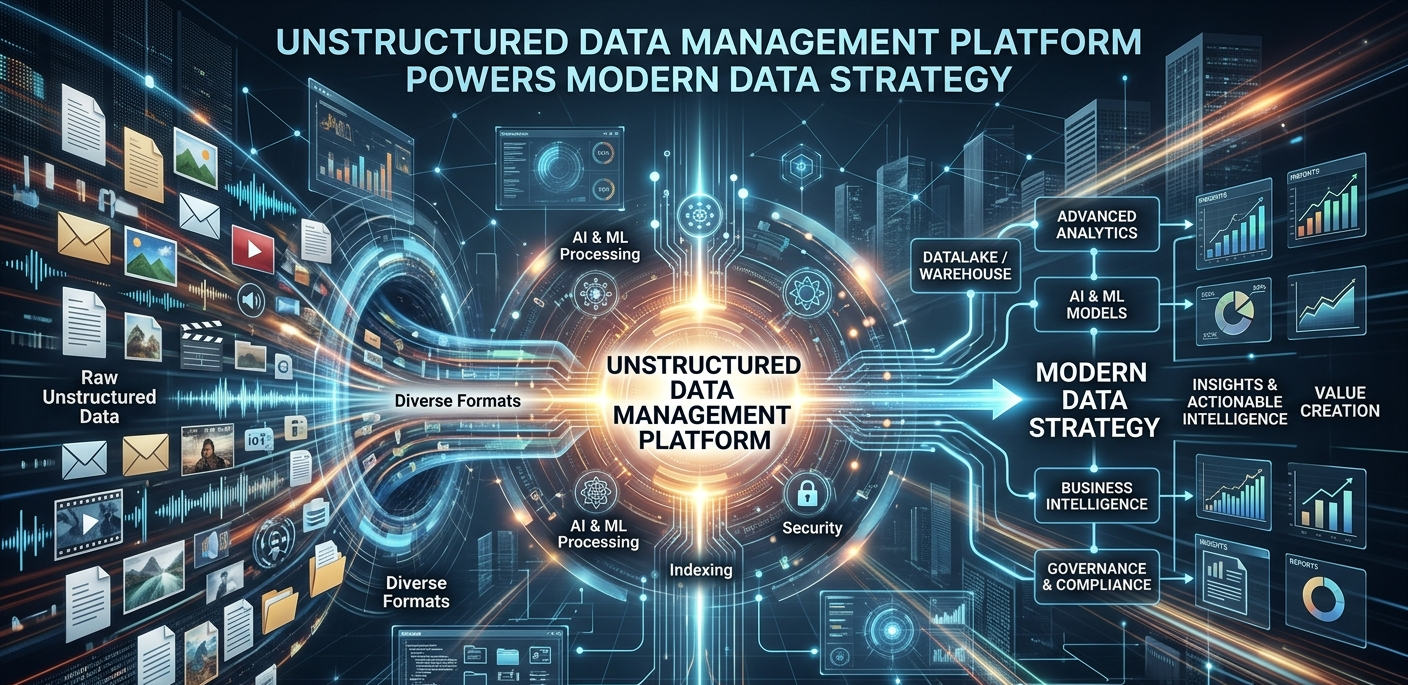
An unstructured data management platform provides a centralized architecture designed specifically for handling data that lacks a predefined structure. Instead of relying solely on traditional database models, these platforms incorporate advanced technologies such as metadata indexing, artificial intelligence, and automated data classification.
These platforms allow organizations to collect and analyze information from distributed storage environments including on-premises infrastructure, cloud platforms, and hybrid systems. The goal is not only to store data but also to extract meaningful insights from it.
For example, modern enterprise platforms support advanced data discovery capabilities. They automatically scan systems to identify files, classify sensitive information, and detect redundant or obsolete data. Intelligent indexing and search technologies allow teams to locate critical documents and digital assets quickly.
Another important capability involves data governance. Enterprises must comply with various regulatory requirements related to privacy, security, and retention policies. An unstructured data management platform enables organizations to enforce policies automatically, ensuring that sensitive information is properly protected and managed throughout its lifecycle.
By combining storage optimization, analytics, and governance features, these platforms help organizations transform unstructured information into a strategic resource.
Why Organizations Need an Unstructured Data Management Platform
As data volumes grow rapidly, enterprises are facing increasing pressure to maintain efficiency, security, and regulatory compliance. Without an effective solution for managing unstructured data, businesses risk losing valuable insights and increasing operational costs.
One major challenge involves storage management. Unstructured data often spreads across multiple storage environments, making it difficult to track usage and eliminate redundant files. Intelligent data optimization tools help organizations identify redundant, obsolete, or trivial data and move inactive information to cost-efficient storage tiers.
Another challenge involves data accessibility. When information is scattered across different platforms, employees spend significant time searching for files or verifying their reliability. A centralized unstructured data management platform provides a unified view of enterprise data, enabling faster discovery and improved collaboration.
Security is also a critical factor. Unstructured data frequently contains sensitive information such as customer records, financial data, and intellectual property. Advanced data governance capabilities ensure that access permissions and compliance policies are applied consistently across the organization.
In addition, the rise of artificial intelligence and machine learning has increased the demand for high-quality data. Many AI applications rely heavily on unstructured information such as text documents, images, and user interactions. Proper data management ensures that these assets are accessible, accurate, and ready for analysis.
Core Capabilities of an Unstructured Data Management Platform
A modern unstructured data management platform includes several integrated capabilities that allow enterprises to control and analyze data across the organization.
Data discovery and indexing play a critical role in identifying information stored across file systems, cloud platforms, and enterprise applications. Advanced scanning tools analyze metadata and file content to provide visibility into where data resides and how it is being used.
Intelligent classification systems help categorize data automatically based on content and context. Machine learning algorithms analyze files to determine whether they contain sensitive information, intellectual property, or operational data. This automated classification reduces manual effort and improves governance accuracy.
Data governance and compliance management are essential for organizations operating in regulated industries. Policy-driven governance allows enterprises to enforce access controls, retention schedules, and regulatory requirements automatically.
Another key capability involves storage optimization. Many organizations store large amounts of redundant or outdated information that increases infrastructure costs. Intelligent data management tools analyze usage patterns and move rarely accessed files to lower-cost storage environments while preserving accessibility.
Finally, integration capabilities allow the platform to connect with analytics tools, enterprise applications, and AI systems. By integrating with business intelligence platforms, organizations can transform unstructured data into actionable insights that support strategic decision-making.
Enterprise Solutions for Scalable Data Management
Organizations increasingly rely on enterprise-grade platforms to handle the complexity of modern data ecosystems. Solutions such as advanced data integration and analytics platforms allow companies to manage structured and unstructured data within a unified framework.
Enterprise platforms provide end-to-end capabilities including data ingestion, preparation, governance, and analytics. They help organizations manage complex data pipelines across on-premises systems, cloud environments, and hybrid architectures while maintaining control and data quality.
These solutions are designed to scale with growing data volumes and evolving business needs. They support real-time data processing, automated workflows, and advanced analytics that enable organizations to extract maximum value from their information assets.
In addition, enterprise platforms often integrate with data cataloging systems that provide detailed visibility into data lineage, usage patterns, and quality metrics. This transparency allows data teams to maintain trust and reliability across analytics and reporting systems.
Future Trends in Unstructured Data Management Platform Technologies
The future of data management is increasingly driven by artificial intelligence, automation, and cloud-native architectures. As organizations adopt advanced analytics and generative AI technologies, the demand for intelligent data platforms will continue to grow.
Modern unstructured data management platform solutions are beginning to incorporate AI-powered semantic search, automated tagging, and natural language processing capabilities. These technologies enable organizations to analyze vast amounts of text, images, and multimedia content more efficiently.
Another emerging trend involves multi-cloud data management. Enterprises often store data across multiple cloud providers and on-premises systems. Unified data platforms allow organizations to manage and move data seamlessly across these environments while maintaining governance and security.
Automation will also play a key role in the future of enterprise data management. Intelligent platforms will automatically detect data quality issues, optimize storage resources, and recommend governance policies based on usage patterns.
As data volumes continue to expand globally, organizations that invest in scalable and intelligent data platforms will be better positioned to leverage data as a strategic asset.
Conclusion
Unstructured data has become the dominant form of information generated by modern enterprises. From documents and multimedia files to application logs and social media interactions, these diverse data sources contain valuable insights that can drive innovation and competitive advantage.
However, managing such complex data environments requires advanced technologies and strategic planning. A robust unstructured data management platform enables organizations to centralize control, improve data governance, and unlock meaningful insights from previously untapped information.
By implementing the right tools and strategies, enterprises can transform unstructured data from a storage challenge into a powerful resource for analytics, artificial intelligence, and informed decision-making. In an increasingly data-driven economy, effective unstructured data management is no longer optional—it is a critical component of enterprise success.