Cognac Beyond the Cellar Door: Ten Stops That Explain the City
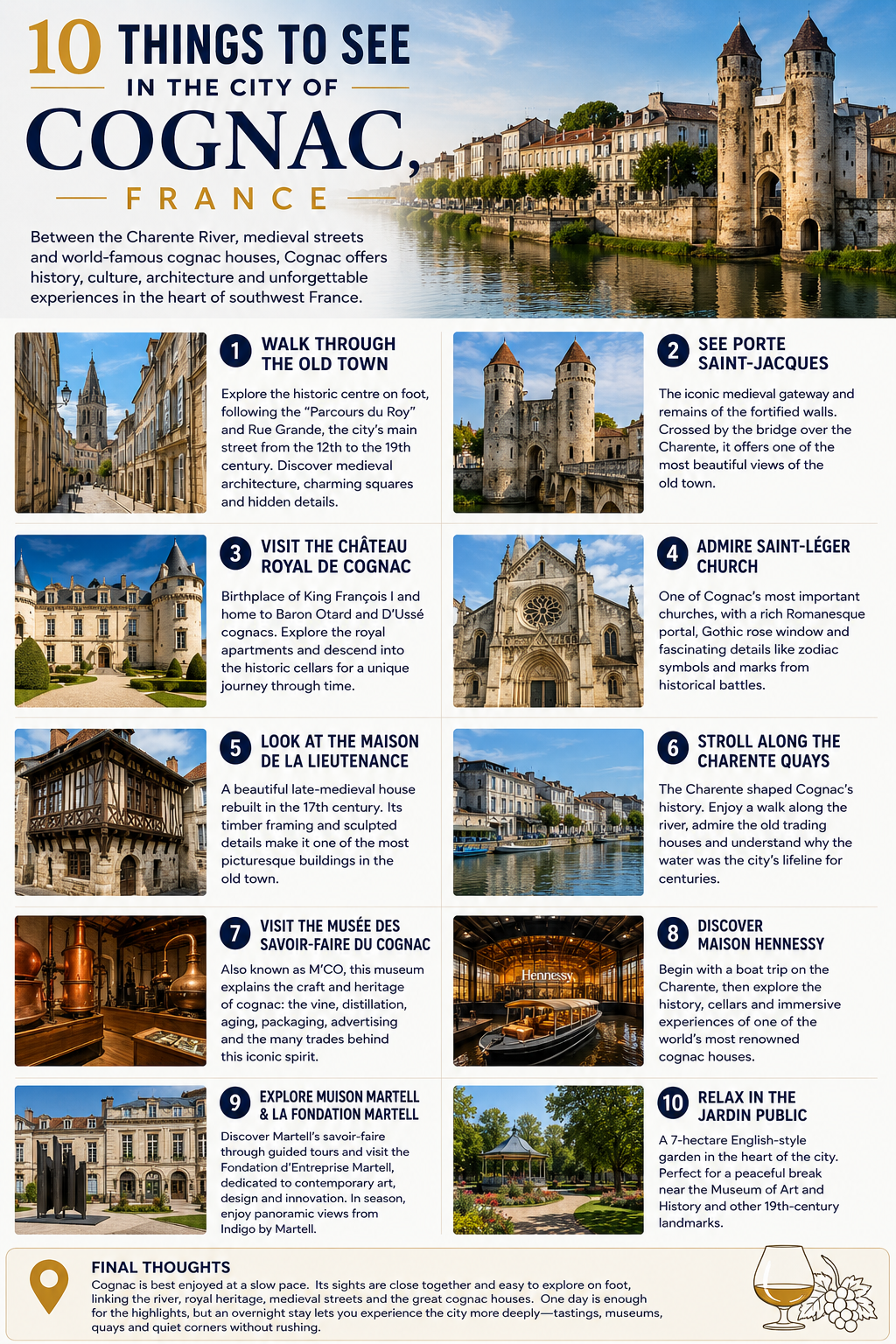
Cognac is a small French city with a world-sized name, but the real place is more varied than the label suggests. Set on the Charente River, it grew through water transport, salt, wine, eau-de-vie, warehouse trade, and the patient work of distillers, coopers, glassmakers, and merchants. The result is a compact urban landscape where medieval gates, pale limestone façades, Romanesque stone carving, riverside quays, public gardens, and major cognac houses stand within walking distance of one another.
The city is best explored as a sequence rather than a checklist. A good route starts in the old town, follows the logic of the river, passes through royal and religious heritage, then adds museums and working cellar culture for technical depth. This pace helps a visitor understand why Cognac became important: not by accident, but because geography, craft, materials, and trade routes reinforced each other over centuries.
The City Works Like a Map of Trade, Stone, and Water
The old town is the most useful starting point because it gives Cognac a human scale. Rue Grande connects the castle area with Saint-Léger Church and shows the kind of street pattern that supported daily commerce for generations. Narrow alignments, stone façades, small architectural details, and changes in building materials reveal how the centre developed before cars, wide roads, and modern storefronts changed the rhythm of French towns.
Porte Saint-Jacques gives the route its defensive outline. The two towers once controlled access from the river side, where a bridge and fortified walls shaped movement into the town. Viewed from across the Charente, the monument reads clearly: stone mass for protection, vertical towers for visibility, and a gateway position tied directly to trade and transport. It is one of the strongest places in Cognac for understanding how the river was not scenery, but infrastructure.
The Château Royal de Cognac adds a different kind of weight. It is associated with François I and also with later cognac ageing, so it connects political memory with commercial use. This overlap is valuable for visitors because the building is not only a royal site and not only a drinks-related stop. Thick masonry, historic rooms, and cellar spaces show how architecture can move from defense and residence to storage, ageing, and brand heritage without losing its older identity.
Ten Places That Give Cognac Its Shape
Saint-Léger Church slows the pace in a productive way. Its façade appears within the density of the old streets, making the carved portal and rose window feel concentrated rather than isolated. The sculpted details, including zodiac signs and agricultural scenes, are not decorative filler; they show how stonework communicated time, belief, labor, and social order. Around the church, the cloister and traces of damage add evidence of use, conflict, repair, and adaptation.
The Maison de la Lieutenance is smaller than the towers or château, but it is one of the most expressive façades in the old town. Timber framing, carved wood, a stone ground level, and late-medieval proportions make it a practical lesson in materials. Wood allowed lighter upper construction and sculptural detail, while stone gave the base durability and resistance at street level. It is the kind of building that rewards walking slowly instead of trying to cover the city by vehicle.
A strong Cognac route should combine monuments, craft sites, and quiet urban spaces:
-
Walk Rue Grande to read the old street plan through façades, proportions, and shopfront scale.
-
See Porte Saint-Jacques from the opposite bank for the clearest view of its river-facing role.
-
Visit the Château Royal de Cognac to connect royal history with cellar heritage.
-
Study Saint-Léger Church for Romanesque carving, Gothic elements, and visible marks of time.
-
Stop at the Maison de la Lieutenance for timber framing and carved urban architecture.
-
Follow the Charente quays to understand transport, warehousing, and river trade.
-
Add the Musée des Savoir-Faire du Cognac for distillation, cooperage, packaging, glass, and export context.
-
Compare major cognac houses such as Hennessy and Martell for different approaches to history, blending, scenography, and tasting.
-
Include the Fondation d’Entreprise Martell when contemporary design and exhibitions are part of the plan.
-
Finish in the Jardin Public for a quieter view of nineteenth-century civic Cognac.
The Musée des Savoir-Faire du Cognac is especially useful because it turns a famous product into a technical system. It explains vines, distillation, barrel ageing, cooperage, labels, packaging, advertising, and export networks as connected trades. That matters because cognac is not produced by one gesture. It depends on agricultural conditions, copper stills, oak barrels, cellar humidity, skilled blending, bottle design, and the commercial ability to send a regional product far beyond Charente.
The quays make those processes easier to understand. Large cognac houses face the Charente because the river once carried goods and gave the city a practical trading route. Barrels, glass, wine, salt, and eau-de-vie all belonged to a wider logistical chain, and the riverbank still explains why warehouses, gates, and merchant buildings are placed where they are. A walk here is not just scenic; it links physical geography to economic history.
For travelers who want to stay near the heritage instead of treating Cognac as a short stop, accommodation can shape the entire rhythm of the visit. A private historic property with oak beams, dressed stone, preserved furniture, large light-filled rooms, and modern comfort gives the surrounding region a more tactile presence. In that context, villas in Charente fits naturally into an itinerary focused on architecture, privacy, cellar visits, riverside walks, and slow travel rather than a compressed schedule.
The Jardin Public is a sensible final pause because it changes the materials underfoot. After stone streets, cellar walls, church carving, and river quays, its English-style layout brings curved paths, mature trees, lawns, shade, and civic calm into the route. The nearby museum setting also points to another period in Cognac’s development, when private mansions, collections, and public green space became part of the city’s cultural identity.
A Slower Visit Reveals the Real Cognac
Cognac works because its sights support one another. The river explains trade; trade explains the quays and warehouses; the old town explains movement and daily commerce; the château adds royal memory; the church and cloister add religious and social depth; the museums and houses explain the technical skill behind the city’s global reputation. A one-day visit can cover the essentials, but a longer stay gives enough time to connect them without rushing.
The best way to leave Cognac is with a practical mental map: towers at the river, streets rising into the old centre, cellars holding the temperature and humidity that ageing requires, and gardens softening the urban stone. That map turns the city from a famous name into a specific place built from limestone, oak, water, craft, and patience.