Virtual Reality in Education: Why VR Learning Is Important for Students
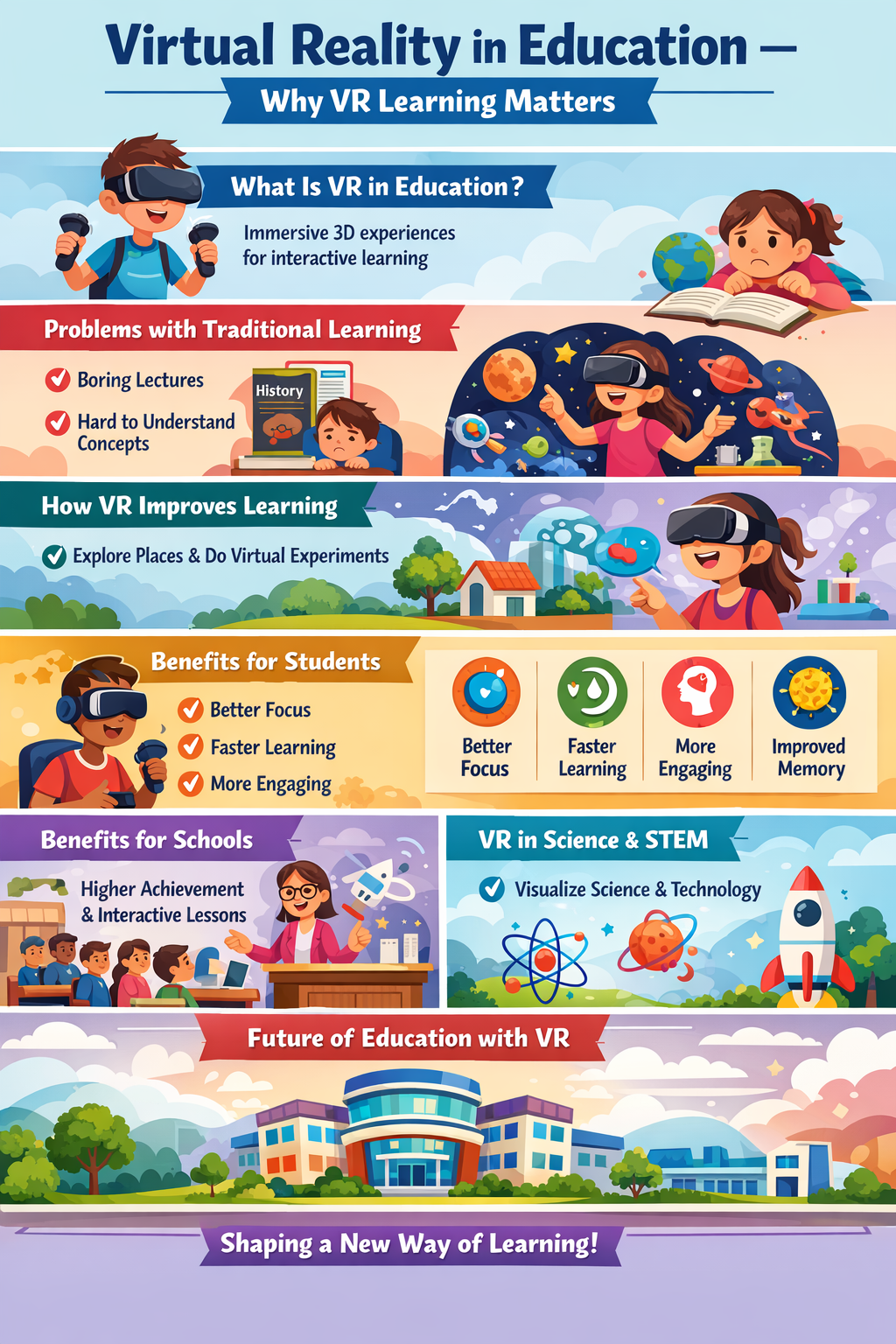
Education is evolving rapidly in the digital age, and Virtual Reality (VR) is emerging as one of the most powerful tools transforming how students learn. Unlike traditional methods that rely heavily on textbooks and memorization, VR allows students to experience concepts in a virtual environment, making learning more engaging, interactive, and effective.
By placing students inside a 3D learning space, Virtual Reality bridges the gap between theory and practice, helping learners understand subjects more deeply and retain knowledge for longer periods.
What Is Virtual Reality in Education?
Virtual Reality in education refers to the use of immersive, computer-generated environments where students can explore, interact, and learn through realistic simulations. Using VR headsets and interactive content, students can visit virtual science laboratories, travel through space, explore historical events, or understand complex biological processes.
This experiential form of learning transforms abstract concepts into visual and hands-on experiences, making lessons easier to understand and more enjoyable for students of all age groups.
Why Is Virtual Reality Important in Education?
Traditional teaching methods often face challenges in explaining complex or abstract topics. Many students struggle to visualize concepts such as molecular structures, astronomical systems, or internal human anatomy. Virtual Reality solves this challenge by offering visual, interactive, and immersive learning experiences.
VR encourages active participation rather than passive listening, which improves focus and comprehension. It also helps reduce learning fatigue by making lessons more engaging and dynamic.
Key Benefits of VR Learning for Students
Virtual Reality offers several benefits that directly enhance student learning outcomes:
Improves concept clarity by visualizing difficult topics
Increases student engagement through immersive experiences
Enhances memory retention by learning through experience
Encourages curiosity and creativity in young learners
Boosts confidence by allowing safe practice and exploration
These benefits make VR a powerful tool for both academic learning and skill development.
How VR Helps Students Learn Better
Students learn more effectively when they can see and interact with what they are studying. Virtual Reality supports multiple learning styles visual, auditory, and experiential ensuring that no student is left behind.
By reducing distractions and improving concentration, VR creates a focused learning environment. Students can revisit lessons, explore concepts at their own pace, and gain a deeper understanding without the pressure of traditional classrooms.
Why Schools Are Adopting Virtual Reality
Schools across the world are adopting Virtual Reality to modernize classrooms and improve learning outcomes. Educational institutions using VR report:
Higher student participation and interest
Better academic performance and exam results
Increased interest in STEM subjects
More interactive and collaborative classrooms
VR also supports teachers by making lessons easier to explain and more impactful.
Role of VR in Science and STEM Education
Virtual Reality plays a crucial role in science, technology, engineering, and mathematics (STEM) education. It enables students to conduct virtual experiments, understand complex formulas visually, and explore scientific phenomena that are otherwise impossible to experience in a classroom.
This practical exposure builds strong conceptual foundations and encourages students to pursue careers in science and technology fields.
Future of Virtual Reality in Education
The future of education is closely connected to immersive technologies like Virtual Reality. As schools move toward smart classrooms and digital learning platforms, VR will become an essential part of modern education systems.
With continuous technological advancements, VR will offer more personalized, accessible, and inclusive learning experiences for students worldwide.
Conclusion
Virtual Reality is not just a technological innovation—it is a game-changer in education. By creating immersive, interactive, and meaningful learning experiences, VR is shaping the future of education and empowering students to learn better, faster, and with greater confidence.