What Is a VR Lab in Schools and How Does It Work?
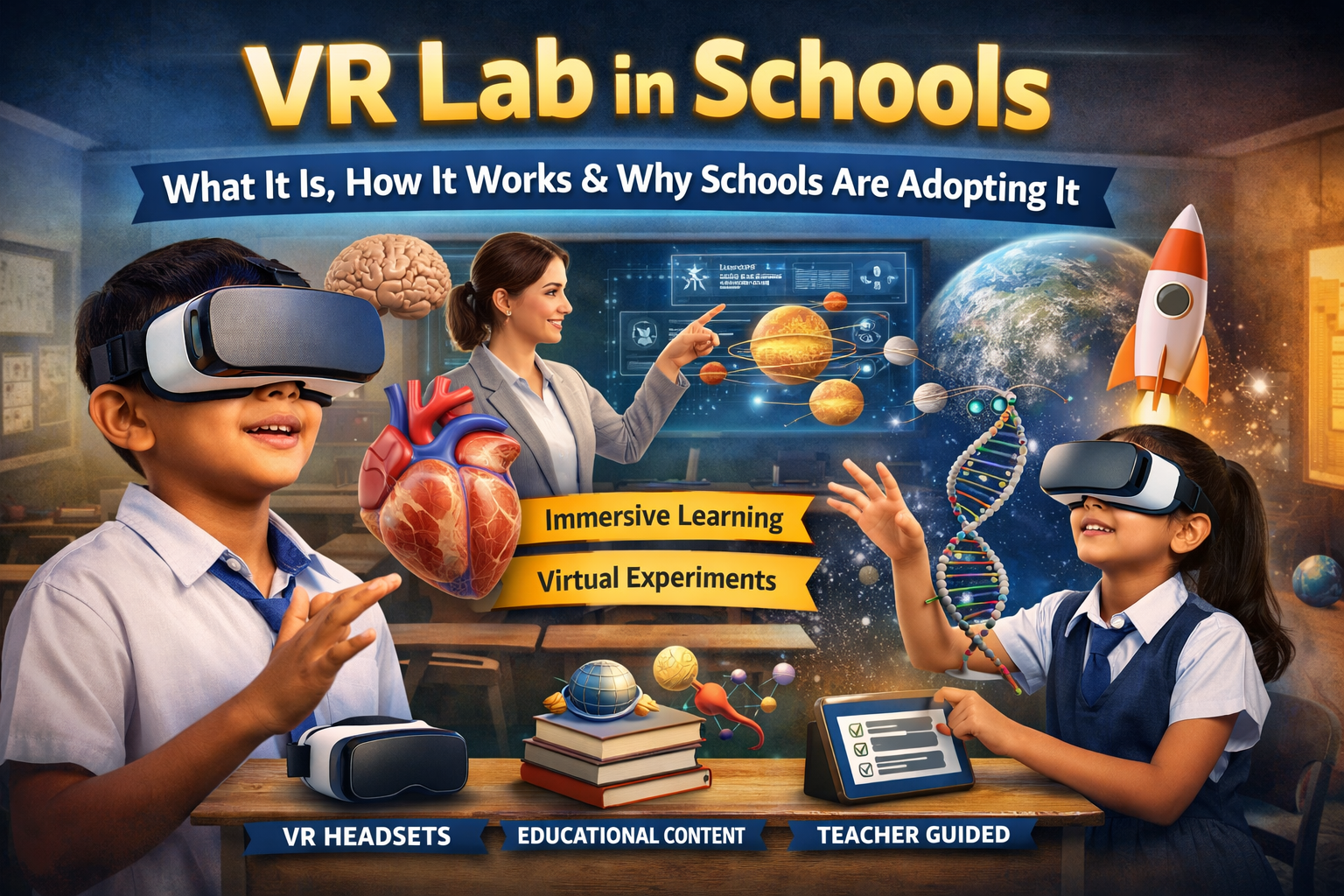
Education is rapidly evolving with the help of advanced technologies, and one of the most impactful innovations is the VR Lab in schools. Virtual Reality (VR) is no longer limited to gaming—it is now transforming how students learn, understand, and experience complex concepts.
This article explains what a VR lab is, how it works, and why schools are adopting it as a modern learning solution.
What Is a VR Lab in Schools?
A VR Lab (Virtual Reality Lab) is a dedicated learning space where students use VR headsets and immersive software to explore subjects in a 3D virtual environment. Instead of reading from textbooks or watching flat videos, students can experience lessons as if they are happening in real life.
For example:
Walking inside the human heart
Performing chemistry experiments safely
Exploring space, planets, and galaxies
Visualizing electromagnetic fields in physics
This makes learning more interactive, engaging, and easier to understand.
How Does a VR Lab Work?
A VR lab works through a combination of hardware and software:
- VR Headsets
Students wear VR headsets that display 360-degree immersive visuals. These headsets track head movement, allowing students to look around naturally. - Educational VR Content
Specially designed educational content covers subjects like:
Biology
Physics
Chemistry
Geography
History
Environmental science
The content is aligned with school curricula and learning objectives.
- Teacher Control System
Teachers can control sessions, select lessons, and monitor student activity through a dedicated dashboard. This ensures structured and guided learning. - Student Interaction
Students interact with virtual objects, conduct experiments, and explore environments, making learning active rather than passive.
Why Are Schools Adopting VR Labs?
Schools across India and globally are adopting VR labs for several reasons:
✔ Better Concept Understanding
VR helps students visualize abstract and complex topics that are difficult to explain through traditional methods.
✔ Increased Student Engagement
Immersive experiences keep students focused and curious, improving attention and participation.
✔ Safe Learning Environment
Dangerous or expensive experiments can be performed safely in a virtual lab.
✔ Improved Learning Outcomes
Studies show that experiential learning improves memory retention and conceptual clarity.
✔ Inclusive & Multilingual Learning
VR content can be customized for different learning levels and languages, making education more inclusive.
Subjects That Benefit Most from VR Labs
Biology: Human anatomy, cell structure, organ systems
Physics: Magnetic fields, forces, electricity, motion
Chemistry: Molecular structures, reactions, lab safety
Geography: Earth structure, climate, natural disasters
History: Ancient civilizations, monuments, events
Is VR Safe for Students?
Yes, when used responsibly.
Schools follow recommended usage guidelines, such as:
Short session durations
Age-appropriate content
Supervised usage
Modern educational VR systems are designed specifically for student safety and comfort.
Role of EdTech Companies in VR Education
EdTech companies play a crucial role in bringing VR education to schools by providing:
Curriculum-aligned content
Teacher training
Hardware setup
Ongoing technical support
Companies like FotonVR are helping schools implement immersive VR labs by offering customized educational content, teacher-friendly software, and end-to-end VR lab solutions designed for school education.
Future of VR Labs in Education
With initiatives like NEP 2020 promoting experiential and digital learning, VR labs are expected to become a standard part of modern classrooms. As technology becomes more accessible, immersive learning will play a key role in shaping future-ready students.
Conclusion
A VR lab in schools bridges the gap between theory and practical understanding. By allowing students to learn through experience, VR transforms education into an engaging, effective, and future-focused journey.
Schools that adopt VR learning today are preparing students not just for exams but for the real world.