# From Wallet to Execution Engine: The Rise of Cross-Chain Trading Terminals
1. Multi-chain users, single-chain execution
The crypto ecosystem has become fundamentally multi-chain.
Users hold assets across Ethereum, multiple rollups, sidechains, and alternative L1 networks. Capital no longer sits in one place, and neither does liquidity. Public data shows that DeFi activity is widely distributed across chains rather than concentrated in a single ecosystem.
link: https://defillama.com/chains
Yet the execution logic of most wallets still behaves as if the ecosystem were single-chain.
Wallets can display tokens across networks, but they rarely coordinate the movement of capital between those networks. When users want to act — trade, rebalance, or deploy funds — they still need to orchestrate the process themselves.
This means switching networks, finding bridges, opening external DEX interfaces, and manually tracking several transaction states at once.
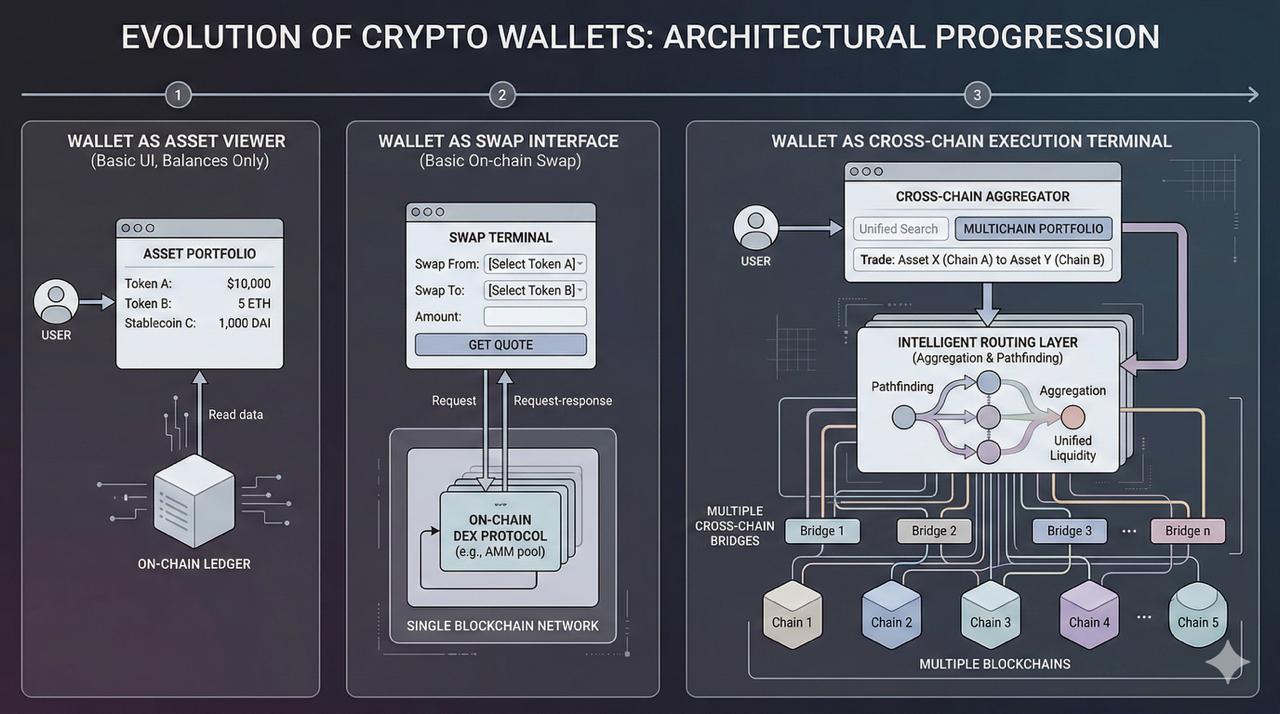
The gap is subtle but fundamental: wallets visualize multi-chain assets, but they do not execute multi-chain strategies.
2. Cross-chain trading is a routing problem
Executing a swap on one chain is relatively predictable.
A liquidity pool is selected, price impact is calculated, gas is paid, and the trade settles. Cross-chain trading introduces a completely different category of complexity.
Several new variables appear simultaneously:
- assets may not share direct liquidity
- bridges add latency and settlement delays
- transactions run across multiple environments
- routing choices affect total cost dramatically
- bridge-layer risk must be considered
As a result, cross-chain trades often consist of multiple sequential actions. A user might swap an asset, bridge it to another network, and swap again into the final asset.
Sometimes the route becomes even more complex, involving multi-hop paths or fallback execution strategies if liquidity disappears mid-route.
Bridge usage metrics demonstrate how frequently capital moves between ecosystems, highlighting the scale of this challenge.
link: https://defillama.com/bridges
The difficulty here is not merely interface design — it is pathfinding through fragmented liquidity.
3. Why wallets need routing APIs
The most practical solution is to move routing intelligence out of the wallet.
Instead of embedding complex logic directly into wallet software, wallets can integrate execution APIs provided by specialized infrastructure.
With a cross-chain aggregation API:
- the wallet sends a request describing the desired outcome
- the routing engine analyzes liquidity across chains
- the system constructs an optimal execution path
- the wallet simply signs the resulting transactions
The wallet therefore does not need to understand bridges, swaps, or routing rules. It becomes an orchestration layer that delegates pathfinding to infrastructure designed for that purpose.
This approach mirrors the evolution of on-chain trading. DEX aggregation engines removed the need for users to choose between exchanges manually. The same abstraction is now appearing in cross-chain execution.
4. Aggregators become the infrastructure layer for wallets
Cross-chain aggregators provide the routing intelligence required to make this system work.
Their responsibilities typically include:
- route discovery across chains
- slippage estimation across liquidity venues
- multi-hop execution planning
- fallback routing when paths fail
- integration with bridge infrastructure
Several projects operate across these layers.
Route aggregation platforms such as LiFi help unify fragmented liquidity. Liquidity routing marketplaces like Bungee provide additional execution paths. Bridge primitives such as Stargate enable direct cross-chain liquidity transfers, while bridge routers like Squid Router extend routing coverage through alternative infrastructure.
Within this landscape, CrossCurve represents a deeper aggregation model.
Rather than focusing on a single layer of execution, CrossCurve aggregates across multiple infrastructure categories simultaneously — bridges, DEX liquidity, and even other aggregators. This expanded aggregation surface allows it to construct complex execution paths that traditional routers cannot easily replicate.
By combining bridges such as Stargate, router layers like Squid, on-chain DEX liquidity, and external aggregators, CrossCurve enables anything-to-anything routing. An asset can move from any supported chain and token into another chain and token through a single coordinated execution plan.
This breadth significantly improves routing flexibility and fallback coverage, which is essential for wallet-native cross-chain trading.
link: https://crosscurve.fi
5. Delegating execution changes the role of the wallet
When routing intelligence moves into infrastructure, the wallet’s role changes.
Instead of deciding how a trade should be executed, the wallet becomes the interface through which users initiate and approve actions.
Execution complexity is handled behind the scenes.
This shift allows wallets to simplify the user experience while supporting more sophisticated strategies. Multi-step cross-chain trades can be presented as a single action, even if the underlying execution involves several networks and protocols.
The wallet remains the security boundary where users sign transactions, but routing intelligence lives elsewhere.
6. Wallets as cross-chain trading terminals
Wallets have evolved steadily over time.
They began as secure storage tools.
Then they became transaction interfaces.
Later they expanded into portfolio dashboards that display assets across chains.
The next stage is execution.
Wallets that integrate deep aggregation infrastructure can transform into cross-chain trading terminals — environments where users can move capital across ecosystems without thinking about bridges, networks, or routing decisions.
In this model, the wallet itself is not a bridge and not a DEX.
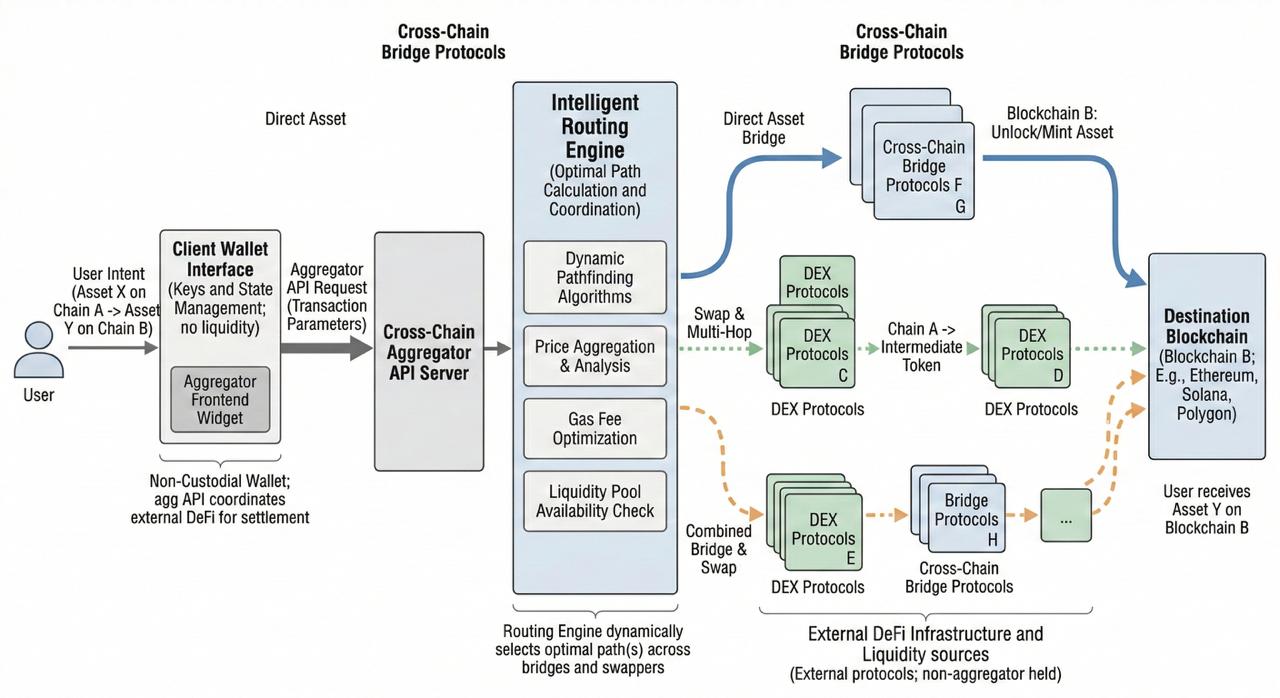
Instead, it becomes the terminal through which execution engines operate.
Closing Thought
As DeFi liquidity spreads across chains, the ability to move capital intelligently becomes more important than simply tracking balances.
Cross-chain aggregation infrastructure provides the routing intelligence that wallets currently lack. By integrating engines like CrossCurve — capable of aggregating bridges such as Stargate, routers like Squid, DEX liquidity, and even other aggregators — wallets gain access to a much broader execution universe.
In the next phase of Web3 UX, wallets will not only show where assets are.
They will determine where those assets can go.