Is Your Business Website Built to Handle Growth, or Will It Break the Moment You Scale?
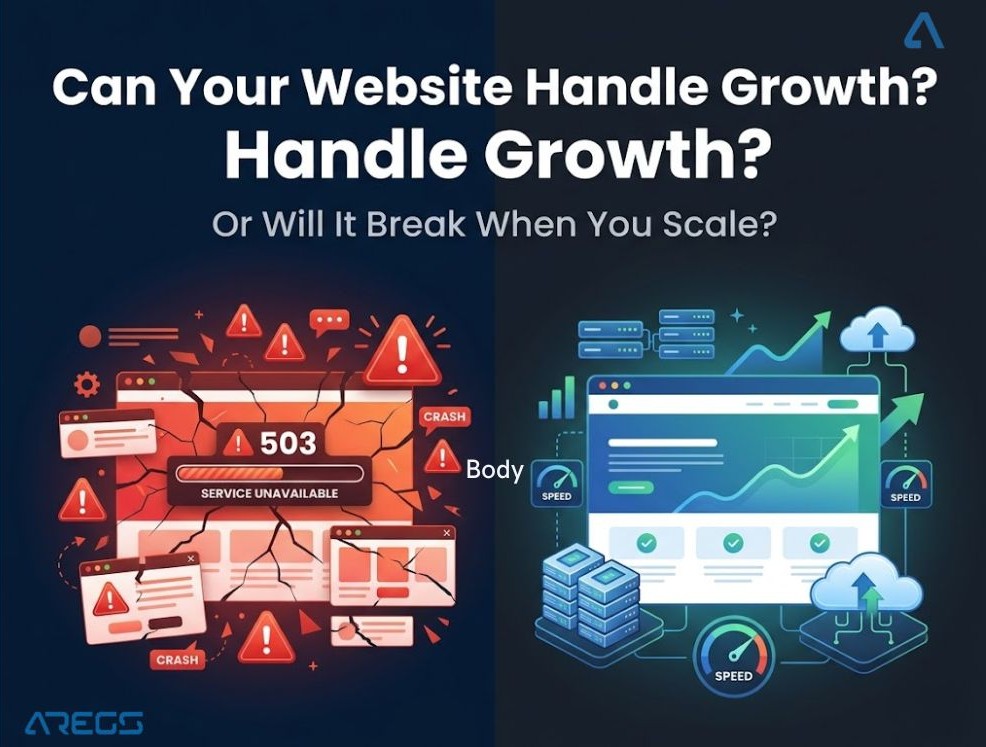
There is a particular kind of growth problem that catches businesses completely off-guard: a website that works perfectly at one level of traffic, content, and complexity, but then begins to visibly strain and fail as the business scales. Pages slow to a crawl during a product launch. The CMS becomes unusable as content volume grows. A new feature requirement turns out to be impossible without rebuilding half the site. What looked like a solid website at launch reveals itself, under the pressure of real growth, to have been built for where the business was, not where it was going. This is an expensive lesson to learn after the fact. Working with a customweb development company in Gurgaon that builds with scalability as a design principle from day one can save businesses from the cost, disruption, and lost momentum of rebuilding a website that was never architected to grow.
What 'Scalable' Actually Means in Website Development
Scalability is one of the most overused and least understood terms in technology. In the context of website development, it means the ability of your website to maintain performance, reliability, and functionality as three things grow simultaneously: traffic volume, content volume, and feature complexity.
A website that handles 500 monthly visitors without issue but degrades significantly at 50,000, is not scalable by traffic. A CMS that works well with 100 product pages but becomes impossibly slow to manage with 10,000 is not scalable by content. A codebase that accommodates your current feature set but requires near-total reconstruction every time a new requirement emerges is not scalable by complexity.
True scalability means that growth in any of these dimensions can be accommodated without fundamental architectural changes, through configuration, infrastructure upgrades, or modular feature additions, rather than rebuilds.
The Most Common Scalability Failures
Shared Hosting That Can't Handle Traffic Spikes
The majority of small business websites are hosted on shared hosting plans, servers where hundreds or thousands of websites share the same computing resources. Under normal traffic conditions, this is often adequate. But when a product launch, a viral social media post, a press mention, or a successful advertising campaign sends a surge of visitors to the site simultaneously, shared hosting buckles.
Pages timeout. The site goes offline. Visitors who arrive at exactly the moment of maximum interest find a broken experience and leave. The business that worked months for that moment of attention loses it entirely because the infrastructure wasn't built to handle it.
The fix is not necessarily expensive: managed cloud hosting on platforms like AWS, Google Cloud, or DigitalOcean can auto-scale computing resources in response to traffic demand, ensuring that a traffic spike is an opportunity rather than a crisis. The cost difference between shared hosting and scalable cloud hosting is often a few hundred rupees a month, trivial compared to the cost of downtime during a critical moment.
Monolithic CMS Architectures That Slow Down Under Content Volume
Many businesses launch on a CMS like WordPress and add content steadily over time, blog posts, product pages, service descriptions, landing pages, team profiles, and case studies. As the content library grows into the hundreds or thousands of pages, the database queries that power every page load become progressively slower.
Without proper database optimization, caching configuration, and infrastructure designed for content-heavy sites, what was a fast website at launch becomes a frustratingly slow one two years later. And slow websites, as discussed extensively in SEO research, rank lower, convert less, and cost the business in ways that aren't immediately visible in a single metric.
Addressing this proactively, through proper database indexing, object caching, CDN implementation, and query optimization, is far less expensive than diagnosing and fixing performance degradation after it's already affecting rankings and conversions.
Tightly Coupled Codebases That Resist Change
In poorly architected websites, everything is connected to everything else. Change the navigation and three other features break. Update the payment integration, and the product listing pages display incorrectly. Add a new content type, and the search functionality stops working. This is the hallmark of tightly coupled code, where components are so interdependent that modifying one creates cascading failures elsewhere.
For growing businesses, this is a development tax that compounds over time. Every new feature takes longer and costs more than it should, because developers must carefully untangle existing dependencies before adding anything new. Innovation slows. The team becomes reluctant to touch the codebase at all for fear of breaking something.
The solution is a modular architecture, building a website from independent, loosely coupled components that can be modified, replaced, or extended individually without affecting the rest of the system. This approach requires more careful planning upfront, but delivers dramatically lower maintenance costs and faster feature development over the life of the website.
Building for Scale: Key Architectural Principles
Separate the Front-End From the Back-End
One of the most powerful modern approaches to scalable website development is the decoupled or headless architecture — separating the content management layer (the back-end) from the presentation layer (the front-end). In a traditional monolithic website, these two layers are tightly integrated. In a headless architecture, they communicate through an API, allowing each to be scaled, updated, or replaced independently.
This means you can upgrade your front-end framework without touching your CMS. You can deliver the same content to a website, a mobile app, and a digital kiosk from a single back-end. And you can scale the front-end and back-end independently based on where the performance demand actually lies.
Headless architecture is not right for every business; it adds complexity and upfront cost that isn't justified for a simple brochure website. But for businesses with serious growth ambitions, omnichannel content needs, or complex integration requirements, it represents the most future-proof approach available.
Design for Caching From Day One
Caching, storing pre-generated versions of pages and data so they can be served instantly without repeated database queries, is one of the most impactful performance optimizations available and one of the most commonly neglected during initial development.
A website designed with caching in mind, at multiple levels (browser caching, server-side caching, CDN caching, database query caching), can handle orders of magnitude more traffic than the same website without caching, using the same underlying infrastructure. This is not a post-launch optimization; it needs to be designed into the architecture from the beginning to be implemented effectively.
Use APIs for Third-Party Integrations
Every third-party service your website depends on, a payment gateway, a CRM, an email marketing platform, an analytics tool, should be integrated via a clean, documented API rather than through direct database connections or fragile plugin dependencies. API-based integrations can be updated, replaced, or extended without touching the core website codebase, and they fail gracefully when the third-party service is temporarily unavailable rather than taking down the entire site.
Questions to Ask Your Development Partner About Scalability
• What hosting infrastructure do you recommend, and how does it handle traffic spikes?
• How is the codebase structured, monolithic or modular? Can you explain the component architecture?
• What caching strategy is built into the development plan?
• How are third-party integrations handled, plugins, direct integrations, or API-based?
• If we need to add a major new feature type in 18 months, how difficult would that be with this architecture?
• What does the database structure look like, and how has it been optimized for query performance?
A development partner who can answer these questions clearly and specifically has genuinely thought about your website's future — not just its launch.
Conclusion
The website you build today will be asked to do considerably more in two, three, and five years than it does at launch. Businesses that build with scalability as a primary architectural concern are the ones that can respond to growth opportunities quickly, reliably, and without the cost and disruption of emergency rebuilds.
Scalability is not a feature you add later. It is a design philosophy that must be embedded from the first line of code. Choose a development partner who understands this, and make sure your brief reflects it as a non-negotiable requirement, not an optional upgrade.