The Wheel Strategy: How to Generate Monthly Income from Stocks on Interactive Brokers
Most people think options trading is for Wall Street pros with too many screens and too much coffee. But the reality is simpler: the wheel strategy is one of the most beginner-friendly income strategies in investing, and you can run it directly from your Interactive Brokers app. Many investors use this approach to target a steady monthly income on stocks they already want to own, without trying to guess short-term market moves.

This guide walks you through every step in simple language. You'll learn what options are, how the wheel strategy works, how to set it up in Interactive Brokers, and what to avoid as a beginner.
Table of Contents
WHAT IS AN OPTION?
WHAT IS THE WHEEL STRATEGY?
IS THE WHEEL STRATEGY GOOD FOR BEGINNERS?
HOW DOES SELLING A CASH-SECURED PUT WORK?
HOW DOES SELLING A COVERED CALL WORK?
HOW DO I PICK THE RIGHT STOCK FOR THE WHEEL?
HOW DO I SET UP OPTIONS TRADING ON INTERACTIVE BROKERS?
WHAT ARE THE BEST PRACTICES FOR THE WHEEL STRATEGY?
WHAT MISTAKES SHOULD I AVOID WITH THE WHEEL STRATEGY?
A REAL-WORLD EXAMPLE OF THE FULL WHEEL CYCLE
FREQUENTLY ASKED QUESTIONS
YOUR NEXT STEP
WHAT IS AN OPTION?
An option is a contract that gives someone the right (but not the obligation) to buy or sell a stock at a specific price before a certain date.
There are two basic types of options:
Call option: Gives the buyer the right to BUY a stock at a set price
Put option: Gives the buyer the right to SELL a stock at a set price
When YOU sell an option, the other person pays you a fee upfront for that right. That fee is called the Premium. You receive this premium immediately into your account.
A simple way to think about it:
Selling an option is a bit like being an insurance company. Someone pays you to protect them at a certain price. If nothing happens, you keep the money.
This "collect the premium and manage the risk" idea is exactly what the wheel strategy is built on.
WHAT IS THE WHEEL STRATEGY?
The wheel strategy is a simple, repeatable process to generate income from stocks using options. The idea is to collect premium at every step while only dealing with shares you're happy to own.
Here's the basic cycle:
You sell a cash-secured put on a stock you like and collect premium
Either the put expires and you keep the cash, or you get assigned 100 shares
Once you own the shares, you sell a covered call on them and collect more premium
Either the call expires and you keep the shares, or the shares are sold at a profit
If the shares are sold, you're back to cash and can start again by selling a put
It's called a "wheel" because you keep rotating through these steps:
Cash → Sell Put → Get Assigned Shares → Sell Call → Shares Sold → Back to Cash
The beauty of the strategy is that in every phase, you are collecting income from option premiums.
IS THE WHEEL STRATEGY GOOD FOR BEGINNERS?
Yes, the wheel strategy is often recommended as one of the most beginner-friendly option strategies, as long as you respect the risks.
Here is why it suits beginners:
It uses only two simple option types: cash-secured puts and covered calls
Your maximum risk is owning 100 shares of a stock you chose in advance
You collect income at each step, which helps reduce your cost basis over time
The rules are clear and repeatable, so you aren't guessing what to do next
However, you still need:
Enough capital to buy 100 shares if assigned
Discipline to pick good quality stocks
Patience to let the strategy play out over months and years, not days
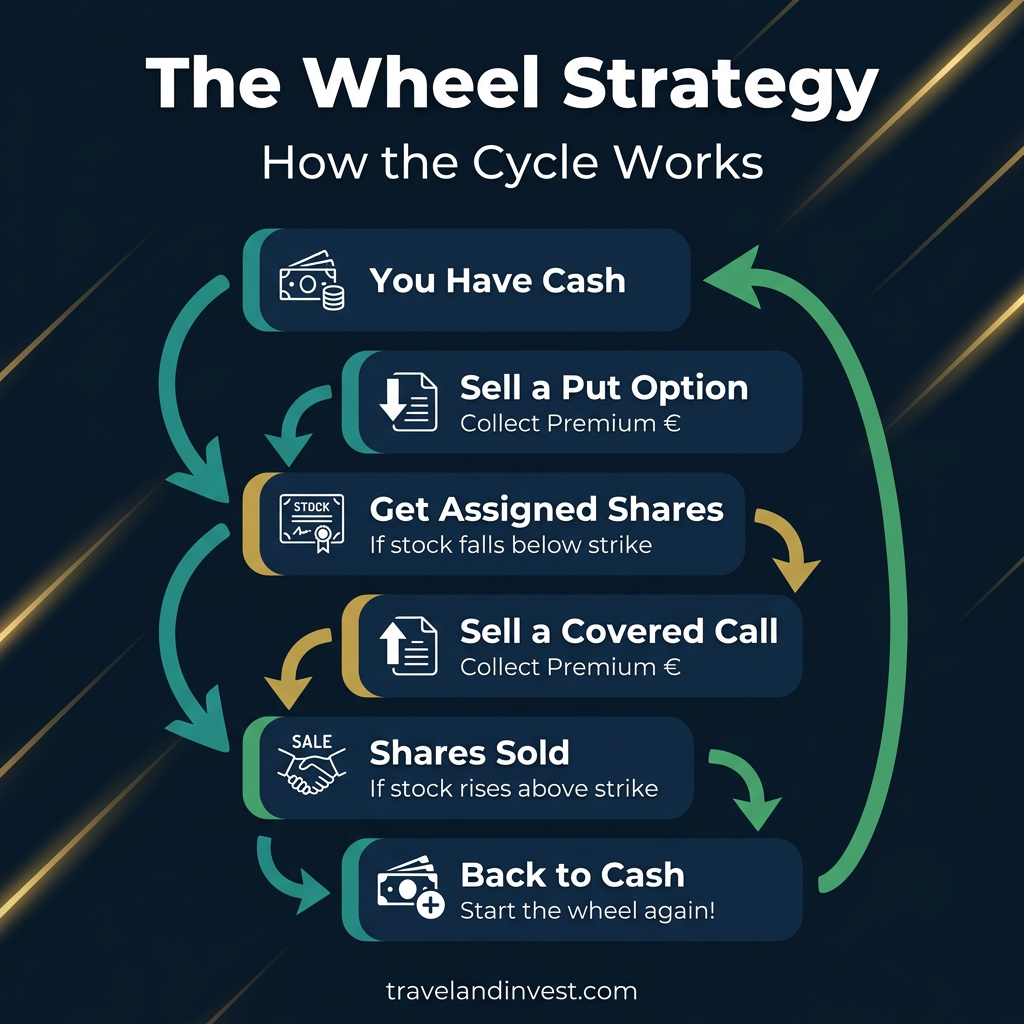
The Wheel Strategy cycle: sell put, get assigned shares, sell covered call, shares sold, back to cash
HOW DOES SELLING A CASH-SECURED PUT WORK?
You sell a put option on a stock, collect the premium upfront, and agree to buy 100 shares at the strike price if the stock drops to or below that price.
Key terms in simple language:
Strike price: The price you agree to buy the stock at if assigned
Expiration date: The last day the option contract can be used
Premium: The money you receive instantly for selling the option
Cash-secured: You keep enough cash in your account to buy 100 shares at the strike price
In the wheel strategy, you usually:
Choose a strike price below the current stock price (for example, 3-8% lower)
Choose an expiration 20-35 days from today
Make sure you have enough cash to cover 100 shares at that strike
If the stock stays above your strike price until expiration, the option normally expires worthless, and you simply keep the premium and your cash. If the stock falls below the strike, you get assigned and buy 100 shares at that strike price, then move to the next step: selling a covered call.
HOW DOES SELLING A COVERED CALL WORK?
Once you own 100 shares of a stock, you can sell a call option on those shares to collect more premium. When you sell a covered call, you agree to sell your 100 shares at the strike price if the stock goes above that level before expiration.
"Covered" simply means you already own the shares. That's what makes the position safer than selling "naked" calls, where you don't own the stock.
In the wheel strategy, you typically:
Choose a strike price above your cost basis, so you lock in a profit if the shares are sold
Pick an expiration 20-35 days out
Collect the premium immediately
If the stock stays below the call's strike price, the option expires worthless, and you keep both the premium and your shares. If the stock goes above the strike, your shares are sold at that strike price, and you realise a profit plus the premium you collected.
HOW DO I PICK THE RIGHT STOCK FOR THE WHEEL?
You should only run the wheel strategy on stocks you'd be genuinely comfortable owning for the long term.
This matters because:
If the stock drops and you're assigned, you will hold 100 shares
You might need to keep selling calls for several months while you wait for a recovery
Strong companies are more likely to bounce back over time
What to look for in a wheel stock:
Well-known, established companies (i.e. companies in S&P500)
Good trading volume and active options markets (tight bid-ask spreads)
Moderate volatility: enough movement to give decent premiums, but not wild swings
A price level that fits your account size (remember: 100 shares per contract)
What to avoid, especially as a beginner:
Meme stocks and hype names that move 20% in a day
Highly speculative biotech or penny stocks
Stocks with major news coming soon (earnings, big court cases, major product decisions)
HOW DO I SET UP OPTIONS TRADING ON INTERACTIVE BROKERS?
To use the wheel strategy, you first need to enable options trading in your Interactive Brokers account.
On IBKR Web Portal:
Log in and go to your account menu
Tap Settings → Trading Permissions
Enable Options and answer the short questionnaire about your experience, income, and goals
Submit the request and wait for approval (usually 1-2 business days)
For the wheel strategy, make sure your approval allows:
Selling cash-secured puts
Selling covered calls
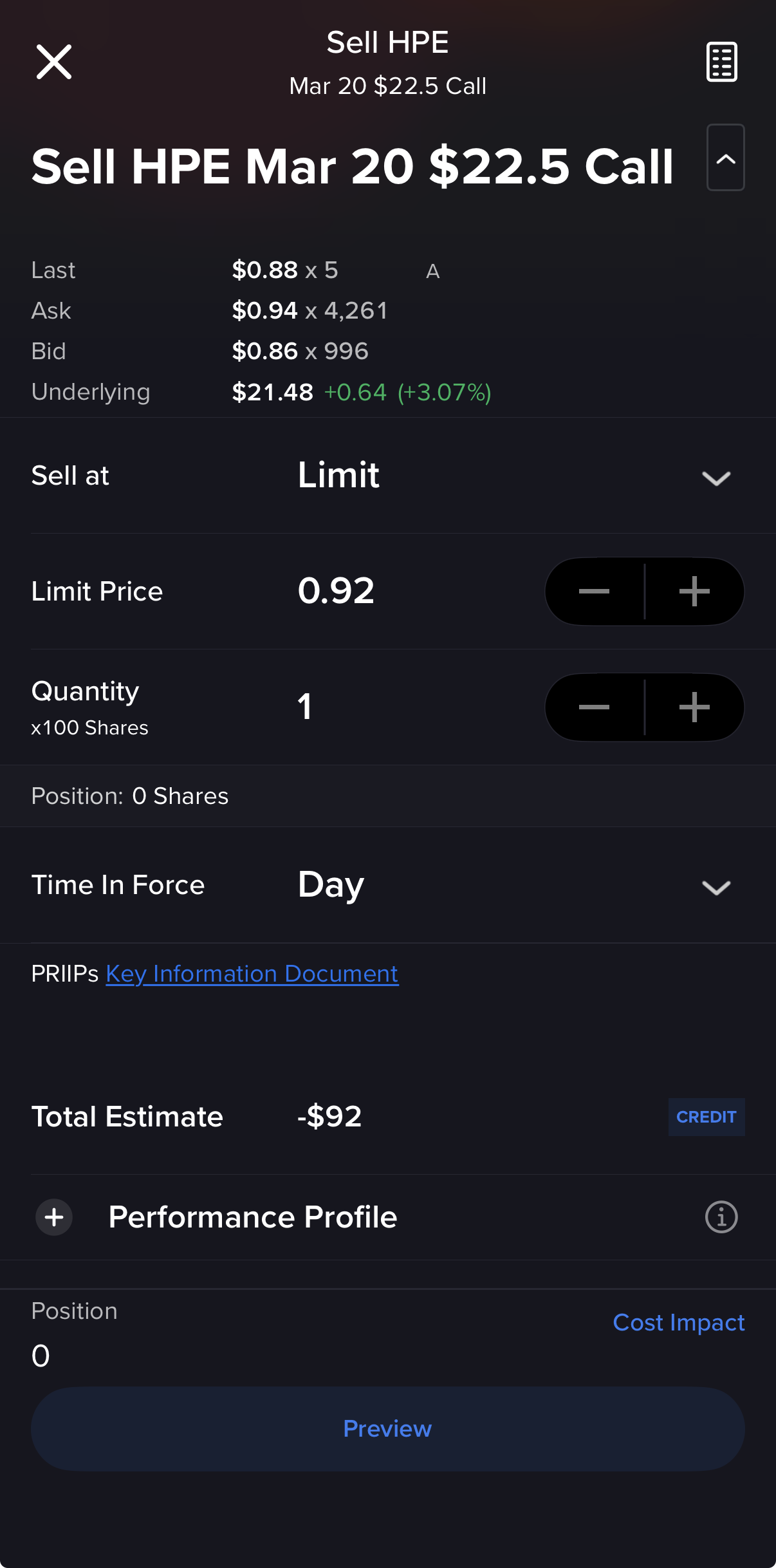
Once approved, placing an options trade looks roughly like this:
- Open a stock in IBKR Mobile
Search and Find the Stock you want
Click on the Stock and then select the Options tab to view the options chain
Select an expiration date
Tap a strike price (bid column either Put or Call)
Review and Submit the Order (always use Limit Orders with Options)
If you are new, start small and consider very small positions while you learn the interface and the behaviour of options.
Interactive Brokers trading permissions page showing Options level 3 enabled alongside Stocks and Bonds
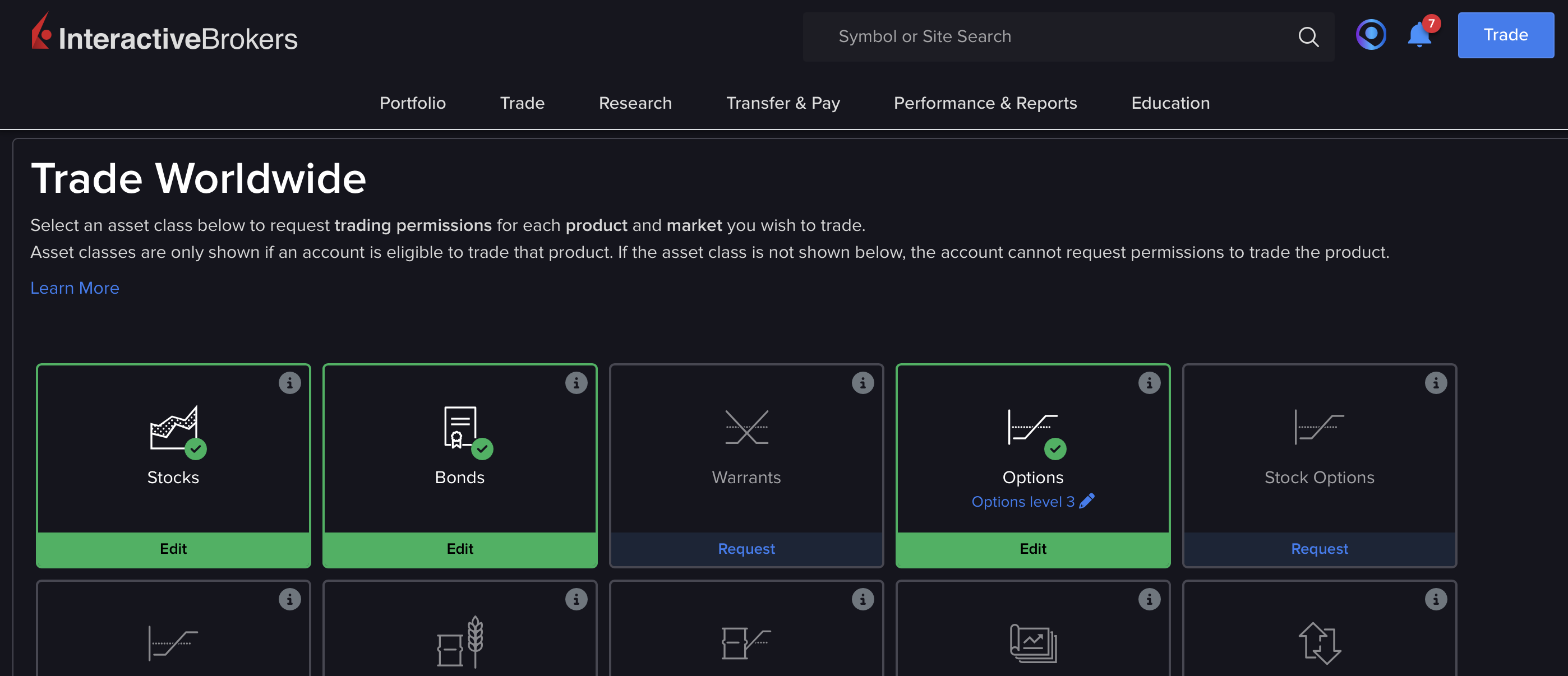
- At least Options Level 2 trading permissions is required
Interactive Brokers Mobile app options chain showing calls and puts with strike prices and expiry dates
WHAT ARE THE BEST PRACTICES FOR THE WHEEL STRATEGY?
These habits help keep the wheel strategy safer and more consistent.
Limit risk per position. Avoid putting more than 5-10% of your total portfolio into one wheel trade.
Always stay cash-secured. If you sell a €95 put, you must have €9,500 available for assignment.
Stick to 20-35 day expirations. This window often gives a good balance of premium and risk.
Roll instead of panic. If a put moves against you, you can roll it (close and reopen at a different strike or date) to give the trade more time.
Keep a simple log. Track each trade's entry, strike, premium, and exit so you can learn from experience.
WHAT MISTAKES SHOULD I AVOID WITH THE WHEEL STRATEGY?
Avoiding these common mistakes can save you a lot of money and stress.
Chasing huge premiums on risky stocks. High premium usually means high risk and large price swings.
Selling puts without full cash backing. This can lead to forced liquidations or margin calls if the stock drops.
Ignoring earnings dates. Volatility around earnings can push stocks sharply up or down overnight. Avoid selling options within 14 days of a company's earnings announcement.
Using very short expiries as a beginner. Weekly or ultra-short-dated options can move too fast and are harder to manage.
A REAL-WORLD EXAMPLE OF THE FULL WHEEL CYCLE
Let's combine everything into one complete wheel cycle with real numbers.
Starting point: Stock XYZ is trading at €100 per share.
STEP 1: Sell a Cash-Secured Put
You sell 1 put at the €95 strike price, expiring in 35 days
You collect €180 in premium immediately
You set aside €9,500 in cash as collateral
Scenario A: The stock stays above €95
XYZ finishes at €99 on expiration day
The option expires worthless
You keep your €180 premium and your €9,500 cash
You can now sell another put and repeat
Scenario B: The stock falls below €95
XYZ finishes at €90
You are assigned and buy 100 shares at €95, paying €9,500
Your effective cost basis: €95 minus €1.80 (premium per share) = €93.20 per share
STEP 2: Sell a Covered Call
You sell 1 call at the €97 strike price, expiring in 35 days
You collect €150 in premium
Scenario A: The stock stays below €97
XYZ finishes at €94
The call expires worthless
Your new cost basis: €93.20 minus €1.50 (premium per share) = €91.70 per share
You keep your shares and sell another covered call next month
Scenario B: The stock rises above €97
XYZ finishes at €100
Your shares are called away at €97
You receive €9,700 from selling the shares, plus €150 from the call premium
Profit per share: €97 minus €91.70 = €5.30
Total profit from this full wheel cycle: €530
You are now back to cash. You can start the wheel again.
FREQUENTLY ASKED QUESTIONS
How much money do I need to start the wheel strategy?
You need enough cash to buy 100 shares of the stock at the strike price of your put. If you sell a put with a €40 strike, you need €4,000 in available cash. For most beginners, a starting capital of at least €2,000 to €4,000 allows you to run one position on a lower-priced stock.
Is the wheel strategy risky?
Yes, there is risk. The main risk is that the stock can drop significantly and you may end up holding shares at a loss for a while. The premiums you collect help reduce your cost basis, but they do not remove risk entirely.
Can I run the wheel strategy on Interactive Brokers from Europe?
Yes. As long as your IBKR account has options permissions and the stock you choose has an active options market, you can use this strategy.
What happens if the stock crashes after I am assigned?
You will be sitting on an unrealised loss. Your two main options are: keep selling covered calls each month to slowly reduce your cost basis, or close the position and accept the loss. This is why stock selection matters so much.
Do I have to hold the shares forever if the price drops?
No. You can sell the shares at any time. The wheel strategy just gives you a structured way to generate income while you decide what to do next.
What kind of stocks are best to start with?
Most beginners start with large, well-known companies with high trading volume and very active options markets, rather than small or volatile stocks.
YOUR NEXT STEP
The fastest way to truly understand the wheel strategy is to try it before risking any real money. Interactive Brokers offers a free Paper Trading account that lets you practice options trades in real market conditions, using virtual money. It looks and works exactly like the real platform, so everything you learn transfers directly when you are ready to go live.
Start by picking just one stock you know well. Sell a small put, and watch how the price, premium, and profit/loss move over time. Do not rush. Spend a few weeks getting comfortable with how options behave before putting real capital at risk.
Once you feel confident, you can slowly scale up with real money. Always keep your positions cash-secured and your stock choices sensible.
Small
Consistent steps
Beat big risky ones every time.
-You can find more trip itineraries and travel tips on [Travel & Invest Blog] (https://travelandinvest.com/)
-This article was initially published on Travel & Invest Blog [The Wheel Strategy: How to Generate Monthly Income from Stocks on Interactive Brokers] (https://travelandinvest.com/wheel-strategy-interactive-brokers)
-© 2025 [Travel & Invest Blog] (https://travelandinvest.com/) All rights reserved.
Disclaimer: This article is for educational purposes only and is not financial advice. Options trading involves significant risk, including possible loss of capital. Always do your own research and consider speaking with a qualified financial professional before making investment decisions.