The People You Need to Know on an Anne Frank Tour in Amsterdam
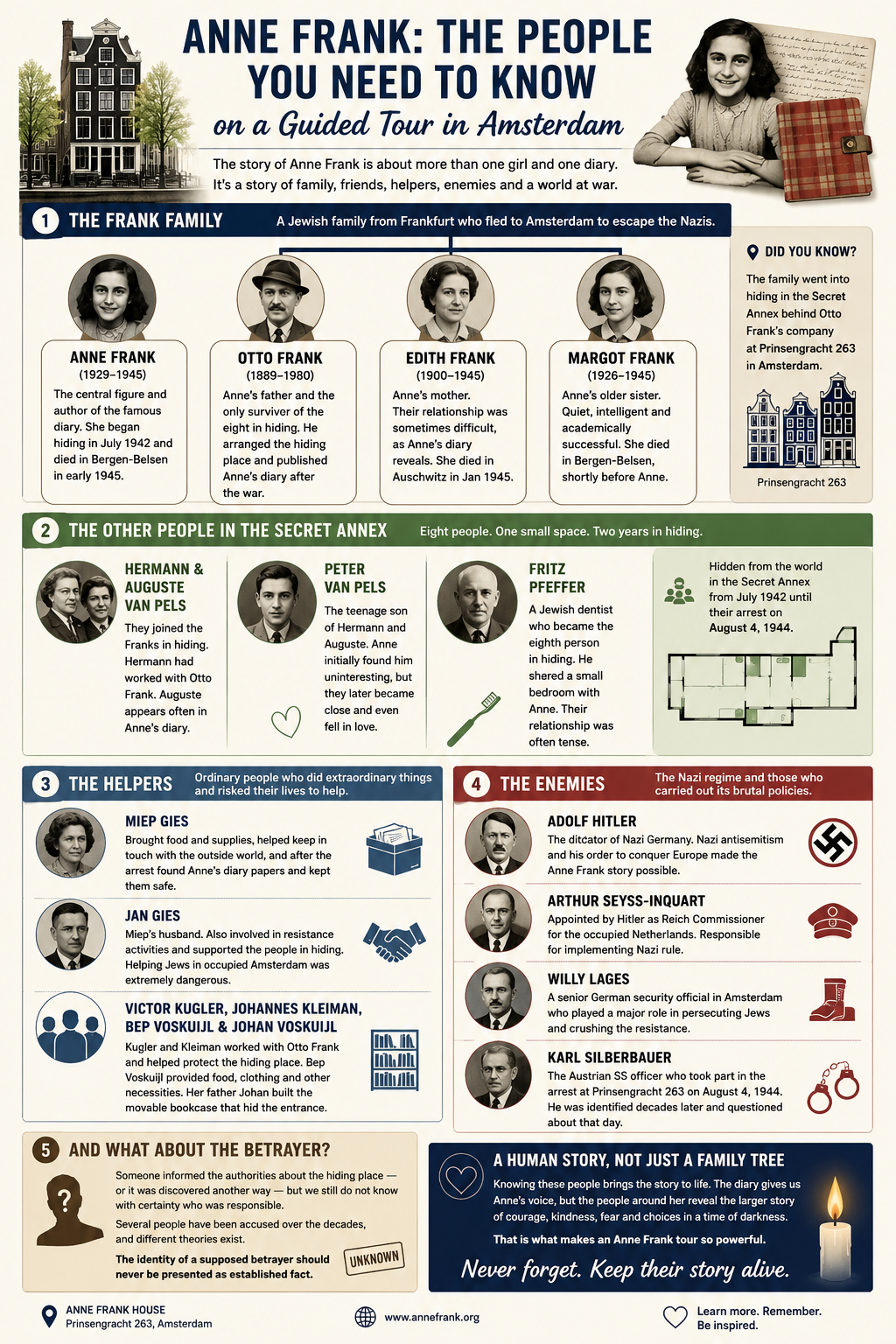
The story of Anne Frank is much easier to understand when you know the people around her. A guided Anne Frank and WWII tour in Amsterdam is not only about one girl and one diary. It is a story of a family, friends who risked their lives, eight people hiding together, and the Nazi officials responsible for their arrest and persecution.
Here are the key characters worth knowing before your tour.
The Frank Family
Anne Frank (1929–1945)
Anne is, of course, the central figure. Born in Frankfurt, she moved to Amsterdam with her family after Hitler came to power. She received her famous diary for her 13th birthday in June 1942 and began hiding only weeks later. She died in Bergen-Belsen concentration camp in early 1945.
Otto Frank (1889–1980)
Anne's father and the only one of the eight people in hiding to survive the Holocaust. Otto had moved his business to Amsterdam and later arranged the hiding place behind his company's premises at Prinsengracht 263. After the war, he received Anne's surviving diary papers and eventually had them published.
Edith Frank (1900–1945)
Anne's mother. Anne's diary reveals that their relationship was sometimes difficult, which makes Edith a particularly interesting character. She died in Auschwitz in January 1945.
Margot Frank (1926–1945)
Anne's older sister was quiet, intelligent and academically successful. In July 1942, Margot received a summons for forced labor in Nazi Germany. This accelerated the family's decision to go into hiding. She later died in Bergen-Belsen, probably shortly before Anne.
The Other People in the Secret Annex
Hermann and Auguste van Pels
The van Pels family joined the Franks in hiding. Anne used pseudonyms for them in her diary. Hermann had worked with Otto Frank, while Auguste frequently appears in Anne's observations about daily life and arguments inside the Annex.
Peter van Pels
The teenage son of Hermann and Auguste. Anne initially found Peter rather uninteresting, but the two later became close and developed a romantic relationship. Their meetings in Peter's room and attic became an important part of Anne's life in hiding.
Fritz Pfeffer
A Jewish dentist who became the eighth person in hiding. He shared a small bedroom with Anne — not exactly an ideal arrangement for an independent teenage girl. Their relationship became tense, and Anne called him "Albert Dussel" in her diary.
The Helpers
Miep Gies
One of the most famous helpers. Miep brought food and supplies to the people in hiding and helped maintain their connection with the outside world. After the arrest, she found Anne's diary papers scattered in the Annex and kept them safe.
Jan Gies
Miep's husband was also involved in resistance activities and supported the people in hiding. His role reminds us that helping Jews in occupied Amsterdam could mean taking enormous personal risks.
Victor Kugler, Johannes Kleiman, Bep Voskuijl and Johan Voskuijl
These names are also important. Kugler and Kleiman worked with Otto Frank and helped protect the hiding place. Bep Voskuijl provided food, clothing and other necessities, while her father Johan helped construct the famous movable bookcase that concealed the entrance.
The Enemies
Adolf Hitler
Anne never met Hitler, obviously, but without Hitler and Nazi antisemitism there is no Anne Frank story as we know it. The Nazi occupation of the Netherlands from May 1940 gradually stripped Dutch Jews of their rights before deportations began on a massive scale.
Arthur Seyss-Inquart
Hitler appointed Seyss-Inquart as Reich Commissioner for the occupied Netherlands. He became one of the most important figures responsible for implementing Nazi rule and the persecution and deportation of Dutch Jews.
Willy Lages
A senior German security official in Amsterdam who played a major role in the persecution and deportation of Jews and the suppression of resistance.
Karl Silberbauer
The Austrian SS officer who participated in the arrest at Prinsengracht 263 on August 4, 1944. Decades later, Silberbauer was identified and questioned about what happened that day.
And What About the Betrayer?
This is where a good guide should be careful.
Someone apparently informed the authorities about the hiding place — or the Annex may have been discovered through another investigation — but we still do not know with certainty who was responsible. Several people have been accused over the decades, and different theories have received considerable publicity.
The identity of a supposed betrayer should therefore never be presented as established fact.
A Human Story, Not Just a Family Tree
Knowing these characters changes an Anne Frank tour. Suddenly, Prinsengracht 263 isn't simply "Anne Frank's house." You can imagine Otto organizing the hiding place, Margot receiving her summons, Miep arriving with supplies, Peter and Anne talking upstairs, and eight frightened people listening to footsteps below.
And beyond the Annex was occupied Amsterdam: collaborators, resistance members, Nazi officials, ordinary neighbors and thousands of Jewish families facing the same machinery of persecution.
That is what makes an Anne Frank guided tour so powerful. The diary gives us Anne's voice, but understanding the people around her reveals the much larger story.