FedADU-EA: A Federated Evolutionary Optimization Framework for Dynamic and Uncertain Healthcare Environments
The proposed research addresses a critical challenge in modern healthcare systems where decision-making must occur across multiple hospitals while dealing with privacy restrictions, changing conditions, and uncertainty in data. Healthcare organizations increasingly generate large volumes of sensitive patient information that cannot be freely shared due to legal and ethical requirements.
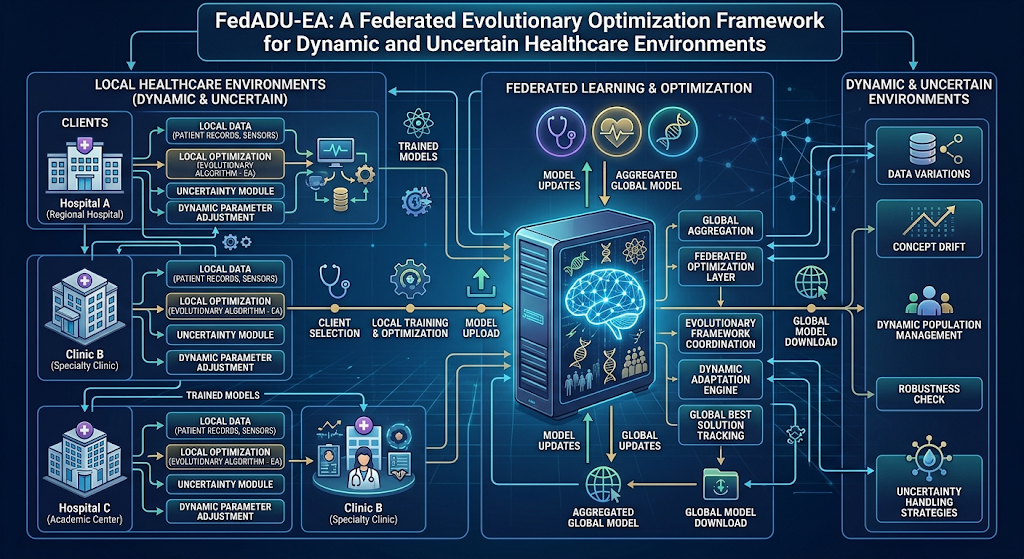
At the same time, healthcare environments are highly dynamic, with factors such as epidemic outbreaks, seasonal disease patterns, and changing treatment protocols continuously altering operational conditions. In addition, healthcare data often contains noise, missing values, and uncertainty, making optimization even more difficult.
The research identifies a significant gap in existing approaches. Traditional machine learning methods typically assume centralized data and relatively stable environments, while standard evolutionary algorithms may handle optimization effectively but often fail to simultaneously address privacy preservation, concept drift, and uncertainty within distributed healthcare systems. As a result, there is a need for a unified framework capable of tackling all three challenges together.
To address this gap, the study proposes the Federated Dynamic Healthcare Optimization Problem under Uncertainty (FDHOP-U). This formulation models a decentralized multi-hospital environment where data remains local, while optimization is performed collaboratively through a federated architecture. The framework incorporates both abrupt concept drift, such as epidemic waves, and seasonal drift, such as recurring flu outbreaks. Uncertainty is handled using a Conditional Value-at-Risk (CVaR) objective, ensuring decisions remain robust under adverse conditions.
The core contribution is the FedADU-EA (Federated Adaptive Dynamic Uncertainty-Aware Evolutionary Algorithm). The algorithm combines local SHADE optimization, Page-Hinkley drift detection, dual-memory adaptation mechanisms, and differentially private migration between distributed optimization islands. These components enable rapid adaptation to environmental changes while preserving patient privacy.
The framework is validated through synthetic benchmark studies and real-world clinical data from ICU atrial fibrillation settings. Statistical significance testing, ablation studies, and privacy-bandwidth trade-off analyses demonstrate the effectiveness of the proposed approach. The research ultimately provides a foundation for future extensions, including multi-objective optimization and real-world clinical pilot deployments, with the potential to significantly improve healthcare decision-making in complex, federated, and uncertain environments.