Federated Evolutionary Computation in Healthcare: Emerging Trends, Challenges, and Future Research Directions
The growing digitization of healthcare has generated vast amounts of patient data distributed across hospitals, clinics, laboratories, and wearable devices. However, strict privacy regulations and ethical concerns restrict the sharing of sensitive medical data, limiting the development of robust artificial intelligence (AI) models. Federated Learning (FL) has emerged as a promising solution by enabling collaborative model training without transferring raw patient data between institutions. Recent literature demonstrates that FL has gained significant attention in healthcare due to its ability to preserve privacy while facilitating the use of diverse and geographically distributed datasets.
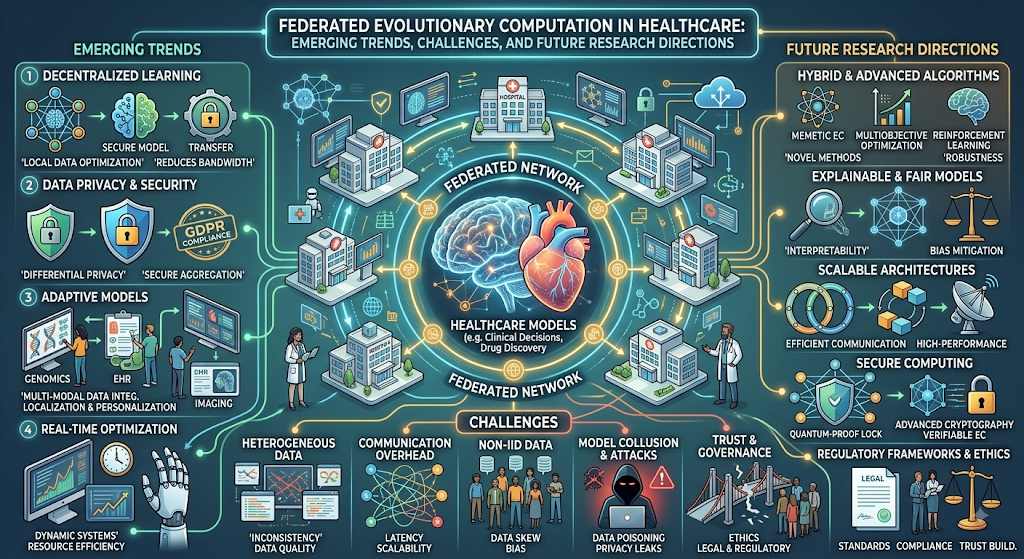
Within this context, Evolutionary Computation (EC) has increasingly been integrated into federated environments to address optimization challenges associated with distributed learning. Evolutionary techniques such as genetic algorithms and grammatical evolution are being used for model optimization, feature selection, hyperparameter tuning, and personalized learning. The literature suggests that combining FL with EC improves model adaptability, predictive performance, and generalization in healthcare applications while maintaining data confidentiality. Studies involving glucose prediction and Alzheimer's disease diagnosis provide evidence that evolutionary approaches can enhance federated systems by improving learning efficiency and handling uncertainty more effectively.
Several healthcare applications have benefited from this integration, particularly in medical imaging, disease diagnosis, chronic disease management, and remote patient monitoring. Despite these advances, research remains largely experimental, with relatively few studies demonstrating real-world clinical deployment. Existing evidence indicates that most federated healthcare systems are still proof-of-concept models, raising concerns about scalability, interoperability, and clinical readiness.
The literature further highlights significant challenges related to governance, explainability, security, communication costs, and data heterogeneity. Although federated approaches reduce direct data-sharing risks, concerns regarding model bias, privacy leakage, and regulatory compliance persist. Governance frameworks specifically designed for federated healthcare systems remain underdeveloped, while the implications of integrating evolutionary optimization into these environments are not yet fully understood.
Overall, the literature indicates that Federated Evolutionary Computation represents a promising direction for privacy-preserving healthcare AI. However, future research must focus on large-scale clinical validation, explainable and trustworthy AI, governance mechanisms, and standardized frameworks to support sustainable adoption within Healthcare 5.0 ecosystems.