How Smart Healthcare Systems Learn Together Safely
Imagine many hospitals, clinics, and mobile health apps all trying to improve how they treat patients. Each one has its own data, but they cannot share raw patient data because it is private. This diagram shows a smart way they can still learn together without breaking privacy rules.
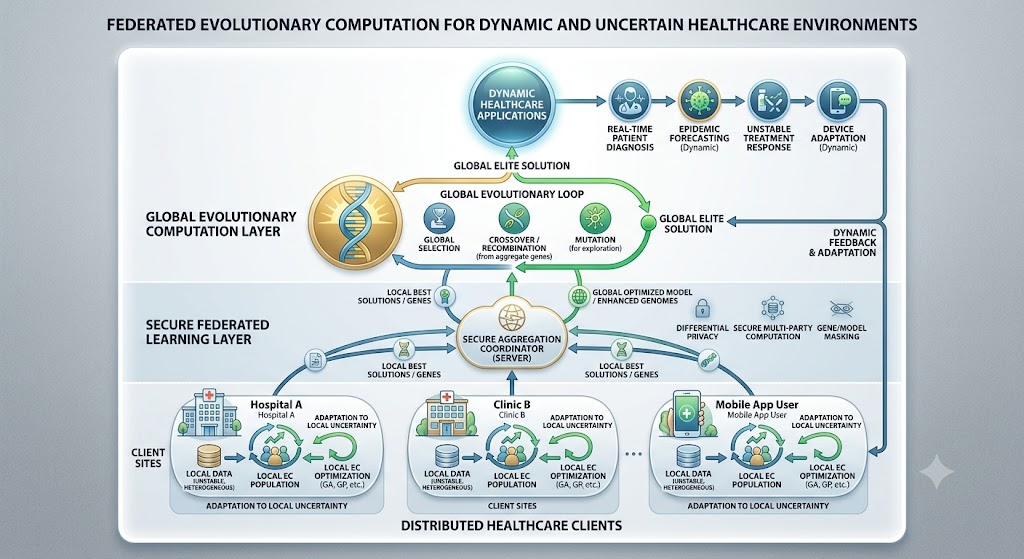
At the bottom, there are different places like Hospital A, Clinic B, and mobile app users. Each one keeps its own data and uses it to train a small model locally. They use something called evolutionary computation, which works like natural selection: they test different solutions, keep the best ones, and improve them over time. These best local results are called “local solutions” or “genes.”
Next, these local solutions are sent (not the data itself) to a secure central server in the middle layer. This part is called federated learning. The server combines all the local solutions into one global model. Special security methods like encryption make sure that no private data is revealed during this process.
After that, the system goes to the top layer, which is the global evolutionary computation layer. Here, the combined model is improved again using processes similar to biology:
- Selection (pick the best solutions)
- Crossover (combine ideas)
- Mutation (try small changes)
This creates an even better model called the global elite solution.
Finally, at the very top, this improved model is used in real healthcare situations like:
- Diagnosing patients in real time
- Predicting disease outbreaks
- Adjusting treatments when patients respond differently
- Improving smart medical devices
Because healthcare situations keep changing, the system continuously learns and adapts using feedback.
✅ In simple terms:
- Each hospital learns on its own data
- They share only results, not raw data
- A central system combines and improves everything
- The system keeps learning and getting better over time
This way, healthcare becomes smarter, safer, and more accurate without risking patient privacy.
Curated by: @ahsansharif