LCD Monitors: The Foundation of Modern Visual Display Technology
LCD (Liquid Crystal Display) monitors are among the most widely used display devices in homes, offices, schools, and businesses around the world. They have largely replaced older CRT (Cathode Ray Tube) monitors due to their slim design, energy efficiency, and superior image quality. LCD technology uses liquid crystals combined with a backlight system to produce images, making these monitors lightweight and suitable for a wide range of applications.
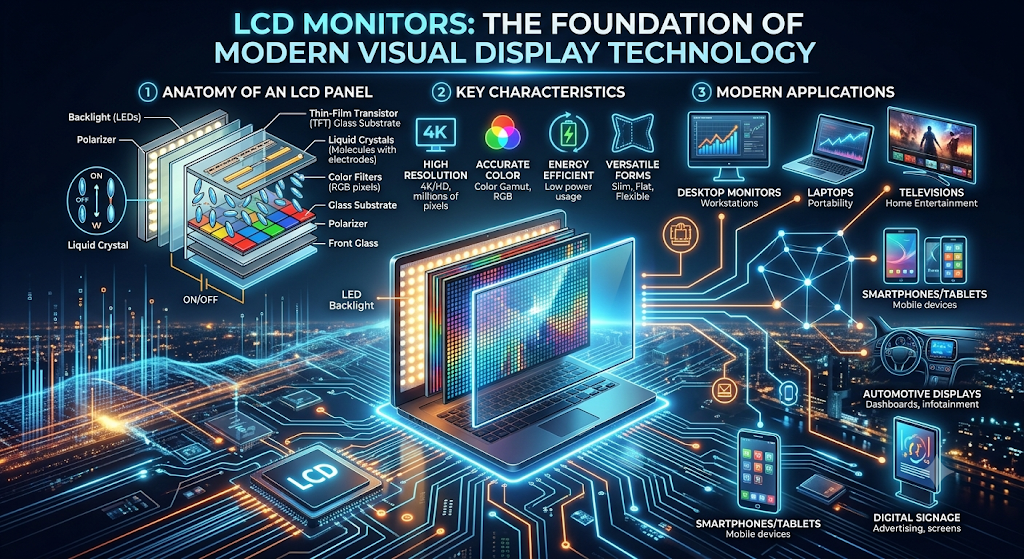
The working principle of an LCD monitor is based on liquid crystals that control the passage of light. A backlight, typically made of LED lights, illuminates the screen from behind. The liquid crystal layer adjusts the amount of light passing through each pixel, creating different colors and images. This technology allows LCD monitors to deliver sharp visuals, accurate colors, and clear text, making them ideal for everyday computing tasks.
One of the major advantages of LCD monitors is their energy efficiency. Compared to older display technologies, LCD screens consume less power, helping users reduce electricity costs. They also generate less heat and occupy less desk space because of their thin and compact design. These features make LCD monitors particularly popular in workplaces where multiple computers are used.
LCD monitors are available in various sizes, resolutions, and panel types. Common resolutions include Full HD (1920 × 1080), Quad HD (2560 × 1440), and 4K Ultra HD (3840 × 2160). Higher resolutions provide sharper images and more screen space for multitasking. Different panel technologies, such as TN, IPS, and VA, offer varying levels of color accuracy, viewing angles, and response times, allowing users to choose a monitor that best meets their needs.
Despite their many benefits, LCD monitors have some limitations. Certain models may experience restricted viewing angles, slower response times, or reduced contrast compared to newer display technologies. However, continuous advancements in LCD technology have significantly improved performance and image quality.
In conclusion, LCD monitors remain a reliable and cost-effective display solution. Their combination of energy efficiency, high-quality visuals, affordability, and versatility makes them an essential component of modern computing and digital communication.