Local Bus Networks Across the UK: Regional Differences and Systems
Local bus services in the United Kingdom vary significantly by region, reflecting differences in governance, funding models, and branding. While all provide essential public transport, many areas have developed distinctive systems to improve accessibility, reliability, and regional identity.
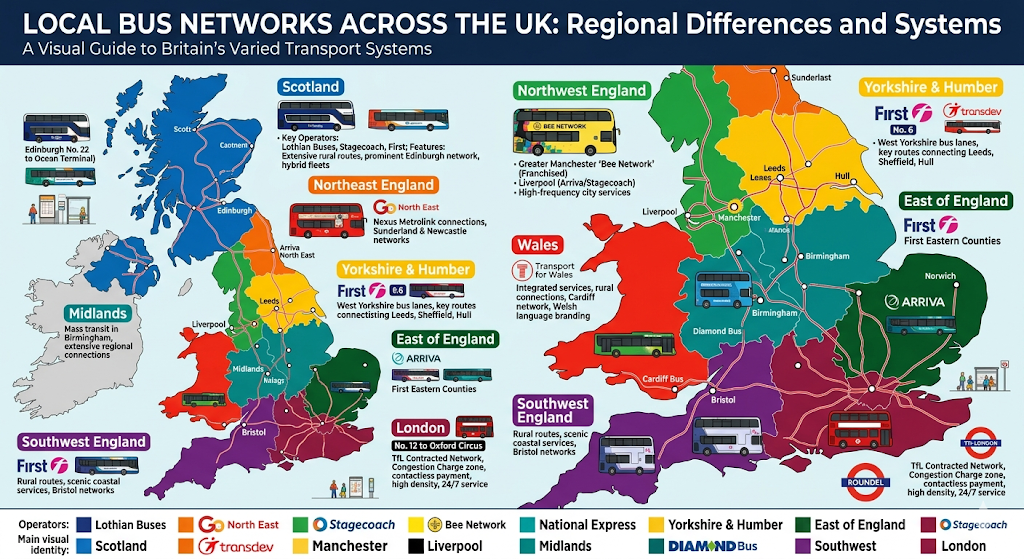
In Greater Manchester, the Bee Network is one of the most notable examples of bus reform. Launched in phases from 2023, it is a franchised system controlled by Transport for Greater Manchester (TfGM). Under this model, routes, fares, and standards are set centrally, creating a more integrated and London-style transport system.
London has long operated the most unified network, managed by Transport for London (TfL). London buses are fully regulated, meaning TfL controls routes, fares, and service levels, while private operators run services under contract. The iconic red buses, contactless payments, and frequent services make it the most comprehensive network in the UK.
In the West Midlands, bus services are being gradually integrated under the West Midlands Network brand, overseen by Transport for West Midlands (TfWM). Although services are still largely operated commercially by companies like National Express West Midlands, efforts are being made to move toward a franchised system similar to Manchester.
Liverpool City Region is also progressing toward bus franchising under the Merseytravel authority. While currently a mix of commercial operations, plans are underway to introduce greater public control to improve consistency and coverage.
In Scotland, major cities such as Edinburgh and Glasgow have distinct systems. Edinburgh’s buses are primarily operated by Lothian Buses, a publicly owned company known for reliability and strong local branding. Glasgow, on the other hand, relies on private operators like First Bus, though regional coordination is improving.
In Wales, bus services are coordinated at a national level under the Transport for Wales (TfW) initiative, which aims to integrate bus and rail services. However, most routes are still run by private companies, particularly in rural areas where connectivity is more limited.
In South West England and other rural regions, bus services are less centralized. Operators such as Stagecoach and First Bus dominate, often running services on a commercial basis with support from local councils for less profitable routes.
Overall, the UK bus landscape is evolving. While London remains the benchmark for integrated services, regions like Manchester and Liverpool are adopting similar models. These changes aim to create more reliable, affordable, and connected public transport systems tailored to local needs.