Roman Catholic Church and Anglo-Catholic Church: Understanding the Differences
The Roman Catholic Church and the Anglo-Catholic Church share many similarities in worship, traditions, and beliefs, yet they differ in authority, governance, and certain aspects of doctrine. Both traditions emphasize the importance of sacraments, liturgical worship, and the historic Christian faith, but they belong to different branches of Christianity.
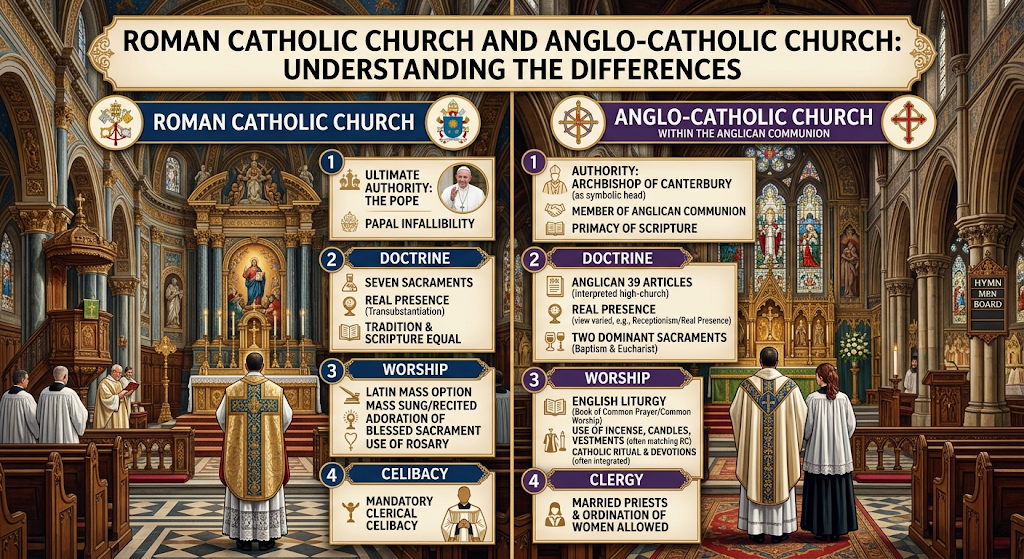
The most significant difference lies in their authority structure. The Roman Catholic Church recognizes the Pope, the Bishop of Rome, as the supreme spiritual leader of the Church worldwide. Catholics believe that the Pope has a special role in guiding the Church and preserving its teachings. In contrast, the Anglo-Catholic Church is part of the Anglican tradition and does not accept the Pope's authority. Instead, it is governed by bishops and church synods within the Anglican Communion.
Another difference concerns church membership and identity. The Roman Catholic Church is a global institution with more than a billion members and follows a unified set of doctrines and practices. Anglo-Catholics, on the other hand, are members of Anglican churches who emphasize the Catholic heritage of Anglicanism. They seek to preserve traditional Catholic forms of worship while remaining within the Anglican Church.
In worship, the two traditions often appear very similar. Both may use elaborate liturgies, vestments, incense, candles, and frequent celebrations of the Eucharist. Because of these similarities, visitors may find it difficult to distinguish between a Roman Catholic Mass and an Anglo-Catholic service. However, differences may arise regarding certain theological teachings and church policies.
The Roman Catholic Church maintains specific doctrines such as papal infallibility, the Immaculate Conception of Mary, and other teachings defined by the Vatican. Anglo-Catholics generally respect many Catholic traditions but are not required to accept all Roman Catholic doctrines. Additionally, many Anglican churches allow the ordination of women and, in some regions, permit clergy to marry, practices that differ from the Roman Catholic Church.
In conclusion, while the Roman Catholic Church and the Anglo-Catholic Church share a rich liturgical tradition and many common Christian beliefs, they differ primarily in their governance, authority, and certain doctrinal positions. These distinctions make each tradition unique while preserving their common historical roots in the Christian faith.