The Tax System in the United Kingdom: An Overview
The tax system in the United Kingdom is a structured framework through which the government collects revenue to fund public services such as healthcare, education, transport, social welfare, and national security. Taxes are administered primarily by His Majesty’s Revenue and Customs (HMRC), which is responsible for collecting taxes and ensuring compliance with tax laws.
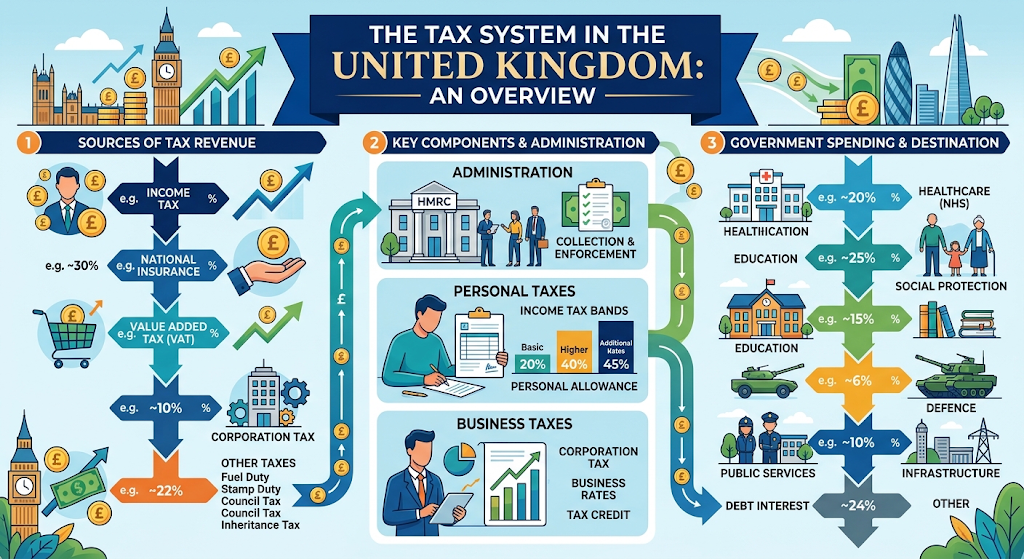
One of the most important taxes in the UK is Income Tax. This tax is charged on earnings from employment, self-employment, pensions, and certain benefits. The UK operates a progressive tax system, meaning that individuals with higher incomes generally pay a higher rate of tax. Most employees pay their Income Tax automatically through the Pay As You Earn (PAYE) system, where tax is deducted from their salary before they receive it.
Another significant tax is National Insurance Contributions (NICs). These contributions help fund state benefits such as the State Pension, maternity allowance, and certain welfare programs. Employees, employers, and self-employed individuals may all be required to make National Insurance contributions depending on their earnings.
The UK also imposes Value Added Tax (VAT) on many goods and services. VAT is an indirect tax paid by consumers when purchasing products or services. Businesses collect VAT on behalf of the government and submit the revenue to HMRC. Some essential goods and services may be exempt or subject to reduced VAT rates.
For property owners, Council Tax is an important local tax. It is collected by local authorities to fund services such as waste collection, street lighting, policing, and community facilities. The amount payable depends on the value and classification of the property.
Businesses in the UK are generally subject to Corporation Tax on their profits. Companies must report their earnings and pay tax according to established regulations. Other taxes may include Capital Gains Tax on profits from the sale of certain assets and Inheritance Tax on large estates passed on after death.
The UK tax system aims to balance revenue generation with fairness and economic growth. Various allowances, reliefs, and exemptions are available to reduce the tax burden for eligible individuals and businesses.
In conclusion, the UK tax system consists of several forms of taxation that support public services and national development. Understanding these taxes helps individuals and businesses meet their obligations while contributing to the country's economic and social well-being.