The Smell Before It Comes
Hi so I've been wanting to do this for a very long time. I wanted to write a mythology or weird happenings from the Philippines. I myself have had some weird stuff happen to me. I will write stories that I have heard, experienced, or just made up stuff. But rest assured it is based on Philippine folklore. I plan this to be a series but let's just get the first one out.
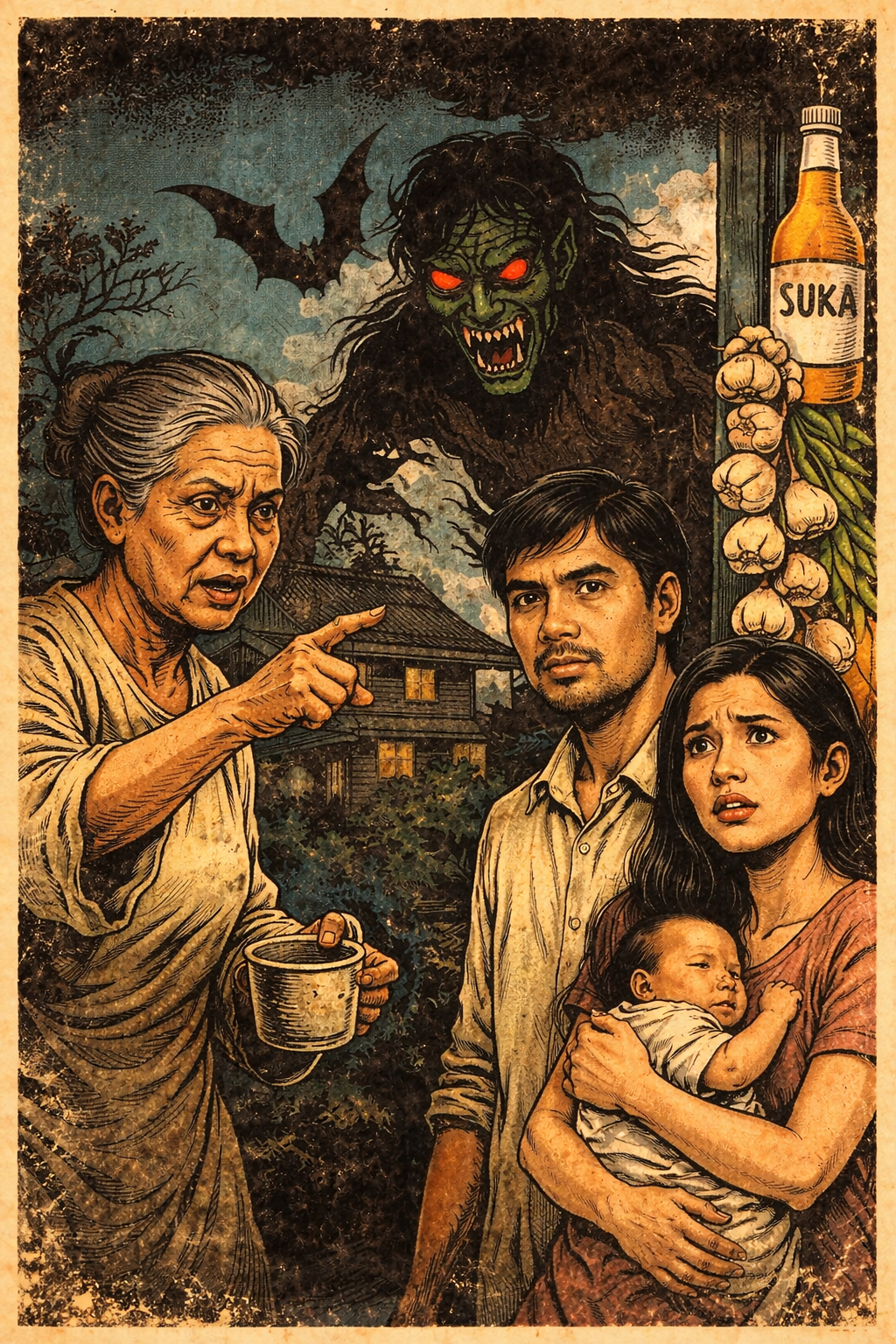
Everyone in Barangay Talim knew that the aswang did not announce itself with a howl or a shadow. It announced itself with a smell.
Old Maring was the one who taught this to the children, back when teaching such things was considered responsible parenting and not something that would get you a talking-to from a school counselor. She would sit on her wooden porch with her tabo of lukewarm water and say it plainly: if you smell vinegar in the middle of the night and nobody is cooking, you go inside and you do not look out the window.
Vinegar. Suka. The sharp, eye-watering kind that your grandmother used to preserve green mangoes.
Nobody ever fully believed her. Not until Carding's wife got pregnant with their third child, and then things in the barangay changed.
It started the way it always starts in small towns -- with dogs.
The dogs along the eastern row of houses began barking at nothing around eleven at night, then going completely silent by midnight. Not the silence of tired dogs settling down. The silence of dogs that have decided that barking is no longer worth the risk.
Carding noticed it first because he was a light sleeper and because his pregnant wife, Luisa, had been having a hard third trimester. He was up most nights anyway, heating water, rubbing her back, doing the small quiet work that nervous husbands do when they feel helpless. On the third night of the dogs going silent, he stepped out to the porch to smoke.
That was when he smelled it.
It hit him somewhere between the first and second step -- a dense, acidic smell, so strong it almost had a texture. He stood very still. The street was empty. The lamppost at the corner threw its usual yellow circle on the pavement and nothing moved inside it.
He went back inside and did not smoke that night.
He told his mother the next morning. His mother told him to buy white vinegar and garlic, to smear the doorframes, and to hang a bundle of rattan near Luisa's side of the bed. She said it without drama, the way she would tell him to take vitamin C when he had a cold.
Carding was a college-educated man. He worked in the municipal hall. But he bought the garlic and the vinegar and he did not feel stupid about it.
The thing about the aswang, the detail that most outsiders get wrong, is that it is not a stranger. It is never a stranger.
In every province where the stories live -- Capiz, Antique, the dark interior towns of Leyte -- the consistent detail is this: the aswang is someone you know. A neighbor. A distant cousin. The woman who sells you rice every Saturday and always gives you a fair weight. The aswang does not come from somewhere else. It is already there, already woven into the fabric of the place, and the horror of it is not that a monster appeared but that someone you trusted was never fully what you thought.
In Barangay Talim, people began to look at each other differently.
Not in any dramatic way. There were no accusations, no torches, no mobs -- this was not the old century. But there was a new quality to conversations, a slight hesitation before answering, a reason to leave gatherings a little earlier than usual. People stopped lingering at the sari-sari store after eight.
Maring said she knew which house it came from. She would not say which one.
Luisa gave birth in the provincial hospital on a Tuesday morning, healthy and furious about it in the way that newborns are furious -- red-faced, loud, and aggressively alive. Carding cried in the hallway. The baby was fine. Luisa was fine.
But when they brought her home three days later, Carding's mother met them at the door with the garlic bundles already fresh, replaced just that morning.
"Sige na," she said. Just a phrase. Go on then. Get inside.
Nobody in the family talked about what the garlic was for. Nobody needed to.
The baby was three months old when it happened.
It was two in the morning and Luisa was already up because the baby had been crying for an hour -- not the hungry cry, not the wet cry, but the other one, the one that had no reason behind it. She had checked everything. She had walked the length of the house four times with the baby against her chest. Nothing helped.
Carding came out of the bedroom and stood in the hallway watching her pace. The baby's face was scrunched and red, eyes squeezed shut, screaming at something neither of them could see.
Then it stopped.
Not gradually, the way babies wind down when they finally tire themselves out. It stopped all at once, like a switch. The baby went still and quiet and turned its head toward the window above the kitchen sink.
Luisa and Carding looked at each other.
That was when Carding smelled it. Sharp and acidic, seeping in through the gaps in the jalousie windows. He moved Luisa back from the kitchen without saying anything. She already knew why. She pulled the baby closer and walked to the bedroom where the garlic hung and she did not come out until morning.
Carding sat in the dark living room until sunrise, not sleeping, not moving much.
Outside, after a while, the dogs went quiet.