Charles de Gaulle: The Man Who Helped Shape Modern France
Walk around Paris and the name Charles de Gaulle is almost impossible to avoid. There is Place Charles-de-Gaulle, the huge square surrounding the Arc de Triomphe, and of course Paris Charles de Gaulle Airport. But why is his name everywhere?
Charles de Gaulle wasn't an architect like Gustave Eiffel or an artist like Claude Monet. He didn't rule France as an emperor like Napoleon either. Instead, his influence came through war, politics, leadership, and his idea of what France should be.
The voice that refused to surrender
De Gaulle was born in Lille in 1890 and became a professional soldier. His defining moment arrived in 1940 when Nazi Germany invaded France.
While the French government accepted an armistice with Germany, de Gaulle escaped to London. From there, on June 18, 1940, he made his famous radio appeal encouraging the French to continue resisting.
At the time, de Gaulle wasn't yet the giant historical figure we know today. But during the war he became the leader of Free France, representing the idea that France had not simply disappeared because Paris was occupied.
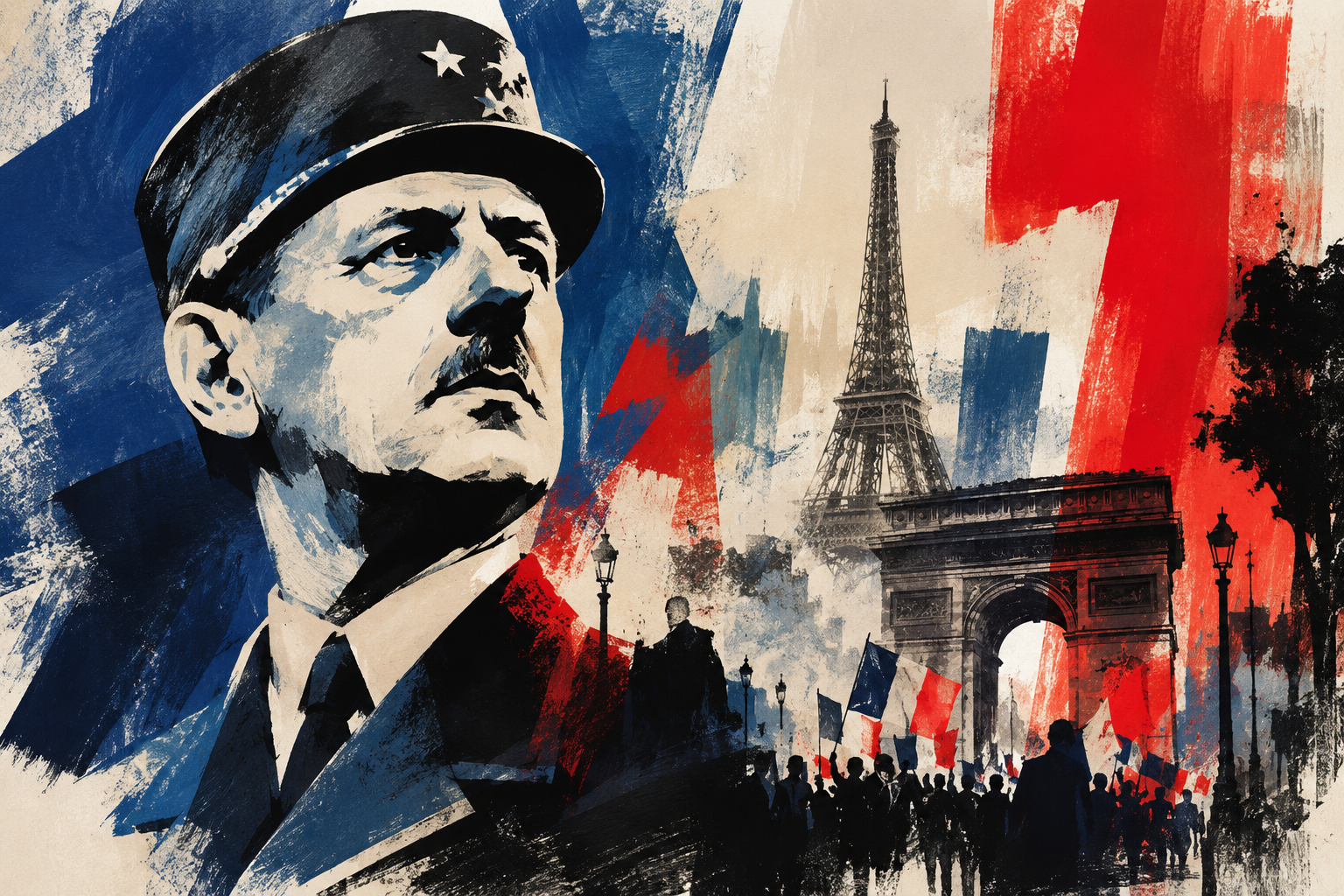
When Paris was liberated in August 1944, de Gaulle returned dramatically to the capital. His walk down the Champs-Élysées through enormous crowds became one of the iconic scenes of liberated Paris.
Building a new France
His influence didn't end with World War II.
De Gaulle returned to power during the political crisis of 1958, when the Algerian War was creating enormous instability. He played the central role in establishing the Fifth Republic, the political system France still uses today.
The new constitution created a much stronger presidency. De Gaulle became its first president in 1959 and remained in office until 1969.
His presidency also changed France's position internationally. De Gaulle wanted France to behave as an independent major power rather than simply follow the United States or Soviet Union during the Cold War. France developed its own nuclear deterrent, and in 1966 de Gaulle withdrew the country from NATO's integrated military command structure.
He also worked closely with West German Chancellor Konrad Adenauer. Their cooperation helped strengthen Franco-German relations, something that became extremely important for European integration.
De Gaulle and Paris
His physical impact on Paris wasn't comparable to Napoleon or the great urban transformations of the 19th century. His connection to the capital is more symbolic.
Paris was the stage for some of the biggest moments of his career: liberation in 1944, presidential power at the Élysée Palace, and the enormous protests and political crisis of May 1968.
Today, his name is attached to one of Europe's busiest airports and one of Paris's most famous squares. That's quite a legacy.
If you'd like to read more about him, the Wikipedia biography of Charles de Gaulle gives a detailed overview of his military and political career.
And de Gaulle certainly wasn't the only person who left a giant footprint on the French capital. Read about Gustave Eiffel, Claude Monet, and Napoleon – three people who changed Paris forever.
Paris isn't just shaped by buildings and streets. Sometimes it is shaped by personalities — and Charles de Gaulle was definitely one of the biggest.
Upvoted! Thank you for supporting witness @jswit.
0.00 SBD,
18.16 STEEM,
18.16 SP