Cryptocurrency Liquidity Dynamics and the Structure of Digital Asset Markets
Over the past few years, cryptocurrency has emerged as one of the most talked about financial innovations. Today, millions of people worldwide are engaging in the purchase/sale and investment of digital assets, including Bitcoin, Ethereum and numerous other cryptocurrencies. One of the crucial ideas that can make or break a market is liquidity as this market expands. The efficiency of cryptocurrency markets is greatly influenced by the market liquidity and dynamics of the market. These concepts are valuable for all investors and traders, and even for new investors to grasp, as they can aid in making informed decisions within the digital economy.
Liquidity means how readily an asset can be sold or bought without any significant price changes. A liquid market is a broad market in which there are plenty of people wanting to buy and sell something. In heavily traded markets, trades occur rapidly and price fluctuates little. However, if a liquid market isn't available, the market may experience large price swings, slower trade execution, and increased trading costs. In my opinion, one of the key indicators of the health and stability of any financial market is its liquidity, which also applies to cryptocurrency markets.
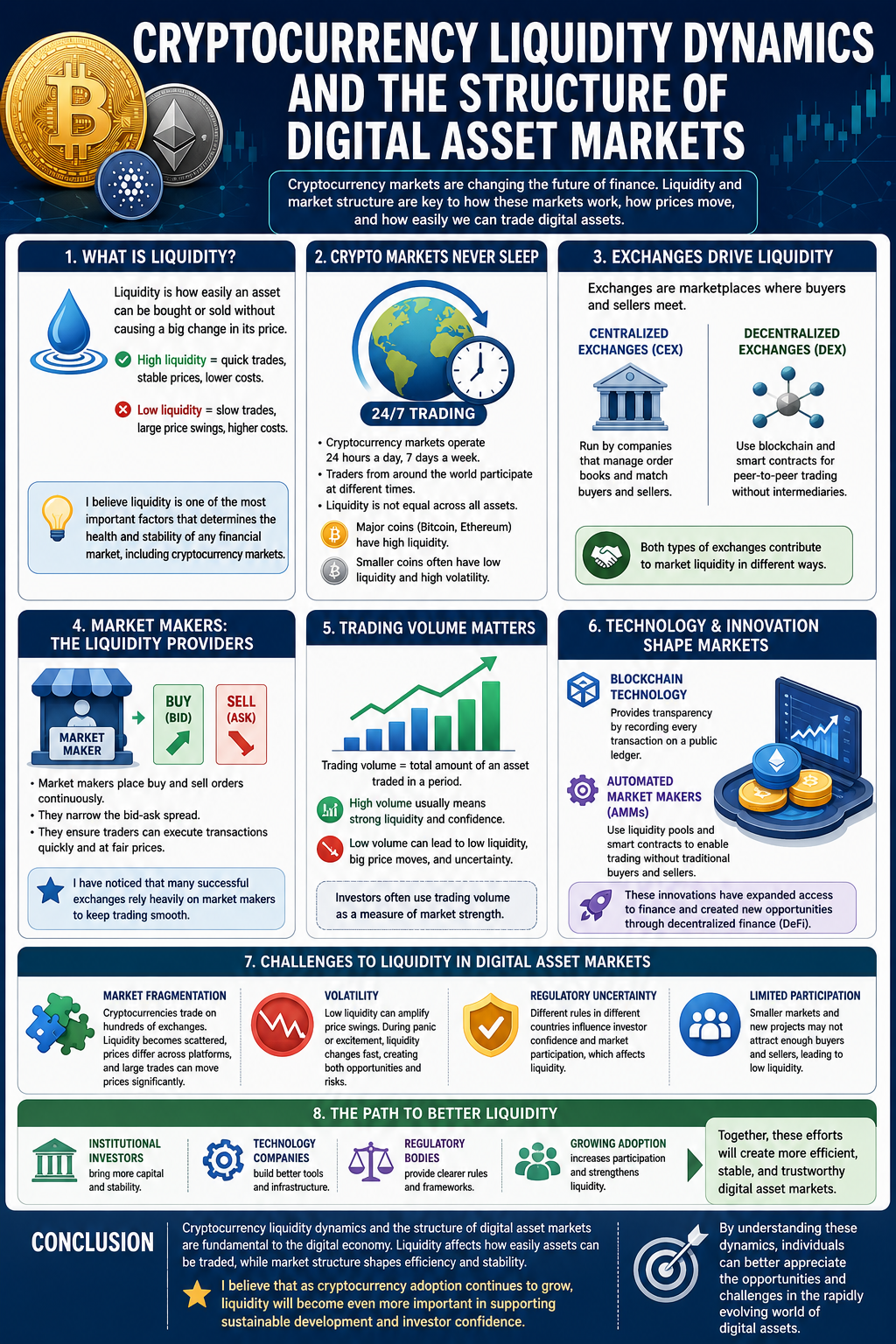
The cryptocurrency market is not like the regular financial market. Unlike the stock exchanges, which are opened at certain hours of the day, a cryptocurrency market is an open market which operates 24 hours a day, 365 days a year. This is the continuous trading environment, which generates special liquidity dynamics. Traders from various nations trade at various times, adding to the round-the-clock trading activity. But some digital assets are more liquid than others. Bitcoin and Ethereum, the two major cryptocurrencies, typically have high liquidity as they have many participants. The liquidity of smaller cryptocurrencies can be less, which can leave them more susceptible to price fluctuations.
Digital asset exchanges are one of the key factors providing liquidity in digital asset markets. They serve as platforms where digital asset traders can connect with each other. Exchanges may operate in a centralized or decentralized manner. The centralized exchanges run regulated by business entities that act as order bookkeepers and conduct transactions. A decentralized exchange, or decentralized trading platform, is a trading platform that employs blockchain technology and smart contracts for peer-to-peer trading without the need for intermediaries. Both of these exchanges bring liquidity into the market, but in different ways.
Market makers are also important for providing liquidity in the market. These participants constantly place buy and sell orders, so that traders can trade quickly. Market makers reduce the spread between the price at which they are willing to buy and sell, which means they make markets more efficient. If they're not there, trading could be slower and costlier. Many successful cryptocurrency exchanges depend on market makers to ensure smooth transactions.
Important liquidity factors are also trading volumes. Trading Volume is the total volume of an asset that has been traded over a specific time frame. Liquidity is generally correlated with the volume of trading in that it tends to increase with more involved trading. Trading volume is a popular indicator of market strength and confidence among investors. If trading volume drops markedly, liquidity could be reduced and there may be increased price volatility and uncertainty.
The structure of digital asset markets is also influenced by technology. The blockchain technology offers transparency because each transaction is recorded on a public ledger. This transparency enables the participants to keep track of the market and confirm transactions on their own. At the same time, technological innovations such as automated market makers have transformed the way liquidity is provided. Automated systems rely on liquidity pools for trading, in addition to the traditional buyers and sellers. All these innovations have brought financial services to a wider reach and new opportunities in the decentralized finance space.
While the digital asset markets offer many benefits, they also have several liquidity challenges. Fragmentation is one of these challenges. Cryptocurrencies are available on hundreds of exchanges globally and can become fragmented with regard to the level of liquidity. This indicates there may be price differences between platforms for the same asset. It will be difficult for large investors to make large trades without impacting the market. In addition, uncertainty around regulation in various countries may affect the liquidity of the market, as it can impact investor confidence and participation.
The other issue related to liquidity is volatility. The price of cryptocurrencies can change significantly in a short amount of time. But in certain instances, low fluidity worsens these fluctuations as a small volume of transactions can have a big effect on prices. Liquidity conditions can change rapidly during periods of market panic or excitement. This presents opportunities as well as risks to traders and investors.
Digital asset markets are evolving and working to increase liquidity and market efficiency. Other institutions such as financial technology firms and regulators are now entering the cryptocurrency space. They are frequently able to provide extra capital, infrastructure and market stability. More institutional involvement will be welcome to improve liquidity and mitigate excessive volatility in the long-term, many experts have argued.
To wrap up, the liquidity characteristics and the organization of digital asset exchanges play a critical role in the understanding of the functioning of the digital economy. The ease with which assets can be converted or sold is known as liquidity, and the structure of the market can affect its efficiency and stability in conducting transactions. The exchange, the market makers, trading volume, technology and regulation all influence the nature of these markets. As more and more people embrace cryptocurrencies, I feel as though it will only become more crucial to have liquidity as a key aspect of the cryptocurrency market to support sustainable growth and investor confidence. A grasp of these dynamics will help people value the opportunities and challenges in the ever-changing digital asset landscape.
Note:-
You have been sharing the same promotional links in all your recent posts.
Regards, @adeljose
0.00 SBD,
0.14 STEEM,
0.14 SP
https://x.com/i/status/2038990196453126632
https://coinmarketcap.com/currencies/pussfi
https://x.com/i/status/2036134193260802100