Quantum Computing Threats and the Future of Blockchain Cryptography
Technology is continuously transforming our lifestyles, working routines and communications. Inventions are made annually that makes life easy and solve many problems. A quantum computer is one of the most intriguing developments of the modern day. Meanwhile, blockchain technology has grown to be of great significance, as it enables individuals to transfer digital currency and maintain secure transaction records while fending off fraudsters. The security of blockchain is well known, but many experts consider that quantum computing can be a significant threat in the future. The more that I learned about these two technologies, I realized that there were many interesting ways that they are related.
Quantum computing is a new form of computing that is different from the one we use on a daily basis. In ordinary computers, pieces of information are represented by bits (a value of 0 or 1). Qubits are quantum bits that are used in quantum computers. Because of the special rules of quantum physics a qubit can represent both 0 and 1 at the same time. This enables a quantum computer to “compute” some problems much quicker than a conventional computer. While quantum computers are still being developed, scientists believe that the computers of the future will be much more powerful.
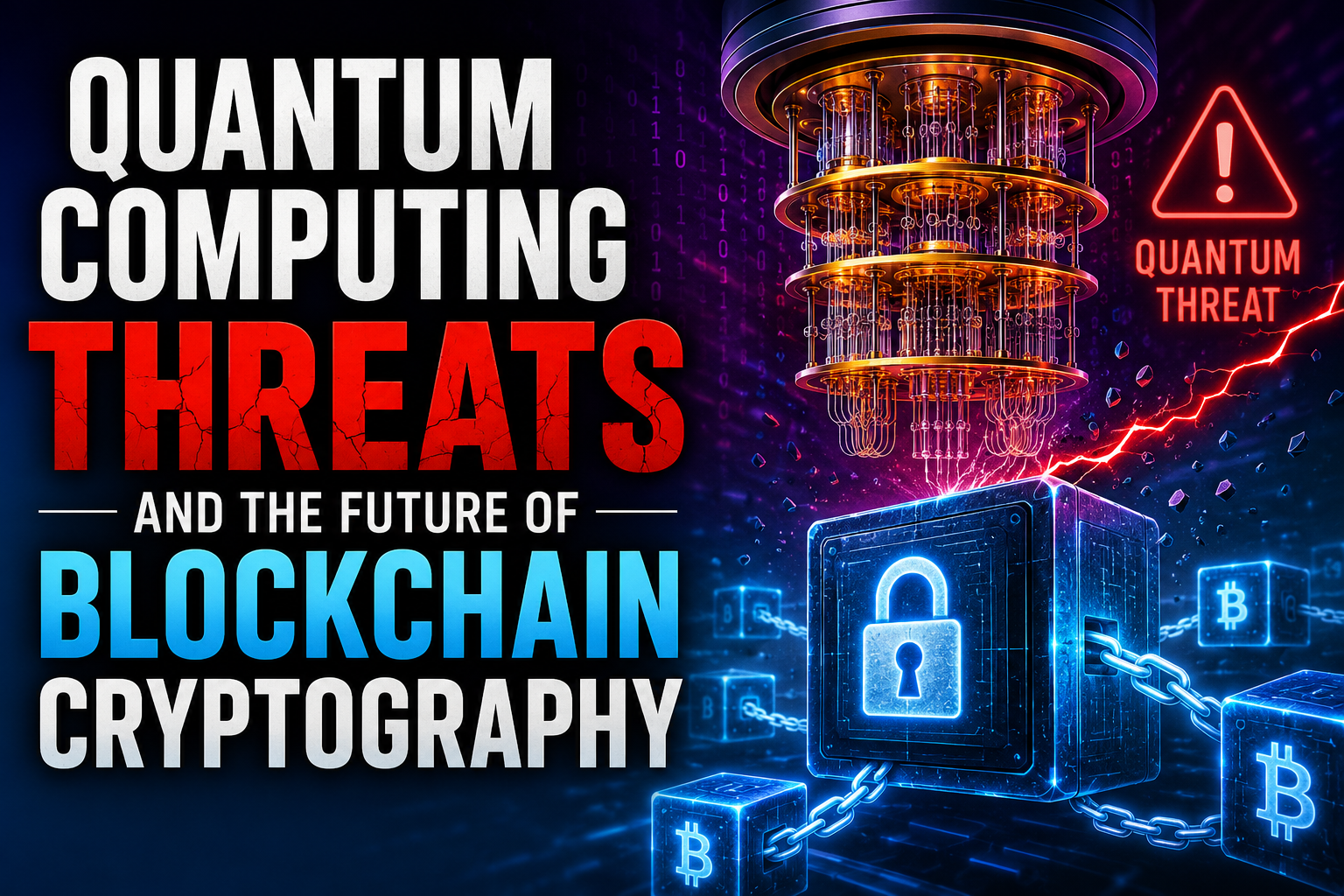
Blockchain is a digital system employed to store data in blocks connected in a chain. After it's added to the blockchain it's extremely hard to alter or remove. This allows blockchain to benefit cryptocurrencies, such as Bitcoin, and various other electronic solutions. Cryptography is also applied in blockchain, a technique that secures information using mathematical formulas. Cryptography ensures the security of users' wallets, secures transactions, and keeps digital assets safe from unauthorized access by anyone.
The most important thing is that some of the cryptographic techniques employed by the blockchain systems that are now in use might be able to be broken by powerful quantum computers. Most blockchain systems are based on Public-key cryptography. This system consists of a public key that is accessible to all, and a private key that is known only to the key's owner. The private key is very close to impossible to guess by normal computers. But, if big quantum computers are made available, they will be able to solve these mathematical problems much quicker than currently possible computers. This may allow criminals to find and get a hold of private keys, and consequently assets.
I believe this is one reason, that many researchers are working hard for the future. Although current quantum computers are not yet capable of cracking significant blockchain networks, experts do not wish to wait till the time when this becomes a reality. A security issue is always better prevented than remedied when people have already lost their money and their trust.
Digital signatures that are critically important in blockchain technology could also be impacted by quantum computing. Each transaction on the blockchain is digitally signed to establish that the transaction is created by the actual owner of the blockchain. Once quantum computers are sufficiently powerful to crack such signatures, fraudsters could make up fake transactions or impersonate other users. This would diminish the faith in blockchain systems and generate considerable monetary dangers.
One problem is many blockchains are created to store data forever. Someone who encrypts the blockchain information today can keep it for many years. However, in the future, with the advent of new powerful quantum computers, they may be able to crack that old information. This means that data that is safe now could not be safe in the future. For this reason, many organizations are already considering long-term security.
Luckily, researchers are working on new solutions. The most critical one is known as post-quantum cryptography. These are new cryptographic techniques which are resistant to the attack of traditional computers and quantum computers. These new security systems are being piloted by a number of governments, universities and technology firms. The aim is to get rid of older cryptographic techniques before quantum computers become a serious threat.
Blockchain developers are also ready for that future. There are several blockchain initiatives that are already looking into improving their networks to accommodate quantum-resistant cryptography. The improvements may need software changes, to get network users to agree, and may need careful testing. The process will take time, but it demonstrates the seriousness of the challenge by the blockchain community.
Quantum computing is not only a threat. It can also impart many advantages. It could enable scientists to find new medicines, better weather forecasting, better artificial intelligence, solve complex scientific problems and make different industries more efficient. I think of this as I recall that each new technology has its pros and cons. The key is whether people use it in a way that is appropriate and how they plan for potential threats.
While researching this topic, I realize that cybersecurity will be even more critical in the near future. The governments, businesses, software developers and users of blockchain should be continuing to learn and adapt to new technology. Technology is a constant and so must be security. Future risks will be mitigated through ongoing research, education and collaboration.
Finally, quantum computing holds promise of transforming the world in numerous positive ways, but also poses new challenges for blockchain cryptography. Researchers are working to create more robust and secure encryption systems, in response to the prospect of decryption of existing systems. The danger still lies ahead but preparations should start now. I believe that blockchain technology, with its ongoing innovation, right planning and cooperation among the globe, can be secure in the era of quantum computing. The answer will lie with how fast people react to these new challenges, as well as how smart they will be in applying the strong technologies that they have developed.
https://x.com/i/status/2075285438105809184
Note:-
You need to add link to your post in X
Regards, @adeljose
I have done it
@adeljose
@adeljose
https://x.com/i/status/2075866577744863576
https://coinmarketcap.com/currencies/pussfi/