The sacred forest of Igbo Akpa in Benin: The forest that devours intruders
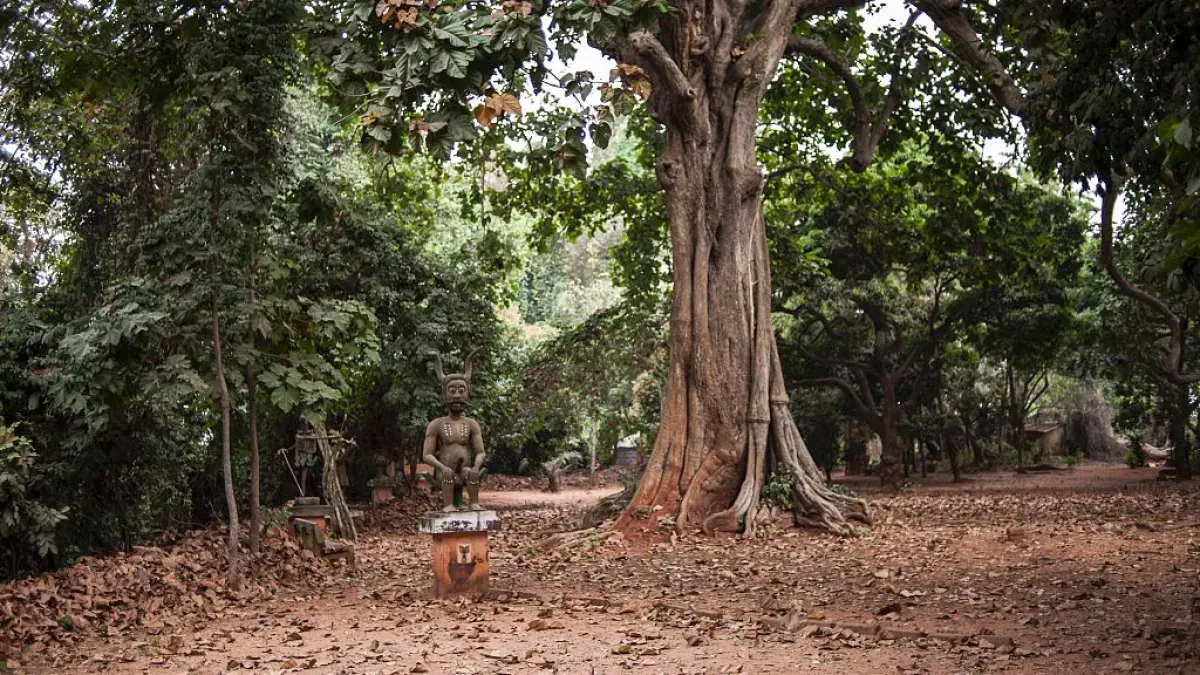
It is said that when night falls, the sacred forest of Igbo Akpa never sleeps. Its ancient trees stand like sentinels, their roots seemingly intertwined to trap anyone who dares to cross its forbidden boundaries. The elders say that the spirits who reside there will not tolerate any desecration: they whisper in the wind, appear as moving shadows, and demand blood for every intrusion.
In the 1970s, a reckless company wanted to build a road through this sanctuary, ignoring the warnings of the villagers. It was a fatal mistake. The bulldozers came to a standstill as if petrified, the workers heard voices that did not belong to any living being, and some disappeared without a trace. The forest seemed to close in on itself, swallowing the intruders into its dark belly.
This place, located between Pobè and Kétou, is not just a stretch of greenery: it is sacred ground, a threshold between the world of men and the world of spirits. The local ethnic groups—Mahis, Gouns, Adjas, Yorubas, and Igbos—know that to enter it without respect is to defy invisible forces capable of shattering reason and destroying flesh.
Even today, the Igbo Akpa forest remains inviolate, protected by an aura of terror and mystery. Those who dare to approach it say that the air is heavier there, that the birdsong stops abruptly, as if nature itself were holding its breath. And in this oppressive silence, it is not uncommon to hear a whisper... that comes from no one.
Historical and cultural context:
A bridge between worlds
In the past, Benin's forests covered nearly 20% of the country's territory. Today, they account for only 12%. However, some areas have resisted the erosion of time and human activity. The Igbo Akpa forest is the most striking example of this.
For the Mahi, Goun, Adja, Yoruba, and Igbo ethnic groups, these sacred forests are inviolable sanctuaries. They are home not only to precious biodiversity, but also to protective spirits who watch over the balance between worlds. To enter these spaces without respect is to challenge invisible forces capable of shattering reason and destroying flesh.
Account of terrifying events:
From the start of construction, workers were confronted with inexplicable phenomena:
Bulldozers would suddenly stop, as if held back by an invisible hand.
Disturbing noises echoed through the night: whispers, muffled laughter, cries from animals that don't exist.
Fleeting shadows crossed the site, frightening the workers.
Several mysterious disappearances were reported. Some workers left the site never to return, others were found distraught, unable to recount what they had seen.
The villagers claimed that the spirits of the forest were demanding reparation. The construction site was eventually abandoned, unable to overcome the invisible obstacles. The road was never built.
Analysis and interpretation:
The Igbo Akpa forest is not just a natural space: it is a spiritual sanctuary where human laws lose their power. The phenomena observed by the workers find meaning in local beliefs: protective spirits watch over the forest and punish those who dare to disturb its balance.
Some skeptics offer rational explanations: mechanical failures, accidents, coincidences. But the repetition and consistency of the incidents make these hypotheses tenuous. Compared to other haunted places around the world, Igbo Akpa stands out for its cultural authenticity and the strength of the traditions that surround it.
Conclusion: a call for respect and awe
The sacred forest of Igbo Akpa remains untouched, protected by an aura of mystery and terror. Its history reminds us that some places cannot be conquered by modernity or human greed. They belong to spirits, traditions, and the invisible.
Anyone who dares to challenge the forest risks disappearing into its oppressive silence. It is not just a natural space: it is a living entity, a force that devours intruders.